Musdi Siraju, 19, picked his way down a mountainside in bare feet, on his way to a grove of coconut palms, canarium and nutmeg trees where he works every day to support his family on eastern Indonesia's Makian Island.
In 1512, Portuguese traders, followed by the Dutch and the English, descended on Makian and the other Moluccas - once known as the Spice Islands for their nutmeg and cloves - to exploit their natural resources.
Today, people in Musdi's home village of Sebelei are earning more from what grows here under an emerging economic model that can boost rural livelihoods while safeguarding natural landscapes.
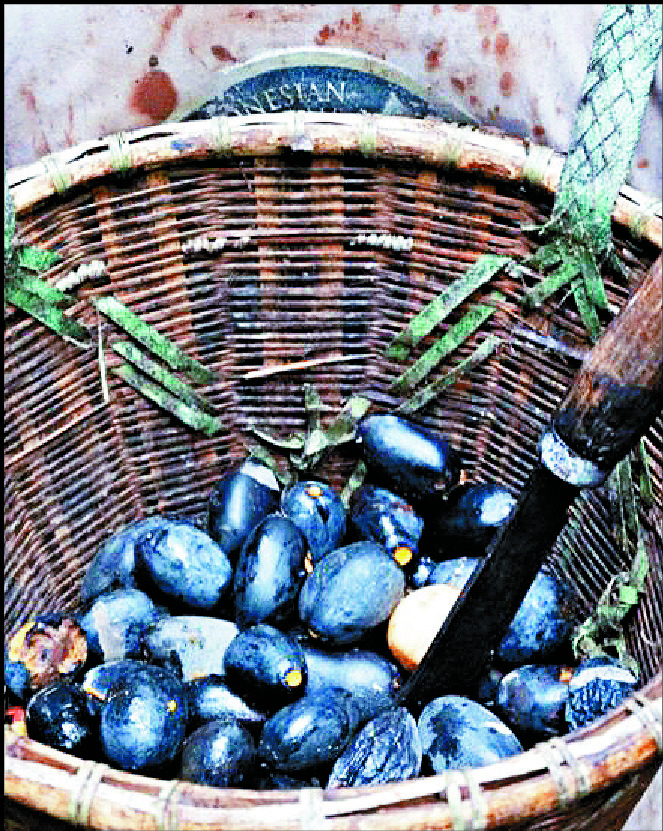
The villagers are harvesting and selling kenari - mineral-rich nuts that grow from century-old trees 30 meters high.
The kenari nut, also known as pili, is believed to be native to the Philippines where it has long been popular, with many uses. It is also exported to Australia from there.
In Indonesia, Islanders eat it raw, blend it with sugar, bake it and add it to coffee, among other ways.
Until recently it was traded in Indonesia only locally as a food staple, keeping prices low for hundreds of farmers like Musdi. But since 2019, a partnership with Jakarta-based food company Timurasa has allowed farmers to increase production and spur demand.
"Very few people even in Indonesia know about the kenari," says Timurasa cofounder Erdi Rulianto.
The enterprise kicked into a higher gear in August, when Timurasa put in an order for 500 kilograms, its largest yet.
Erdi hopes to start exporting kenari nuts to Europe from next year. "People think of almonds and cashews, but this product is overlooked," he says.
More than one in four rural people in Indonesia's under-developed eastern region live in poverty. That means many youths in the Molucca Islands, racked by sectarian violence at the turn of the century, see migration as a route out of subsistence.
In the last two years, Sebelei village head Samiun Asari, 60, has signed papers to allow more than 50 young inhabitants to take up work elsewhere. "They go, but with heavy hearts," he says.
Indonesia last year suffered its first recession since 1998 as the pandemic saw unemployment surge to push the poverty rate above 10 percent. Under a medium-term development plan, the government wants to cut poverty to 7 percent by 2024.
As part of that effort it aims to establish about 75,000 village-owned enterprises like the one in Sebelei over the next three years, says Dani Usadi, who specializes in high-value products at the Ministry of Villages and Development. So far about 42,000 have been set up.
The Sebelei project includes funding for greenhouses where kenari nuts stacked on aluminium trays dry in a day or two. The nuts are then loaded on boats for the port of Ternate, from where they are flown to Jakarta to be packaged into retail products.
Wastage due to moisture in transit has halved since the greenhouses began operating.
Driven largely by the expansion of oil palm and mining, North Maluku province, where Makian Island lies, has lost nearly 7 percent of its old-growth trees in the last 20 years, according to the Global Forest Watch monitoring service.
Yet tropical forests play a vital role in slowing climate heating by storing carbon in trees.
Forestry scientists say low productivity among small-scale farmers growing everything from oil palm to coffee means many have cleared land to earn enough for their daily needs.
But as projects like that in Sebelei boost incomes, they could also ease pressure on forests in some areas.
Ani Adiwinata Nawir, a scientist at the Center for International Forestry Research, says communities need more access to extension services, business training and post-harvest technology to cash in on existing trees, rather than opening up new land to plant more.
For Musdi, the extra income has helped him keep his family together. He had planned to leave home to seek work, until his father died last year and he knew he would have to stay to support his mother and two younger siblings.
The village enterprise made that decision easier, he says. "After it started I didn't have the desire to leave," he says.
THOMSON REUTERS FOUNDATION
Musdi Siraju takes a breather returning home from Mount Kie Besi on Makian with his haul of kenari nuts.