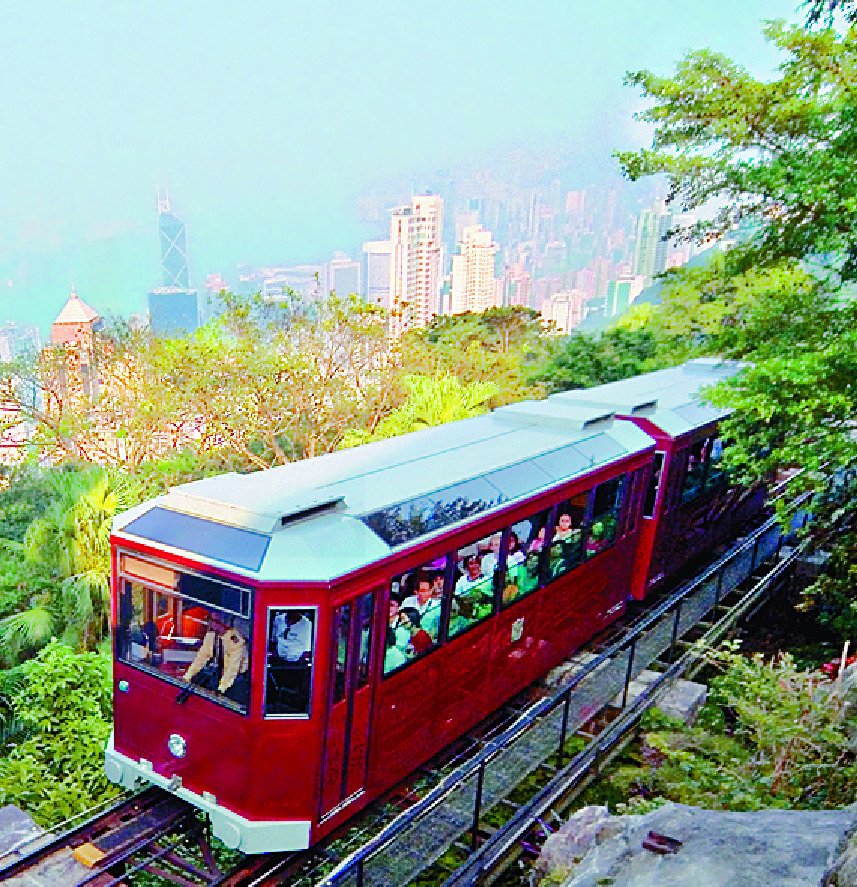
Of all forms of public transport here, the Peak Tram is probably the oldest and the most interesting and picturesque.
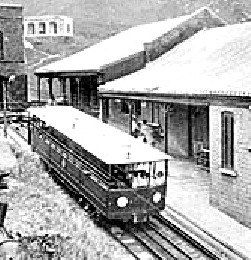
Conceived in 1888, it has gone through five generations of evolution: from being a steam-driven system to being electric driven in 1926; from wooden tramcars to metal ones in 1948; and with fully enclosed cars from 1959.
From 1989, the fifth generation used a microprocessor drive and larger cars carrying 120 passengers each, with more frequent services to meet ever-increasing demand from tourists visiting Victoria Peak.
The Peak Tram is like a tramcar system but is pulled by cables instead of being driven through steel wheels.
It can climb steep slopes as traction is not limited by friction between the wheels and the rail.
Technically, it is called a funicular system and has been widely used as city transport, the most famous of which is San Francisco's.
The Peak system runs two tramcars traveling in opposite directions from Garden Road to Victoria Peak, with a few intermediate stops.
This mode provides a near-perfect counter-balanced system that helps save energy.
It also uses a single track most of the way, except for a midway passing loop.
In the early colonial days, the Peak was the place of residence for most British officials and senior business leaders.
They started off using sedan chairs but soon found them too slow and uncomfortable.
With the Peak Tram providing a quicker means of transport, they could travel to work and back home efficiently.
The early tramcars had three sections, with first class reserved for officials and the second for military and police.
Ordinary people and animals (yes, in those days, they carried live chickens, ducks and maybe other animals for daily food) had to be content with third class, which had no weatherproofing and hard-backed wooden benches.
For a long, long time, the front two seats in first class were reserved for the governor and his lady, and not available to others until two minutes before departure.
As our city progressed, many more people moved up to live on the Peak.
Their commuting needs brought heavy demand for tram services, and this has caused the evolution of the past five generations.
The Peak has also become a must-visit scenic spot.
These increased transport demands had continuously raised the need to upgrade service quality and carrying capacity for the modern tram system.
We expect to see the sixth-generation system in operation next year.
With articulated tramcars carrying 210 passengers - almost double the existing capacity - and a longer lower terminal that is air-conditioned, waiting times will be significantly reduced and the experience further enhanced, as passengers will no longer need to queue up in the heat.
The two terminal stations will be lengthened to accommodate the longer cars.
The track and its foundation have been strengthened to cater for the heavier load, and the track route realigned for greater passenger comfort and easier maintenance.
The Peak Tram has long become a major tourist attraction, in addition to a means of transport.
Our tourists deserve a high quality of service to match their sightseeing experience, and I am glad to see Peak Tram operators modernizing to meet their high expectations.
Unlike commuters who may be happy queueing for buses on the street, we simply cannot afford to put our valued tourists through any discomfort.
Veteran engineer Edmund Leung Kwong-ho casts an expert eye over Hong Kong's iconic infrastructure
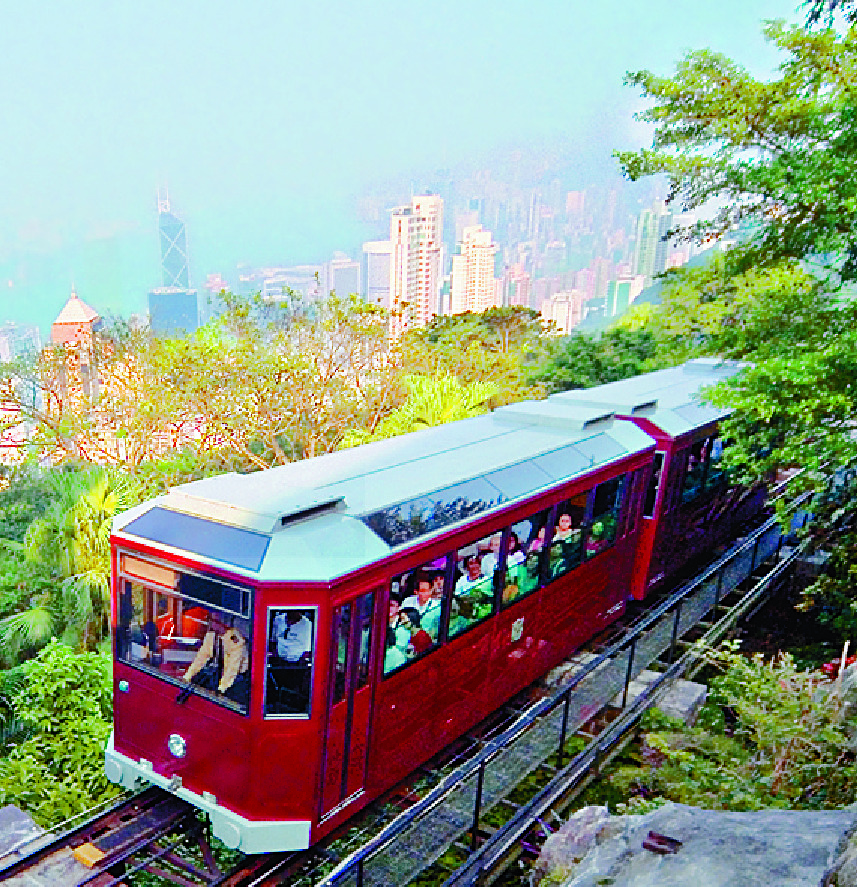
The first generation peak tram in 1888, right, eventually evolved into the fifth generation, introduced in 1989.
James Chan