Read More
Civil servants cannot criticize official policies online or support opposing views in their capacity as civil servants and should avoid their personal views being mistaken as the government's position, the Civil Service Bureau has proposed in its updated code for over 180,000 staff.
ADVERTISEMENT
SCROLL TO CONTINUE WITH CONTENT
Secretary for the Civil Service Ingrid Yeung Ho Poi-yan said the updated code does not prohibit civil servants from expressing their views and they will not be required to submit their social media and messaging accounts for checks.
"However, if it comes to our attention that a civil servant, in expressing his or her own views in private, has not followed the principles set out in the code, we will take disciplinary actions," Yeung said.
The updated code also proposes that civil servants should never selectively refuse to implement government policies with which they may not agree, delay their implementation or passively implement them because of their own political views, under the retained "political neutrality" value.
She said the term "political neutrality" was retained as the bureau noted divergent views from the community, adding that it has always attached importance to its implication and does not wish to see any further misinterpretation of the term.
"Some civil servants believed that support for the government was not required while upholding political neutrality during the social unrest in 2019," Yeung said.
Civil servants should also not arouse distrust or hostility among others toward the government and should never directly or indirectly organize or participate in any activity that impedes government policy implementation, according to the updated code.
Yeung said civil servants can join trade union activities as long as they are related to the original intention of trade unions, which is to fight for employee rights, interests and welfare.
As for activities related to livelihood and politics, she said civil servants should avoid their intentions being mistaken as official views and should consider whether their official status is related to the activities. She suggested they consult their supervisors if unsure.
However, civil servants participating in pro-government activities do not violate the political neutrality of the code.
Yeung said their official duties are already in support of the government and so are allowed to support the government in their private time.
The updated code requires civil servants to shoulder responsibility for their decisions and actions in an official capacity and the use of public resources.
Yeung added that the bureau has met with four representatives from the central staff consultative councils.
They have yet to express their views explicitly but "generally welcomed the updating of the code."
Civil servants are welcome to submit views on the proposed amendments by January 19.
The Legislative Council's panel on public service chairman Kwok Wai-keung welcomed the updated code, saying it is comprehensive and up-to-date.
He also said retaining political neutrality not only provides a more specific interpretation but also refers to warnings about soft resistance.
stacy.shi@singtaonewscorp.com
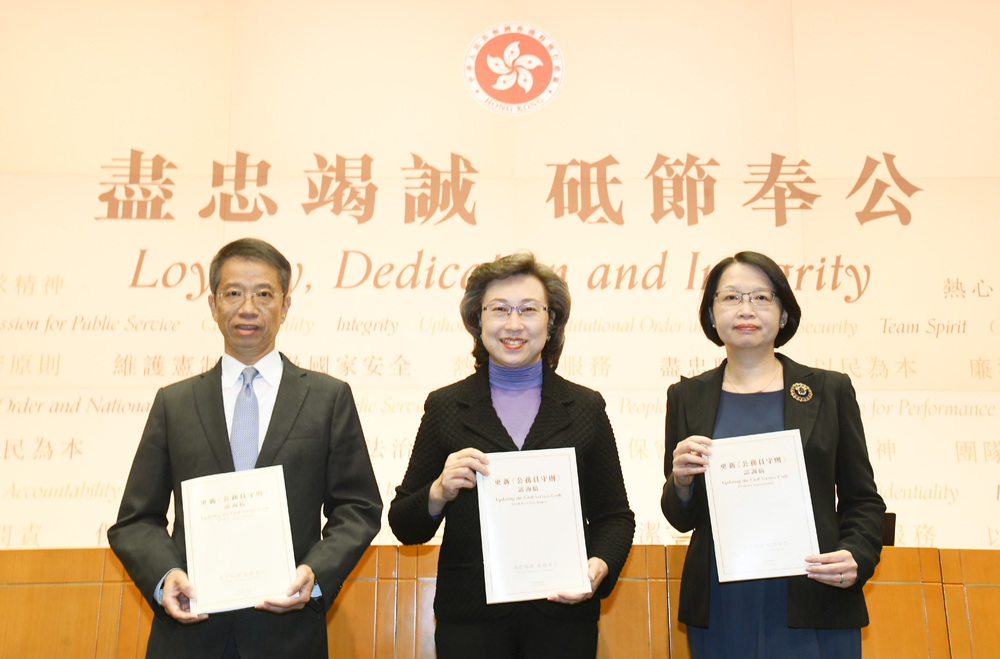
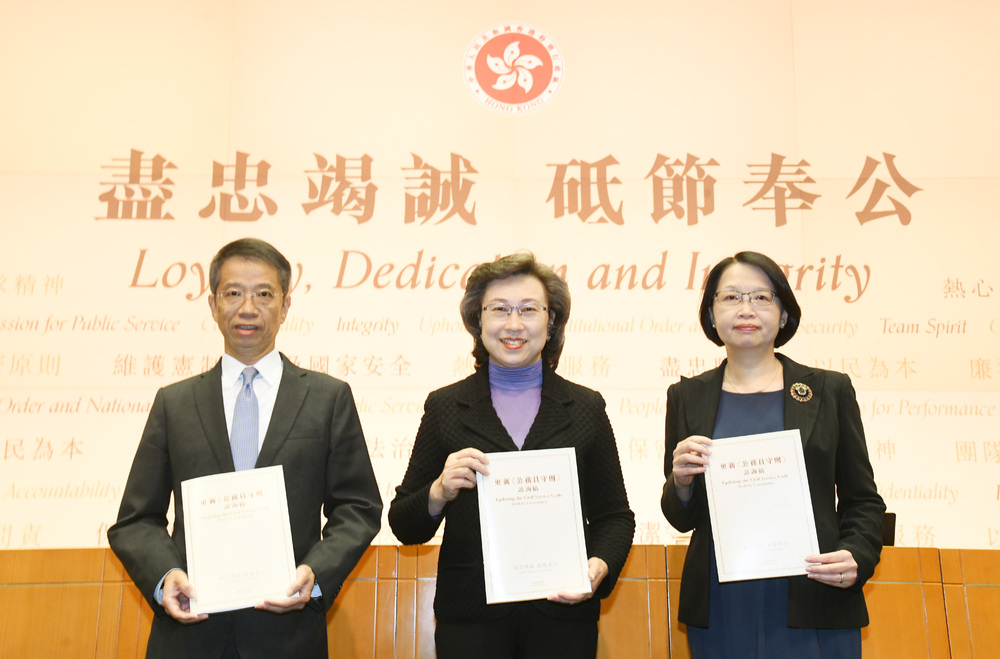
Presenting the updated code are, from left, Clement Leung, Ingrid Yeung and Angela Cheung. SING TAO