Read More
Chronic disease patients in rural areas can reduce the time they spent on visits to the doctor from hours to just minutes.
ADVERTISEMENT
SCROLL TO CONTINUE WITH CONTENT
That's by getting general outpatient service follow-ups in "smart hubs" set up in village offices instead of traveling to Hospital Authority clinics.
That's what around 50 patients have found to their relief from teleconsultations.
They also found time for empowerment activities and to learn self-care skills for chronic diseases, as well as take part in social activities at five hubs set up between February and this month in North district and Tap Mun.
Maria Leung Kwan-wa, chief of service in New Territories east cluster's department of family medicine, said a hub would take into account the number of chronically ill people in a village and availability of WiFi and medical equipment in a village office.
"As long as there is WiFi service and basic medical equipment such as blood pressure meters in a village office, the authority can partner with local non-government organizations to set up the one-stop hub to provide medical service for chronically ill residents," she said.
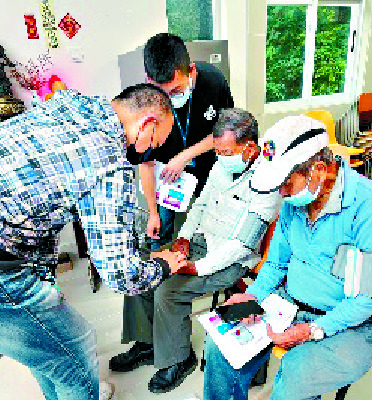
After registering and paying through the HA Go app, patients can get teleconsultations with assistance from NGO workers, who would also conduct basic body checks and transmit the data to doctors through HA Go or Doctogram in real time.
After the teleconsultations, pharmacists from NGOs will deliver medications to the hubs and advise patients on their use.
For three follow-up consultations a year, one would be held at a clinic while the other two would be at smart hubs.
Department consultant Leung Shuk-yun said the hope is that the hubs would make the deployment of health-care manpower more flexible, save patients' transportation time and facilitate follow-up consultations and increase the outpatient rate.
"We also encourage patients to participate in empowerment and socialization activities, during which they can meet new friends and maintain a good mood, which can also improve their body condition."
By March, 20 to 30 hubs are expected to be set up in North and Island districts to serve 150 to 200 patients, with about 450 to 600 general outpatient consultations being provided each year.
Lui, 87, who started on teleconsultations at the hub at Tsiu Keng village, Sheung Shui, in February, said "it saves me so much time as I can get there on foot within five minutes."
Prior to the smart hub being set up in his village, Lui, who suffers from hypertension, hyperglycemia and hypercholesterolemia, had been going to the Fanling Family Medicine Centre for more than 10 years, with each trip taking more than two hours.
Lui's daughter also said it was much more convenient for her as she needed to accompany his father for each follow-up due to his deteriorating memory.
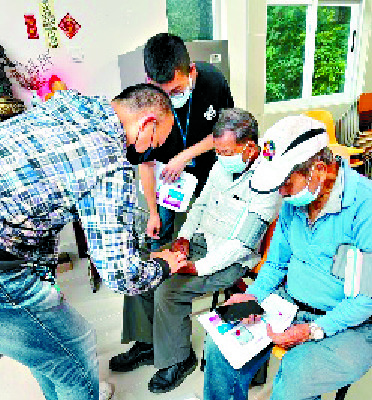
Taking time out to show chronic disease patients an easier way are, from far left, Leung Shuk-yun, Maria Leung, Lui and his daughter.