More than 130,000 eye patients in Kowloon East public hospitals saw their waiting time for treatment greatly reduced to four weeks from previously three months, after the public hospitals cluster team launched its first nurses-led intraocular injection service.
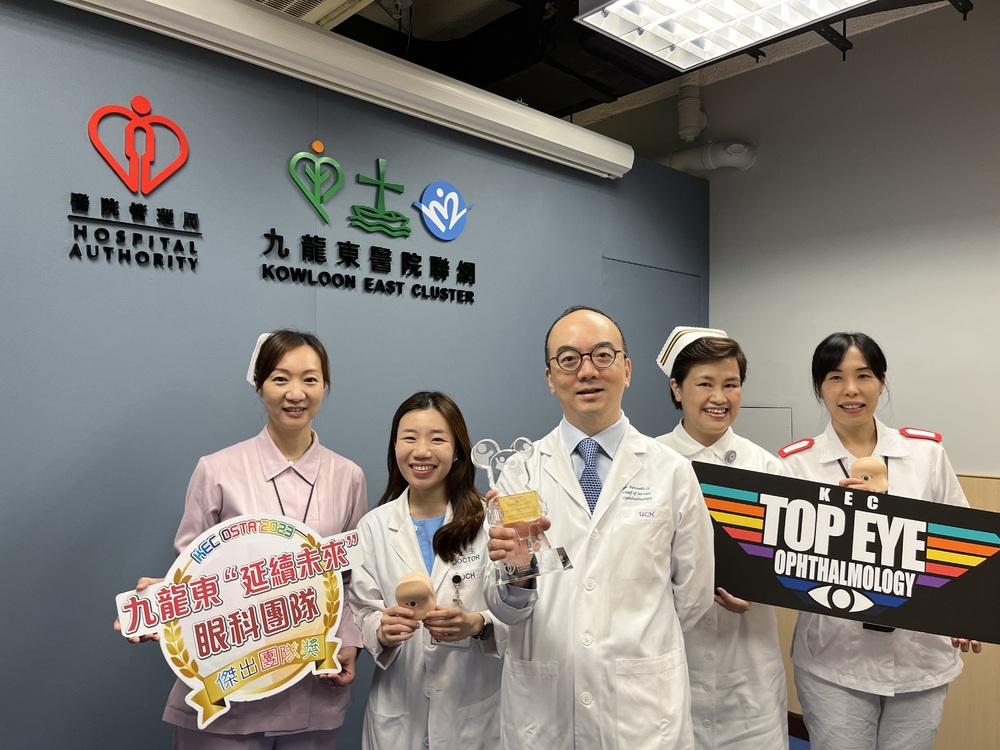
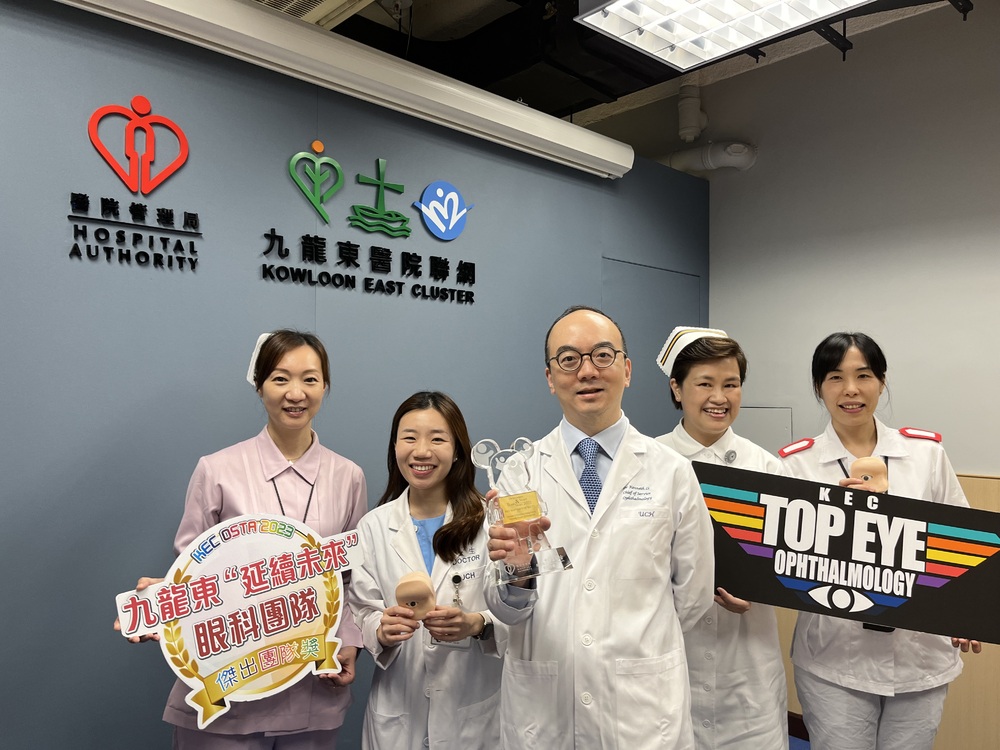
The trial project, initiated by Kowloon East Cluster (KEC) "SUSTAIN'EYE'BILITY" team, began in March last year in the United Christian Hospital and Tseung Kwan O Hospital.
Intraocular injection is the main treatment for macular degeneration, which happens a lot among the elderly and may lead to the loss of vision. With the development of an aging population, the need for ocular health care service has soared over the past decades, with KEC eye patients rising from 80,000 in 2009 to 137,000 last year.
Previously, the intraocular injection was delivered only by doctors. However, as demand grows and the doctor shortage prevails, the three-month waiting period may be further prolonged, which has already posed a hazard for severe patients who may need medicine injection every month.
The project initially invited three senior nurses to take part in the program. Now the number of nurses has increased to five.
The taking part would receive a four-hour theoretical training and a three-hour lab practice on 3D-printed eyes.
After examination, eligible nurses would conduct clinical internship under doctor's supervision. Only upon 100-plus injection cases successfully completed could the nurse complete the training.
The process may take three to six months to finish.
Since the launch of the program, more than 200 macular degeneration patients have experienced the nurse-led injection service with a 98 percent satisfaction rate.
A patient's daughter, surnamed Wong, shared her 80-year-old father's experience in the nurse injection program.
"We are quite satisfied with the result and could not tell the difference whether it was injected by a doctor or a nurse. My father's condition became more stable after joining the program, as he could receive more timely treatment," Wong said.
KEC is able to conduct 75 intraocular injections each week, with a quarter by nurses.
"The result is satisfactory but not ideal in the long run, as the nurse-led intraocular injection rate could be higher than 90 percent in countries like the UK and Singapore," said Monica Lee, the Department Operations Manager at the Ophthalmology Department KEC.
The pilot program - to conclude at the end of this year - aims at serving 314 patients.
Kenneth Li Kai-wang, the chief of service at the Ophthalmology Department KEC, said: "KEC will evaluate the result and consider the possibility to regularize the program.
"We have faith we can further reduce the waiting time for our patients in the future."
Waiting time for eye treatment in Kowloon East public hospitals has been reduced to four weeks.