
Read More

Hong Kong stocks down by midday break
5 hours ago
Hong Kong stocks open lower
7 hours ago
Hong Kong CPI up 1.7pc in August, meets market forecast
23-09-2026 17:08 HKT

A pay trend survey found Hong Kong employees saw an average salary increase of 2.8 percent this year, but inflation shrank the real pay rise to just 1.1 percent — the lowest since the pandemic.
The survey, conducted by the Hong Kong Institute of Human Resource Management (HKIHRM) and released on Thursday, covered 173 companies across 12 industries and about 180,000 full-time employees between January and September.
It found the average pay rise was 2.8 percent, only 0.1 percentage points higher than last year, suggesting companies remain cautious.
Notably, some 92.6 percent of Hong Kong companies opted to grant pay increases this year, while the share of firms freezing wages fell sharply to 6.7 percent from 11.4 percent last year.
Company performance topped the list of factors behind pay decisions at 77 percent, ahead of the local economic outlook and rivals' pay adjustments.
The survey also found that smaller firms gave the biggest raises of any size group at 3 percent. Multinationals, meanwhile, outpaced local firms at 3.1 percent against 2.6 percent.
It is reported that purchasing and banking and financial services tied for the biggest increases at 3.8 percent, followed by logistics and transport at 3.4 percent.
Conversely, accounting and professional services saw the smallest rise at 2.0 percent, with construction, engineering and building at 2.2 percent and hospitality and catering at 2.4 percent.
Among the respondents, 83.9 percent of firms offer a non-fixed bonus scheme, with eligible staff receiving an average of 1.56 months' basic salary higher than last year. Senior staff received the most at 3.25 months.
Fixed bonuses, by contrast, stayed put at one month's basic salary.
Meanwhile, Macau's job market showed more momentum, with average pay rising 0.5 percentage points to 2.8 percent to match Hong Kong.
Across nine mainland Greater Bay Area cities, average pay rose 4.2 percent, led by Shenzhen at 4.4 percent and Guangzhou at 4.1 percent.
The gap between sectors is widening, with high-tech and internet firms raising pay 5.1 percent, pharmaceuticals and energy and chemicals 4.6 percent, and traditional sectors such as property and construction trailing at 2.9 percent and 3.0 percent.
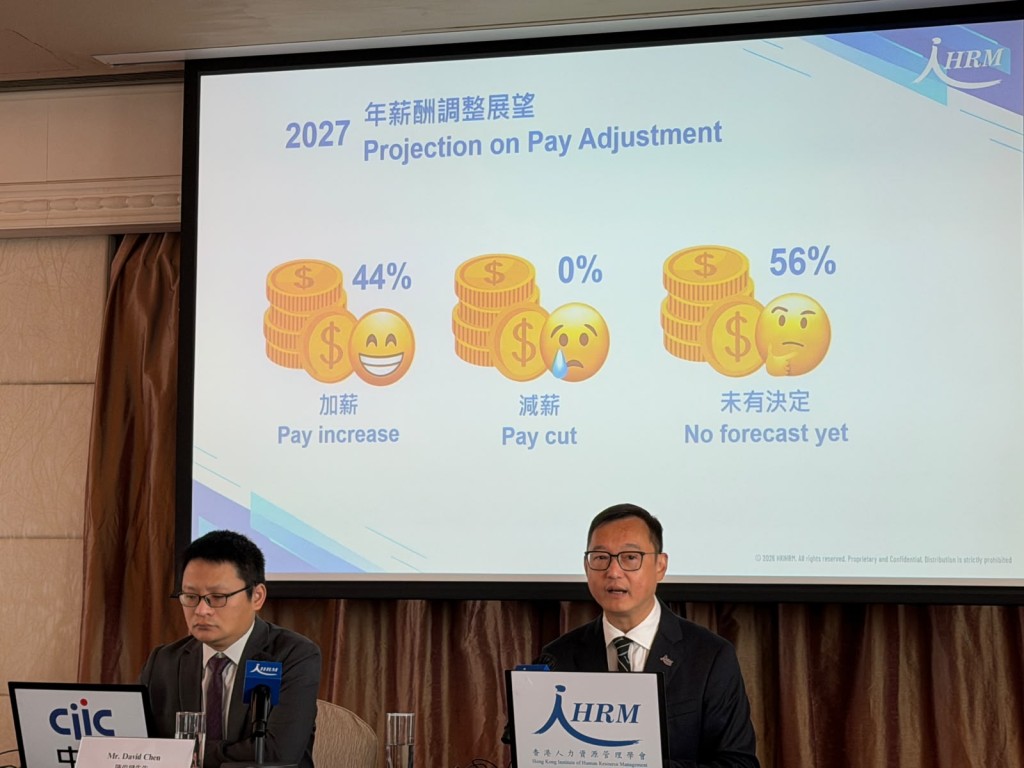
Looking ahead, researchers expect Hong Kong's average pay rise to reach 2.9 percent in 2027.
The survey revealed that 44 percent of firms said they would raise pay, while the remaining 56 percent said they had not decided, citing uncertainty over the city's economic outlook.
On the other hand, Macau and the Greater Bay Area are expected to see rises of 2.6 percent and 4.3 percent respectively.
Lawrence Hung Yu-yan, the immediate past president and executive council member of the institute, attributed the cautious budget to high overseas interest rates and volatile asset markets.
Hung noted that more firms are turning towards "refined workforce management,” prioritizing spending on core talent and skills upgrades.
With limited room for pay rises, he advised companies not to rely on salary alone to retain staff, but to combine training, better benefits and family-friendly measures into a long-term retention strategy.