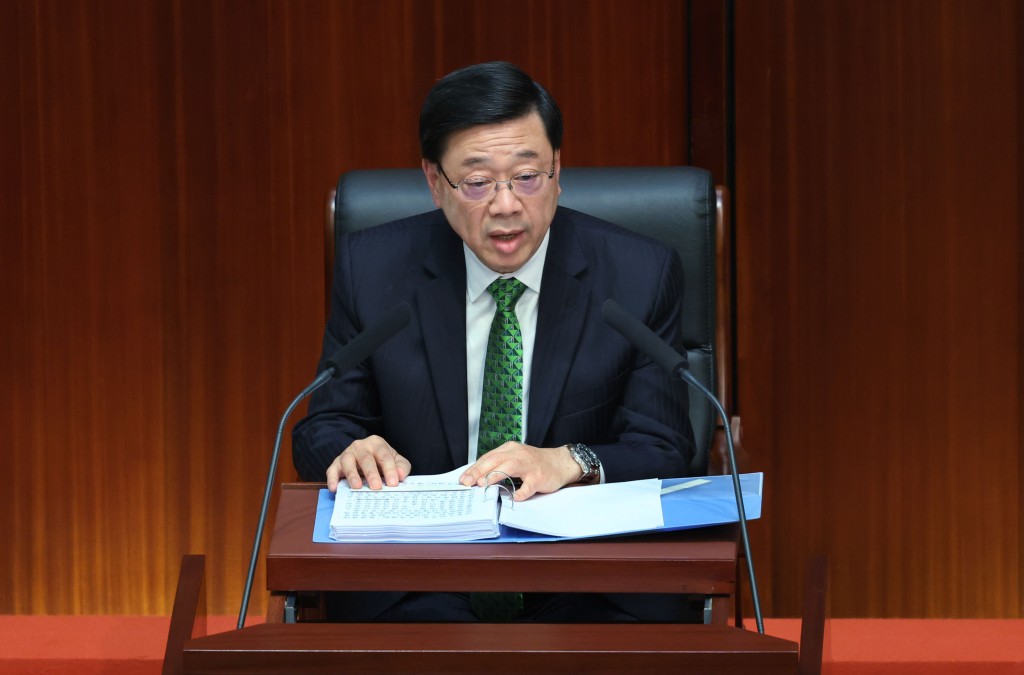
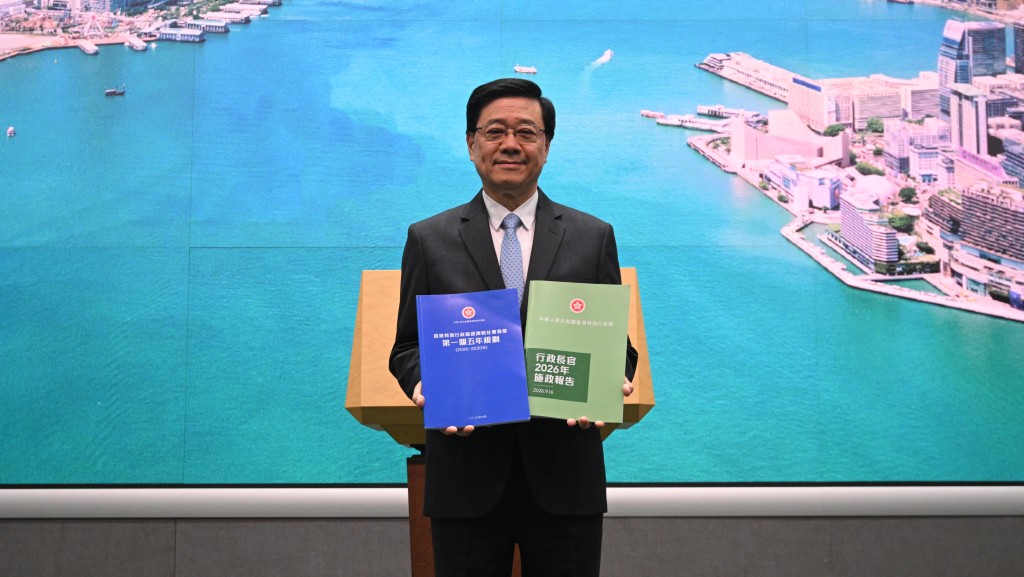
Chief Executive John Lee Ka-chiu released five major objectives of Hong Kong’s first five-year plan and Policy Address to the Legislative Council on Wednesday morning.
The five major objectives are achieving new breakthroughs in economic development, expanding our global competitiveness and influence continuously, enhancing the speed and effectiveness of the Northern Metropolis development, and enhancing social well-being markedly and taking significant strides in integrating into and serving the overall national
development.
Achieving new breakthroughs in economic development
The administration said it will consolidate and strengthen Hong Kong’s “Four Centres and One Hub” strategy, reinforcing the city’s status as an international financial, maritime and trade center, as well as an international aviation hub. It also plans to accelerate Hong Kong’s evolution into an international innovation and technology (I&T) center and a hub for high-calibre talent, fostering deeper integration between technology and industry.
The plan added that the city will further strengthen its role as a global offshore renminbi(RMB) business hub, an international asset and wealth management center, and an international risk management center while developing a commodity trading ecosystem and expanding high value-added supply chain services, alongside financial innovations such as green finance and digital finance.
Expanding global competitiveness and influence
Hong Kong will also work to increase its influence in international legal services and dispute resolution, and develop into a regional intellectual property trade center.
The government said it will further position the city as an “East-meets-West” center for international cultural exchange, supporting integrated development in culture, sports and tourism.
In addition, the administration plans to broaden access to high-quality post-secondary education to attract more non-local students, while drawing global top-tier talent and innovation groups to establish themselves in Hong Kong.
Enhancing the speed and effectiveness of the Northern Metropolis development
The plan calls for accelerating development of the Northern Metropolis, described as a key growth engine for post-secondary education and I&T.
The government said it will promote integrated development across education, technology and talent, and develop an innovation ecosystem through closer coordination among industrial parks, universities and research institutions.
It also plans to adopt the smart city approach in areas including transport, housing, greening and other public facilities, aiming to make the Northern Metropolis a well-equipped metropolitan area for living, working and travel.
Enhancing social well-being markedly
To enhance people’s livelihood, the government will improve public services in healthcare, education, housing, elderly care and other sectors. It also plans to strengthen labor rights protection, enhance employment support measures, and introduce a more efficient social security system for targeted responses.
The administration added that it will continue smart city development to improve daily living and work conditions, while further enhancing community happiness, fulfilment and sense of security.
Taking significant strides in integrating into and serving the overall national development
The final objective focuses on integrating into and serving the overall national development. The government said it will take an active role in major national strategies, and further develop the Guangdong-Hong Kong-Macao Greater Bay Area.
This includes advancing cooperation platforms in Qianhai, Nansha and Hetao, strengthening collaboration with Mainland cities in technological innovation, industry and infrastructure connectivity, and aligning with high-standard international economic and trade rules, which help Hong Kong play a better role as a “super connector” and “super value-adder” in the country’s high-level opening up.
For Belt and Road cooperation, Hong Kong plans to deepen involvement, expand its global network and “tell good stories of China,” aiming to translate these efforts into greater contributions to the country’s development of a “dual circulation” model.
"Dual circulation," is a development pattern that China adopted in 2020, taking the domestic market as the mainstay while allowing domestic and foreign markets to reinforce each other.