Read More
Young professionals view AI as vital to ESG’s future, while smaller firms face high compliance costs, according to a new ICSD survey.
ADVERTISEMENT
SCROLL TO CONTINUE WITH CONTENT
More than 90% of young professionals in Hong Kong believe ESG knowledge can help their career development, while nearly three-quarters say artificial intelligence will play a highly important role in the future development of ESG, according to a survey released by the International Chamber of Sustainable Development (ICSD).
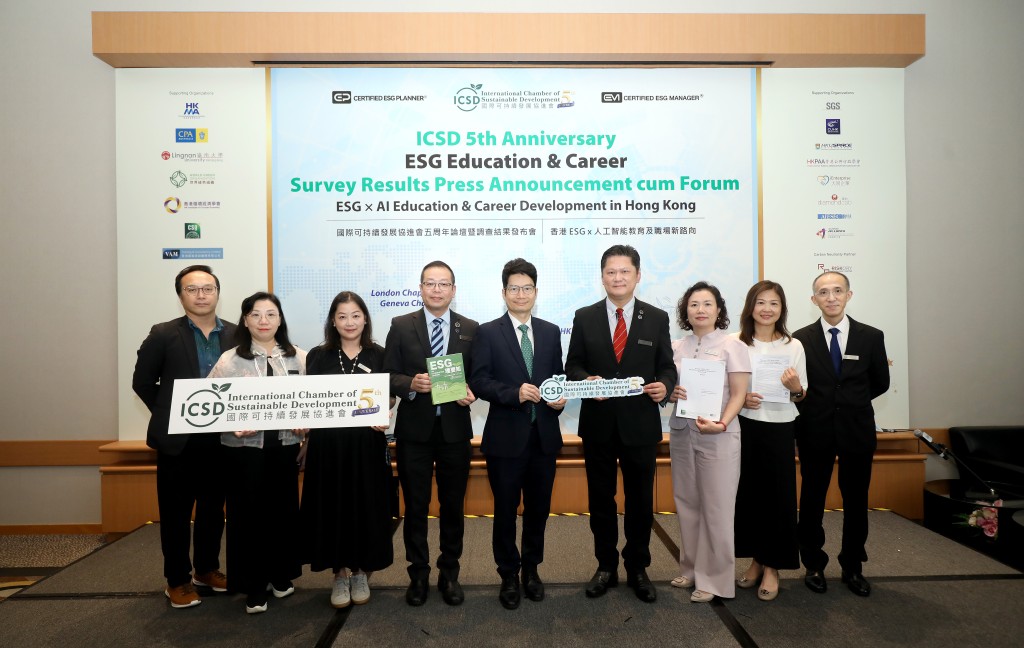
The findings were announced at ICSD’s fifth anniversary forum at the Hong Kong Convention and Exhibition Centre on July 10, 2026. Commissioned by the chamber and conducted by Consumer Search Hong Kong Limited, the survey interviewed 300 tertiary-educated Hong Kong residents aged 21 to 45 from the banking, information technology and professional services sectors.
The results suggest strong demand for skills that combine ESG and AI, with many young professionals actively seeking related training opportunities. Among respondents, 68.3% rated themselves as having good knowledge of ESG. The proportion rose to 88.7% among those aged 21 to 25.
In terms of career value, 93.3% said ESG knowledge is helpful to their current work, while 93.4% said it would benefit their future career development.
The SME Compliance Gap
Listed companies were seen as placing the greatest importance on ESG, with 82.7% of respondents rating their commitment as high, while small and medium-sized enterprises and micro enterprises were rated lower in this regard.
The biggest challenge identified was the increased cost burden arising from ESG regulations for smaller firms, with 61.3% saying SMEs and micro enterprises are struggling to bear the additional costs.
Respondents also viewed AI as a potential way to ease those pressures. Some 72.7% said AI would be highly important to the future development of ESG. The main benefits cited were “accelerates the collection and analysis of ESG-related data”, “improves strategic decision-making”, and “provides new ways of problem solving”.At the same time, respondents said policy support would be needed to prevent smaller enterprises from being marginalised in digital transformation.
Strong demand for ESG and AI training
The survey also pointed to growing demand for upskilling. Nearly half of respondents, or 48%, said they had attended formal ESG training, while 82.7% said they were interested in taking such courses in future. The top priorities identified by respondents were advanced ESG applications, foundational AI skills, and integrated ESG-AI training courses.
To bridge the skills gap, 53.3% of respondents called on the government to offer free or subsidized ESG training courses for the public. Other suggestions were to deepen public education to further raise awareness of ESG and AI (42.0%), provide career counselling and job transition support (42.0%), and support schools and tertiary institutions in incorporating ESG and AI into their programs (39.3%).
Officials stress talent transformation
Speaking at the event, Under Secretary for Financial Services and the Treasury Joseph Chan said the integrated development of ESG and artificial intelligence is not only a technological upgrade, but also an upgrade in talent structure, corporate governance and economic models.
“Hong Kong must seize this opportunity by continuing to promote green finance on the one hand, while further strengthening education, training and cross-sector collaboration on the other,” Chan said.
Dr. Angus Yip, Founding Chairman of ICSD said the findings show the integration of ESG and artificial intelligence is no longer a concept for the future, but a core competitive advantage in today’s workplace.
“The younger generation strongly resonates with this and sees it as an important opportunity for career development,” Yip said. He added that AI has the potential to reduce ESG compliance costs, but policy support is needed to avoid SMEs being marginalised in digital transformation.