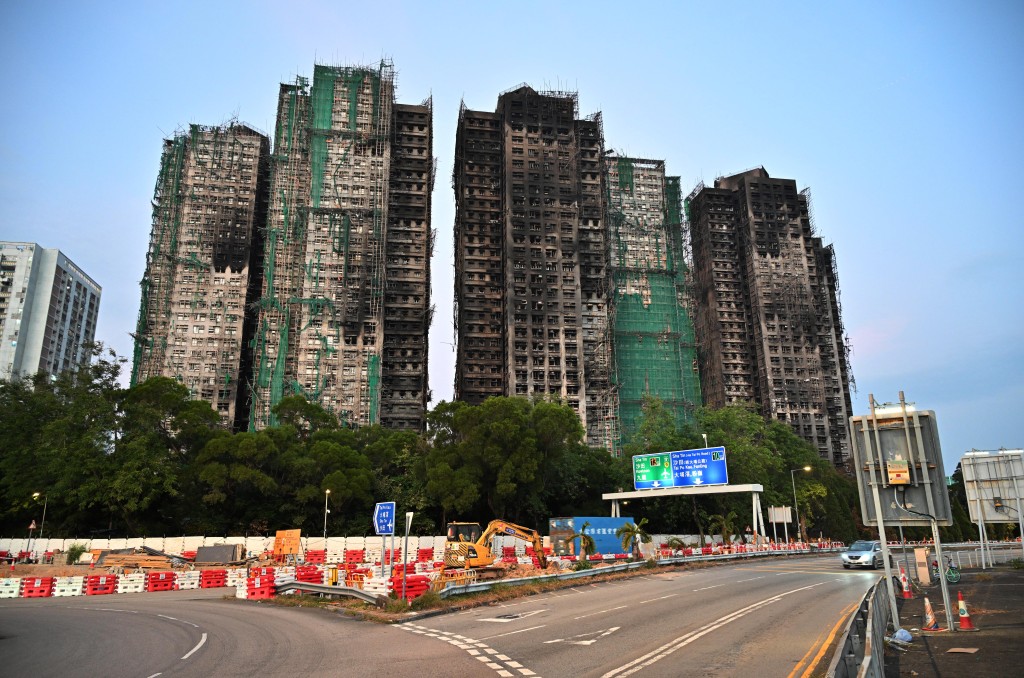
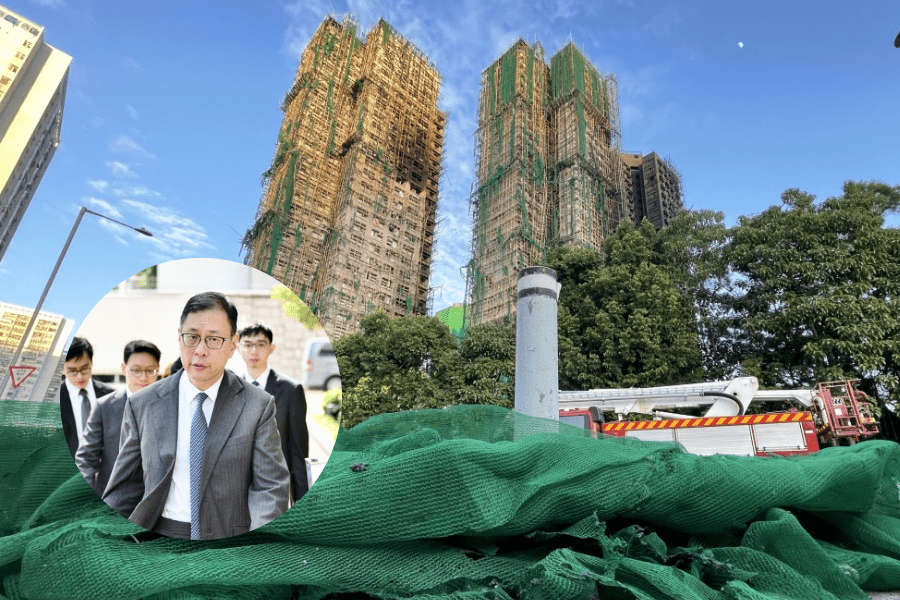
The non-fire-retardant safety nets and canvases contributed to a “secondary ignition” in the deadly Wang Fuk Court fire, a public inquiry heard on Wednesday.
The finding came in the fifth round of hearings as experts examined the cause of the blaze that claimed 168 lives last November.
Government-appointed fire engineering expert Richard Yuen Kwok-kit, chair professor of architectural engineering at the City University, told the hearing that the fire spread vertically outside the building's windows, shattering multiple units’ windows and allowing flames into the units.
Citing experiments in Sichuan that used a full-scale model to replicate the light well of Wang Cheong House, Yuen reported that the peak heat release rate of the collected mesh samples doubled to 3 megawatts after ignition.
He added that the non-fire-rated nets and canvases produced a "secondary ignition" effect, ultimately driving the fire upward at an alarming speed with other combustibles.
Based on the three-storey mock-up's peak of 29 megawatts heat release, Yuen estimated that a 31-storey building would have generated 700 to 800 megawatts. He further pointed out that the highly combustible foam boards used to seal windows would produce burning droplets and ignite surroundings or lower-floor units.
As the fire continued to spread with the non-fire-retardant safety nets, a large “fire web” was formed with other combustibles such as toe boards, wooden planks and bamboo sticks, Yuen said.
Following tests comparing fire-retardant and non-fire-retardant nets, he agreed that the fire might have been prevented with compliant nets. He drew on the team’s simulation, where the fire reached the rooftop in less than three minutes with the non-fire-retardant mesh.
While the canvases should prevent flames from spreading upward, Yuen revealed the samples from Wang Chi House had burned out with a small flame in one experiment, which he believes had further accelerated the spread of fire.
Addressing the temporary access opening, he testified that wooden or aluminum composite panels would burn through under high heat, compromising safety.
Instead, he reported that fire-rated glass would remain intact, keeping the temperature inside the stairwell at a stable 30–40 degrees Celsius.
In response to the scale of the initial fire, Yuen admitted that the study could not determine the exact amount of combustible materials at Wang Cheong House.
He noted that most fires start small and spread with nearby combustibles, and believes the Wang Fuk Court fire was likely small at first as no one noticed it until flaming drips appeared.