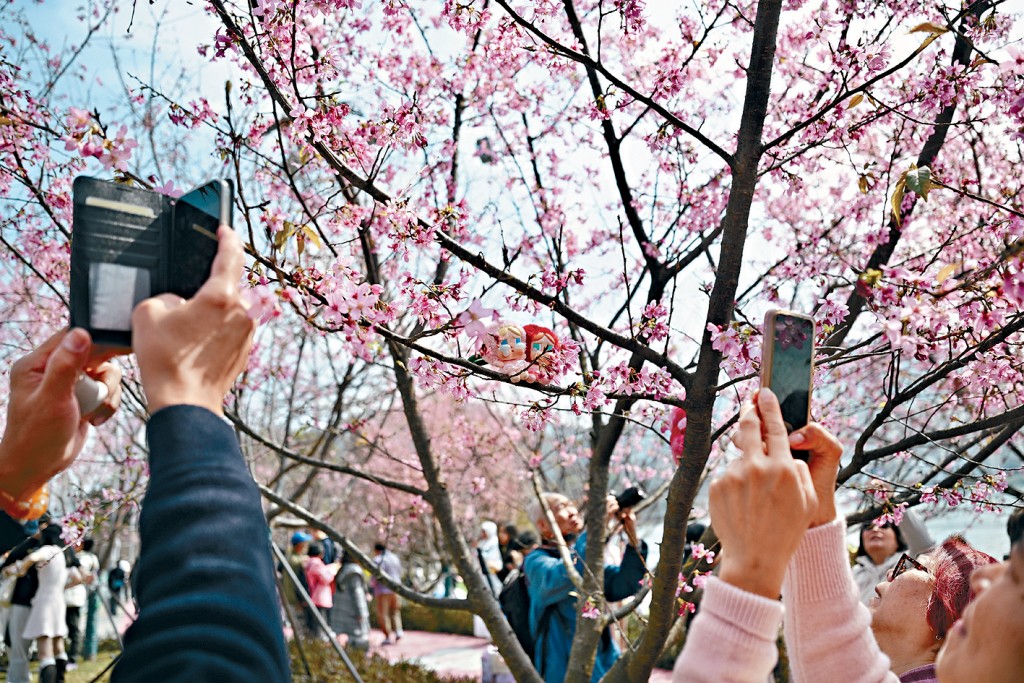
Mainland China has seen the rise of a “flower-viewing economy” in recent years, transforming blossom seasons into tourism-driven business opportunities through large-scale floral landscapes and curated visitor experiences.
With the government continuing to plant ornamental species across districts, industry players say Hong Kong could also tap into the trend.
Scholars noted that flower viewing has become increasingly mainstream, with growing public interest in seasonal blooms. They said the city’s natural resources could be better utilized to support tourism development.
Sampson Wong Yu-hin, a lecturer in the Urban Studies Programme at Chinese University of Hong Kong, said he shared 10 locations for viewing spider tree flowers on social media two years ago, which attracted strong engagement. This year, public contributions expanded the list to nearly 50 locations.
Wong said flower viewing has evolved from an individual hobby into a social activity, with some residents even making time to visit local blossom spots after returning from Easter holidays.
“It reflects that flower viewing is becoming integrated into local life and gradually becoming a culture,” he said.
He added that besides spider trees, other seasonal blooms — including yellow pui, cotton trees, Hong Kong orchid trees and pink shower trees — have also gained popularity. Spider tree flowers, in particular, have heightened public awareness of urban greenery due to their visual impact and widespread presence.
Scale and integration key to tourism potential
Lam Chi-ting, chairman of the Hong Kong Tourism Industry Employees General Union, said the success of flower-viewing tourism in mainland China is largely driven by scale.
He cited rapeseed flower fields in Luoping and Guizhou as examples, noting that they integrate themed dining and photography experiences during peak seasons. In contrast, Hong Kong’s flower-viewing spots are more scattered, limiting their appeal to tour groups.
Currently, local flower-viewing activities are largely limited to day trips, such as visits to Tai Tong for autumn foliage or the annual flower show in Victoria Park.
Lam said the city’s dispersed floral sites are more suited to individual travelers rather than large-scale tourism. He added that further development would require not only scale but also integration with surrounding attractions, such as architecture or cultural heritage.
He suggested the government consider planting ornamental flowering trees along designated routes, such as on hillsides, to create more cohesive visitor experiences.
Sara Leung Fong-yuen, a consultant with the Federation of Hong Kong Trade Unions in Tourism, said flower viewing could be “festivalized” by combining it with markets, creative products and dining offerings to attract larger crowds.
She said flower viewing serves primarily as a “trigger” to draw visitors, while its real value lies in boosting the surrounding economy and supporting small businesses.
Challenges in scaling up urban planting
Despite growing interest, experts said developing large-scale flower-viewing tourism in Hong Kong presents challenges.
Oric Chan She-woon, president of the ISAHK Board of Directors and Officers, said maintaining year-round flowering is technically possible but comes with high maintenance costs and operational demands.
He noted that many popular species, such as yellow pui and cherry blossoms, have short blooming periods of one to two weeks, depending on weather conditions.
Chan said sustaining visual appeal throughout the year would require a mix of fast-growing seasonal flowers and perennial shrubs to create layered planting.
He also pointed to structural constraints in Hong Kong, including limited space, fragmented planting areas, underground infrastructure, and restricted sunlight due to high-rise buildings.
He added that tree selection must balance aesthetics with practical considerations such as shade, size, pest control and ecological impact, following the principle of planting the right species in the right place.
Government promotes biodiversity and themed planting
In response to inquiries, the Leisure and Cultural Services Department said the government follows the principle of “Right Plant, Right Place,” selecting species that enhance landscapes while promoting biodiversity and addressing climate change.
The department added that themed planting will continue in new park projects, alongside increased use of seasonal flowering plants to improve the urban environment, enhance quality of life, and enrich visitor experiences.