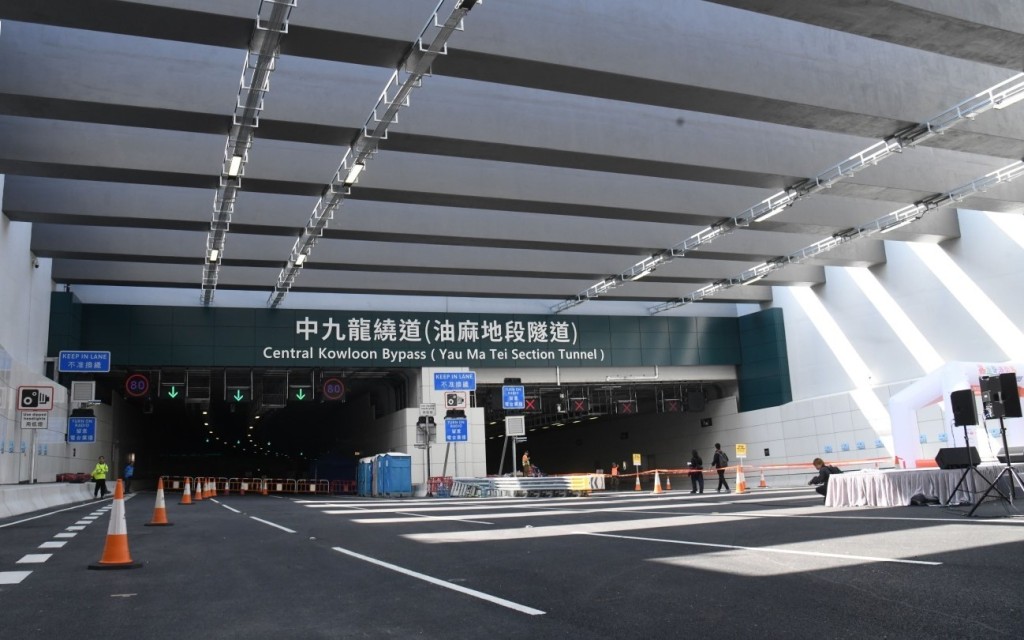
The Yau Ma Tei section of the Central Kowloon Bypass will be commissioned on December 21, Chief Executive John Lee Ka-chiu announced at an event on Wednesday.
Upon its commissioning, the travel time from Yau Ma Tei to Kowloon Bay will be significantly reduced from approximately 30 minutes to just about 5 minutes.
The section is a dual three-lane carriageway connecting the Yau Ma Tei Interchange in West Kowloon to the Kai Tak Development Area and Kowloon Bay in East Kowloon, with a total length of 4.7 kilometers, including a 3.9-km-long tunnel.
The western portal of the bypass connects to the Yau Ma Tei Interchange and provides access to Hong Kong (West), Kwai Chung, Lantau Island, Cheung Sha Wan, Yau Ma Tei, and Tsim Sha Tsui via Hoi Po Road, West Kowloon Highway and Lin Cheung Road.
The eastern portal connects to the Kai Tak Interchange, and motorists can travel via Shing Kai Road, Kai Cheung Road, Kai Fuk Road and Shing Cheong Road to and from Kai Tak Sports Park, Kowloon Bay, Kwun Tong Bypass and Kai Tak Cruise Terminal.
The bypass will also alleviate the traffic burden on existing major east-west corridors, such as Lung Cheung Road, Argyle Street, Prince Edward Road West, Chatham Road North, and Boundary Street, helping to ease congestion.
Neighbouring areas such as Wong Tai Sin, Ho Man Tin, and Kowloon City will also benefit from this bypass, and the road network efficiency in Kowloon will be enhanced.
Meanwhile, the authorities reiterated that this is a large-scale project involving the construction of flyovers, drill-and-blast tunnel, and an underwater tunnel, which presented many challenges.
Its alignment traverses bustling urban areas, requiring the reprovisioning of public facilities and temporary reclamation works. It also intersects with seven existing MTR lines, which significantly increased the construction complexity.
The project team adopted innovative technologies and fostered the use of digitalisation to overcome these challenges, while ensuring that community life continued as usual and that nearby historic buildings were protected during construction.
The Highways Department (HyD) and its contractors are now at the final stage of works, including conducting final tests on systems and relevant drills.