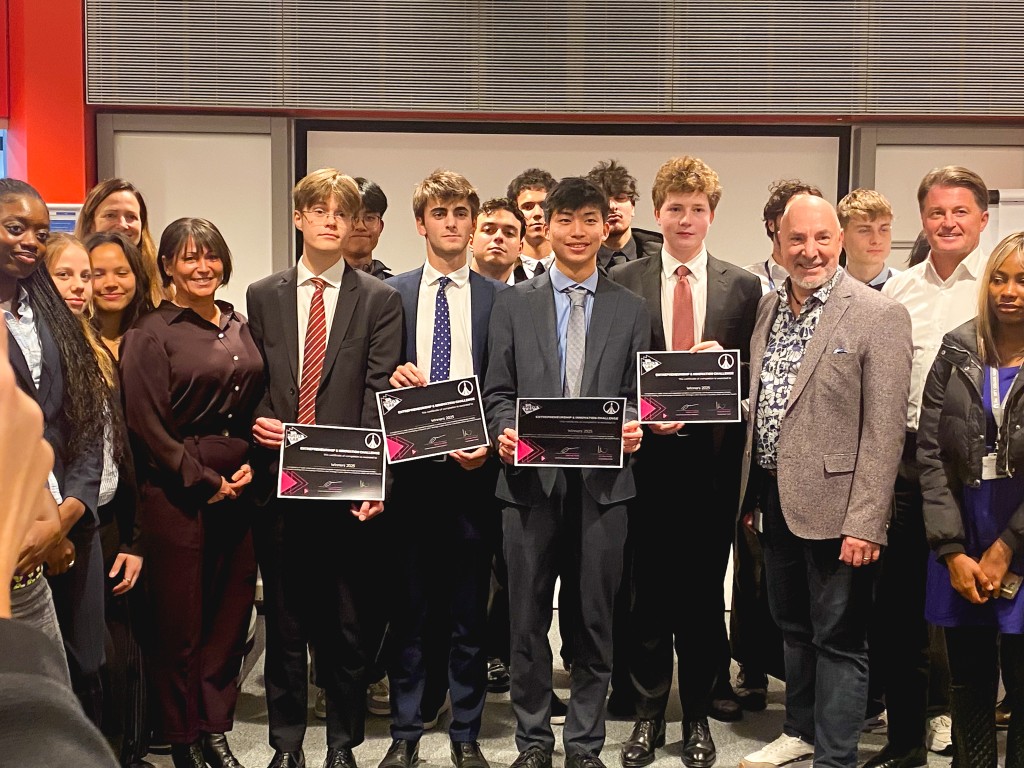
A simple yet powerful goal – to use technology to help the poor – has led a team led by Hong Kong-born student Parker Chan Ji-lek to victory in Imperial College London's Entrepreneurs Innovation Challenge in October.
The Ardingly College Year 13 student's commitment to social equality first took root during a Christmas volunteering experience in Sham Shui Po's subdivided housing.
Encouraged by his teacher, Chan teamed up with three classmates to enter the Challenge, joining around 2,000 participants from the UK, the United States, and the United Arab Emirates.
Tasked with designing innovative business ideas that utilize artificial intelligence to combat poverty, Chan and his team stood out with their project "FarmFair" – a three-phase AI marketplace aimed at supporting subsistence farmers, who constitute 65 percent of the world's poorest population.
"We collect user and market data to optimize crop selection and farming practices, improve market access through our platform, and provide microfinance loans to enhance productivity," Chan explained.
With a focus on affordability and scalability, the project seeks to create tangible social impact for farming communities.
The team's extensive research and professionalism earned them widespread praise, where one of the challenge's judges, Andrew Humphries, noted that the team's understanding of the problem set them apart from other participants.
Julie Halliday, director of enterprise and employability at Ardingly College, acknowledged the challenge of solving world poverty, highlighting that the team had identified potential obstacles to their business ideas and created operational and financial solutions to ensure viability in the short, mid, and long term.
For Chan, the experience was not just an achievement but transformative. "Experiences like this reaffirm that this is exactly the kind of work I want to pursue in the future," he said.
The process of building their idea into a viable business model – from crafting pitches to producing videos – solidified his interest in shaping meaningful vision and strategic direction.
The team remains committed to refining their AI-driven solution and exploring partnerships with NGOs and technology firms to help farmers achieve more sustainable livelihoods through new technology.
Although agriculture is not a primary sector in Hong Kong, Chan sees potential to adapt FarmFair's model to support Hong Kong's fishing industry.
Through integrating different data between the market and buyers, Chan believes that local fishermen could secure better income and access more affordable equipment, leading to a more stable livelihood.
"Helping the poor is what I will continue to do in the future," Chan said, expressing a strong interest in returning to Hong Kong after his studies to pursue socially impactful work that bridges technology and social equality.