





Read More

Night Recap - October 12, 2026
2 hours ago


Thailand plans entry and exit fees totalling $338 for air travellers
09-10-2026 03:37 HKT


Chief Executive John Lee Ka-chiu has outlined policies to promote the development of the new energy industry in his policy address delivered on Wednesday (Sep 17).
The measures aim to achieve the city’s goal of carbon neutrality before 2050 and to meet China's "dual carbon" targets, in which the new energy sector will play a crucial role.
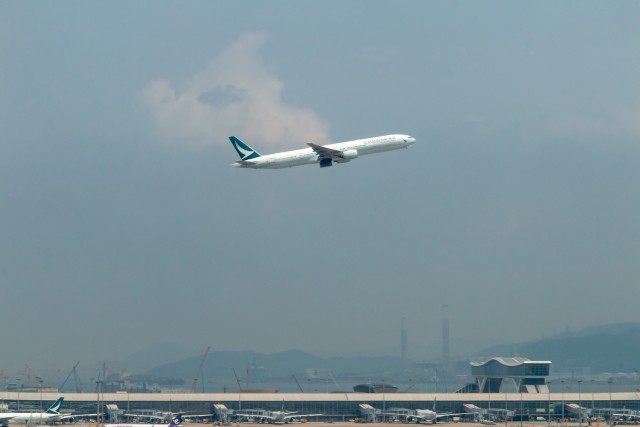
Lee stated that the government is set to develop a sustainable aviation fuel (SAF) industry chain, as major airports and airlines in Europe, America, and Asia have gradually raised their SAF consumption targets.
The authorities will work with the Mainland authorities to enable a local enterprise, one of the world's major SAF suppliers, to develop its business in the Greater Bay Area (GBA), he said.
The enterprise will cover upstream collection of raw materials, the setting up of production plants, and large-scale production, to dovetail with the specified target SAF consumption ratio for flights departing from Hong Kong International Airport by 2030.
An SAF blending facility will also be constructed to boost the competitiveness of our SAF industry and bolster the bargaining power of airlines.
Meanwhile, the government has made top-level planning in the Strategy of Hydrogen Development in Hong Kong, announced last year, and 28 hydrogen energy trial projects are underway or under preparation.
These projects cover, among other things, hydrogen buses, hydrogen street washing vehicles, and a public hydrogen filling station in the New Territories.
“We will establish a hydrogen standard certification,” Lee said, “establish public hydrogen filling facilities on Hong Kong Island and in Kowloon, press ahead with more trial projects, and develop the GBA Hydrogen Corridor in collaboration with Guangdong Province.”
Additionally, the authorities are pushing forward the construction of Hong Kong's first large-scale electric vehicle (EV) battery recycling facility at the EcoPark, which is expected to commence operation in the first half of 2026.
The recycled black mass converted from locally retired batteries will be supplied to the Mainland and neighboring regions, promoting the development of the EV battery recycling industry.