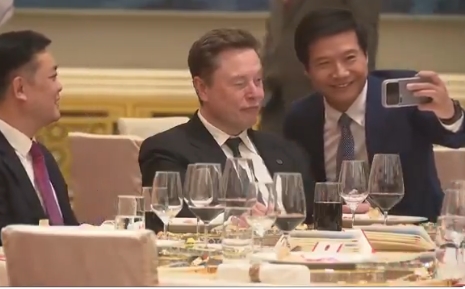
Xiaomi CEO Lei Jun, a longtime admirer of Tesla boss Elon Musk and one of the first Model S owners in China, who also has something of a cult following in China, was seen taking a selfie with the Tesla founder before the start of the state banquet at Beijing's Great Hall of the People.
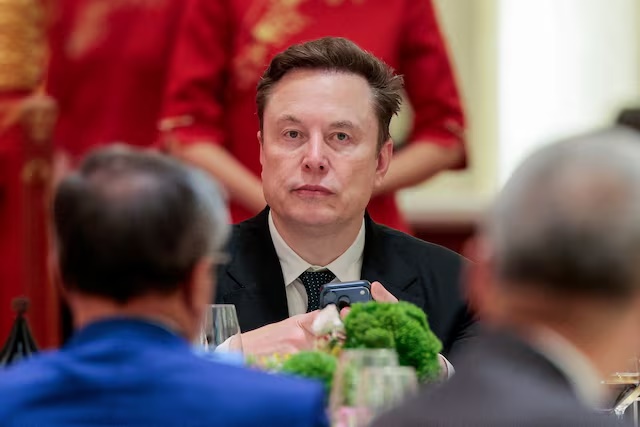
Musk, seemingly exasperated by Lei's selfie request, raised his eyebrows and made a huffing exhalation before the picture was taken. The moment, captured on camera, went viral in China, with many people on social media joking that Lei had been humbled by his hero.
While Tesla is being hit by local electric vehicle makers on technology and price, the company - and Musk - remain influential in China. That is in part because Musk's interests align with those of Beijing, said Kyle Chan, a fellow in Chinese technology at the Brookings Institution.
"When you look at Beijing's tech priorities, many of them line up almost perfectly with Elon Musk's," Chan said, pointing to EVs, autonomous vehicles, AI and humanoid robots, as well as brain-computer interfaces and satellites.
Tesla's self-driving technology is still considered the industry standard in China, Chan said.
EV maker Chery draws its inspiration from Tesla and Toyota 7203.T, its chairman, Yin Tongyue, said in an interview with Reuters last month. Chery, which is now making inroads in Europe, aims to blend Tesla's focus on innovation with Toyota's obsession with quality, Yin said.
In 2018, Tesla became the first foreign car company allowed to set up an automaking operation in China without a local partner.
It sold around 626,000 cars in China last year, making it the country's fifth-largest automaker in terms of sales of EVs and plug-in hybrids, according to the China Passenger Car Association, an industry group. China accounted for around a fifth of Tesla's revenue last year, according to company data.
Tesla's focus on designing cars around battery performance and software is "definitely one of the biggest inspirations for many Chinese carmakers," said Felipe Munoz, a veteran auto analyst.
However, China's military and diplomats have railed against other parts of Musk's business empire. The near-monopoly that his SpaceX holds in lower-Earth-orbit satellites, which provide cheaper and more reliable communications, and its importance in the ongoing conflict between Russia and Ukraine, has alarmed Beijing and spurred it to create domestic alternatives.
"The excellent performance of 'Starlink' satellites in this Russian-Ukrainian conflict will certainly prompt the U.S. and Western countries to use 'Starlink' extensively" in possible hostilities in Asia, said a September 2022 article co-written by researchers at an engineering university run by the People's Liberation Army.
'GLOBAL IDOL'
While his X social media platform is banned in China, Musk has 2.3 million followers on China's Weibo and has been feted on local social media as "a pioneer," "Brother Ma" and a "global idol" during some past trips. Even Musk's mother has become something of a celebrity in China.
His visit this week comes as he is looking to buy US$2.9 billion worth of equipment for manufacturing solar panels from Chinese suppliers, Reuters reported in March. That effort could now be complicated as China considers limiting exports of its most advanced technologies to the U.S.
Tesla is also seeking clearance from regulators to expand adoption of its Full Self-Driving assistance system.
Musk has maneuvered carefully in China, as the world's largest auto market and its massive supply chains remain essential to support his broad business empire across EVs, solar power and space programmes.
In 2021, Tesla was forced to apologize to Chinese consumers for failing to address a customer's complaints in a timely manner. That came after an unhappy customer climbed atop a Tesla model at the Shanghai auto show to protest the company's handling of her complaints about malfunctioning brakes, a moment that was widely shared on Chinese social media and sparked criticism in state media.
In 2021, Teslas were barred from entering military compounds due to security concerns over the cameras installed on the vehicles. That ban was only lifted after Musk visited China in 2024 and the auto industry association endorsed its data compliance.
Longer term, the biggest threat to Musk's popularity in China could come from the continuing rise of its homegrown auto industry.
"As Chinese companies catch up or even overtake Elon Musk’s tech empire, his stature in China may start to dim," said Chang Yan, the founder of Supercharged, a popular blog on Weibo focused on EVs.
"But he will likely remain an icon among China’s tech industry for what he’s accomplished."
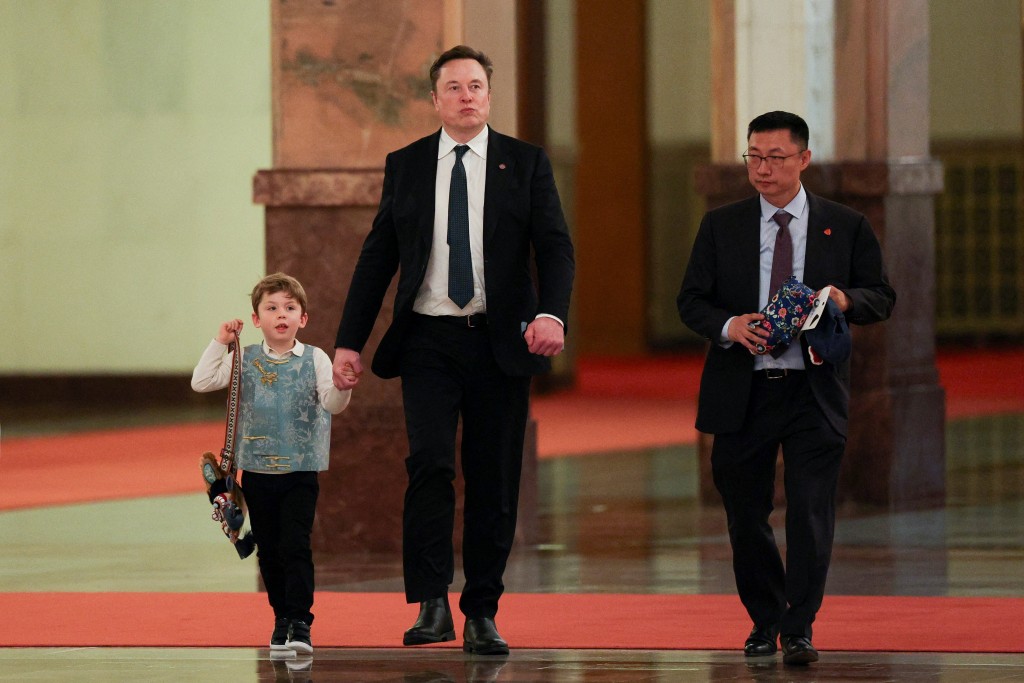
Tesla CEO Elon Musk and his son X Æ A-12 walk on the day Chinese Premier Li Qiang meets with American CEOs, in Beijing, China, May 14, 2026. (Reuters)
Meanwhile, Musk's son X Æ A-Xii has stolen the spotlight prior to a meeting between Chinese Premier Li Qiang and U.S. business representatives that was being held in Beijing.
Musk was seen arriving with the 6-year-old boy at the Great Hall of the People.
(Reuters)