As Chief Executive of The Hong Kong Chartered Governance Institute, Ellie Pang is elevating boardroom standards, influencing regulation and broadening corporate governance into public life to reinforce Hong Kong’s reputation as a trusted international financial centre.
When Ellie Pang speaks about corporate governance (CG), it’s not in abstract policy jargon or regulatory buzzwords. It’s with the conviction of someone who has spent over a decade on the frontlines of regulation and now leads the charge in transforming how organisations in Hong Kong, from listed issuers to NGOs and sports organisations, approach accountability.
As Chief Executive of The Hong Kong Chartered Governance Institute (HKCGI), Pang believes good CG is the foundation for market credibility and investor confidence. “Without corporate governance, there is no international investment,” she says. “Buying shares is all about trust; trust in the market, trust in the regulators and trust in the investees.”
Governance as a competitive edge
As Hong Kong defends its role as an international financial centre, Pang sees CG as Hong Kong’s indisputable competitive advantage. With global institutional investors scrutinising environmental, social and governance (ESG) standards more than ever, Hong Kong’s regulatory framework, she argues, is a signal to the world.
“The Hong Kong listing rules expressly require every listed company to have a qualified company secretary,” she explains. “This is rare globally. That means that governance is embedded structurally, not just culturally.”
That framework gives Hong Kong a distinct advantage, and HKCGI is at its core. Founded in 1949, it remains the city’s sole chartered professional body focused exclusively on CG and is now the largest division of The Chartered Governance Institute worldwide.
From company secretary to governance professional
“The name ‘company secretary’ is misleading,” Pang laments. “Laymen think of it as a clerical role, or someone’s assistant. But in reality these professionals are advising the board of directors on listing rules, risk, governance and compliance. They are, so to speak, governance gatekeepers.”
That perception problem prompted HKCGI to rebrand in 2021, changing its name from The Hong Kong Institute of Chartered Secretaries. The rebrand reflects a broader mission to define governance as strategic rather than something that is operational or procedural.
“We have members who are trusted voices in the boardroom. When boards are unsure, they turn to them,” says Pang, adding that she wants to see more professionals ascend to that level.
But she acknowledges that confidence must be built on knowledge and the ability to communicate. “Once you know your stuff and are able to communicate your advice clearly, you gain the board’s respect. That’s why training is core to what we do.”
Elevating standards through training
Pang is a firm believer in proactive training, not just for company secretaries, but for boards as a whole. “Our professionals implement rules, but more importantly they help shape how organisations approach accountability, transparency and sustainability for long-term success,” she explains. This belief drives HKCGI’s annual and biennial events: the Annual Corporate and Regulatory Update (ACRU) and the Corporate Governance Conference (CGC).
“ACRU gives practitioners timely, first-hand updates directly from regulators, which is actionable intelligence,” she says. “While ACRU focuses on the ‘what’ of compliance, the CGC delves into the ‘how’ and ‘why’, examining governance practices from a strategic perspective.”
HKCGI has indeed invested heavily in professional development. Its flagship offering is the Director Training Package, created to meet the new HKEX requirement that directors must complete 24 hours of training within 18 months.
“We have over 90 expert-led videos in three languages and a centralised tracking system to help company secretaries compile reports for CG compliance,” she explains. “It’s cost-effective, scalable and already being adopted by blue-chip firms.”
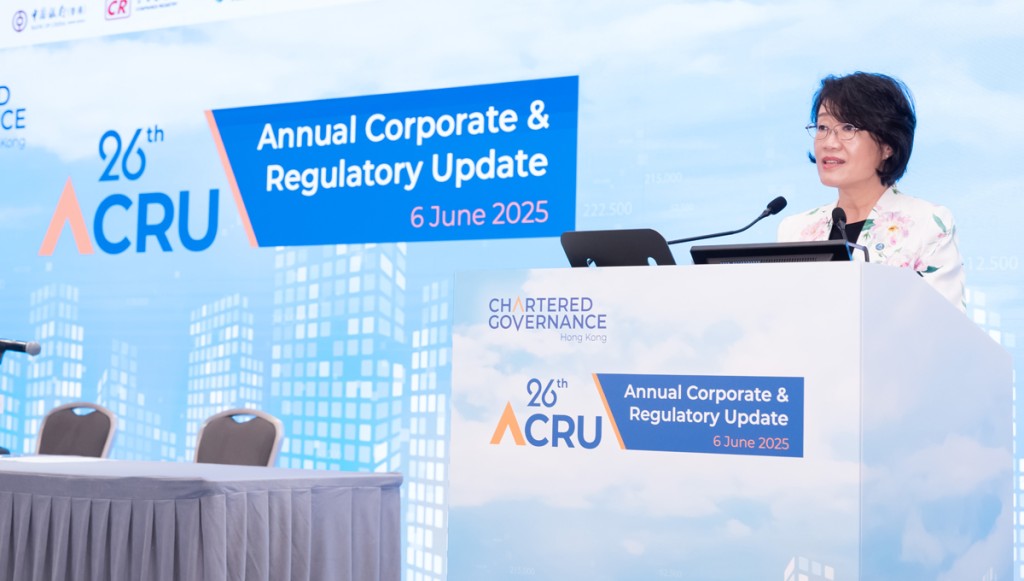
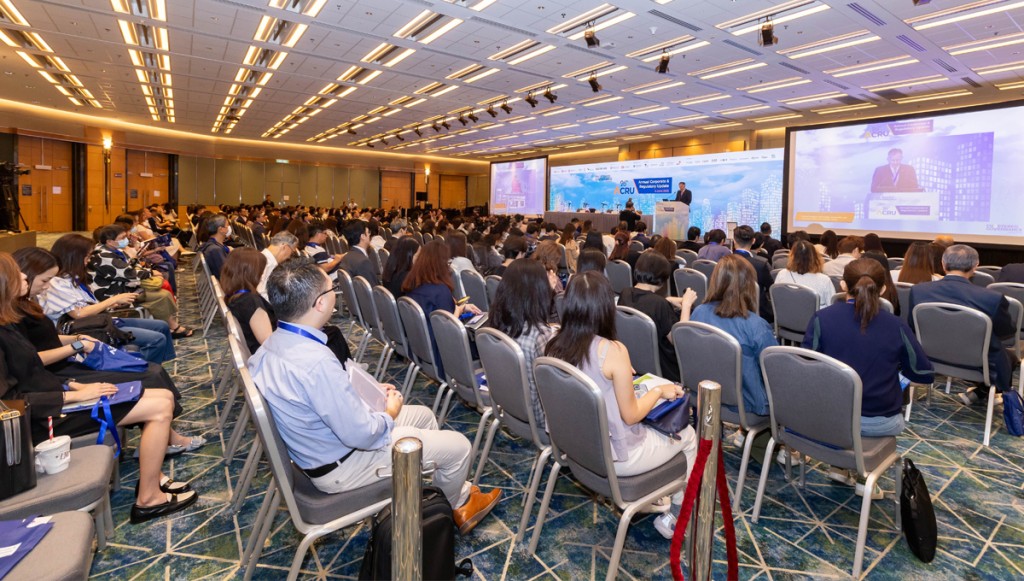
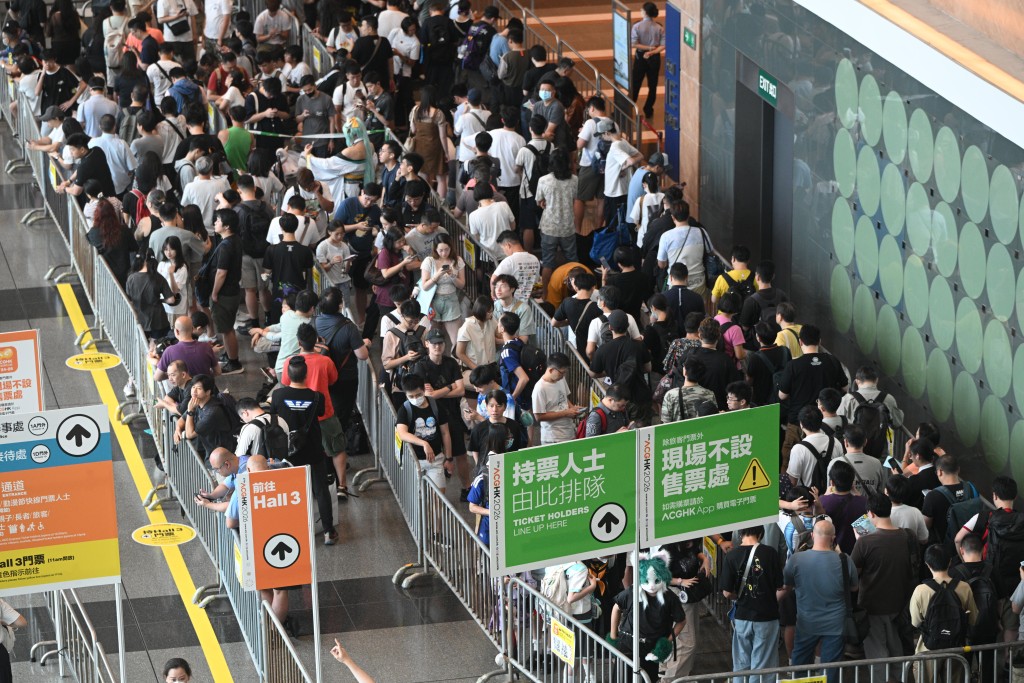
3_Held on June 6, 2025, HKCGI’s 26th Annual Corporate and Regulatory Update (ACRU 2025) brought together over 2,300 in-person and online attendees to discuss the latest regulatory developments in Hong Kong.
Complementing this is the ESG Reporting Certification Course, which has certified more than 1,700 professionals. Certification holders gain access to HKCGI’s Sustainability Governance Academy, a knowledge-sharing community of sustainability professionals. “Few people really understand what ESG actually means. That’s why this course starts from fundamentals and ends with the ability to draft a credible ESG report.”
Governance in NGOs and sports
HKCGI’s mission is no longer confined to listed companies. Pang sees equal, if not greater, need in the non-profit and sports sectors. “NGOs handle public funds and must earn public trust. Without transparency and anti-corruption safeguards, they risk losing legitimacy,” she says.
That conviction also extends into the sports sector. Para 125(iii) of the HKSAR’s 2024 Policy Address calls for reforming the governance of national sports associations (NSAs), with a review and recommendations led by the Sports Federation and Olympic Committee of Hong Kong, China. The goal is to ensure that NSAs operate effectively and fairly, so that all athletes—including those with disabilities—can realise their potential in a professional environment.
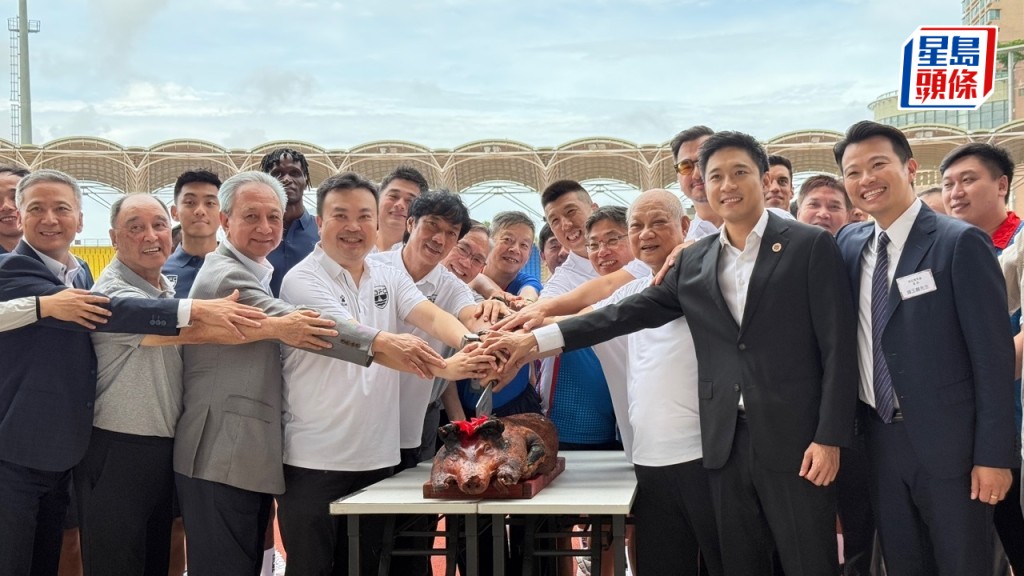
In support of this initiative, the Sports Federation and Olympic Committee issued a Code of Governance for Sports in October 2024. HKCGI is working to design a tailored governance training course for directors and governance officers across Hong Kong’s 85 NSAs. A launch event is scheduled for August 28.
“We’re offering 18 hours of free training to governance officers and board directors. By doing so we want to raise the overall governance capacity in the growing sports sector and ensure that they have the knowledge and tools to operate with integrity, transparency and professionalism.”
Tackling boardroom challenges: INEDs and diversity
Pang is unafraid to confront the cultural headwinds facing governance reform in Hong Kong, particularly when it comes to independent non-executive directors (INEDs) and board diversity.
She acknowledges the sensitivities of boardroom politics. “The new nine-year rule for INEDs aligns with global best practice, but here in Hong Kong there’s a face-saving culture. Telling a long-serving director to step down is no easy task,” she says. Still, she believes board renewal is important for fostering innovation and adaptability, especially in responding to emerging challenges such as AI, climate risk and fintech.
For Pang, the solution lies in better education, transparency and a shift in mindset. Companies must learn to view INEDs not as figureheads, but as independent voices who strengthen governance. “We need to encourage companies to see INEDs not as cheerleaders but as value-adding guardians. That’s the spirit of corporate governance.”
Building trust of the long game
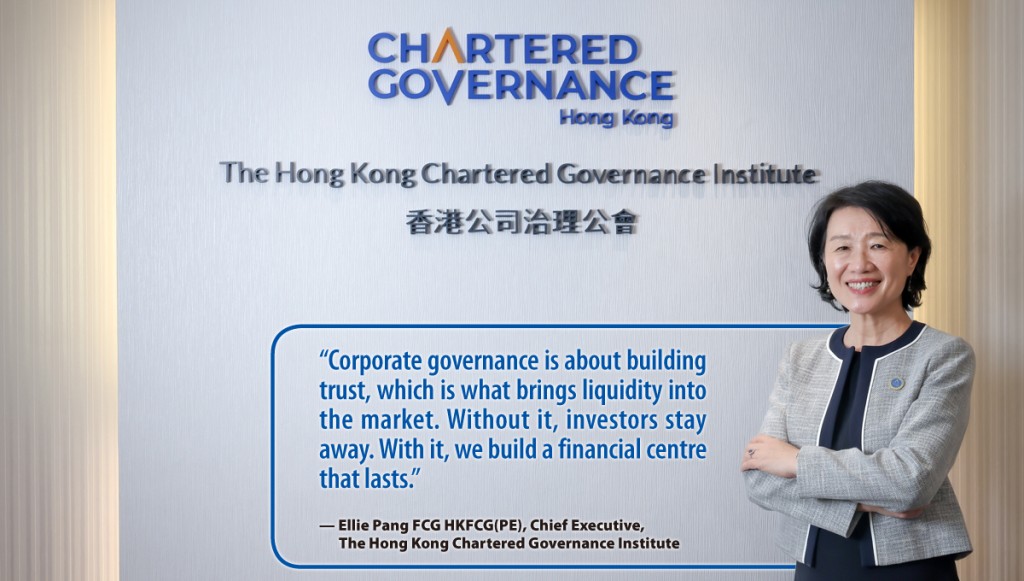
“Corporate governance is about building trust, and trust is what brings liquidity into the market. Without it, investors stay away. With it, we build a financial centre that lasts.” Faced with geopolitical risks and rapid technological change and innovation, Pang and HKCGI believe Hong Kong’s greatest asset is cultivating a deep, enduring culture of governance.
On top of continuous professional development (CPD) and cultural change, Pang is deeply engaged in regulatory advocacy. A case in point is the company re-domiciliation regime, which HKCGI formally proposed in 2019. “We were delighted to see it adopted in May 2025. It shows how professional voices can influence public policy.”
Driving thought leadership through research and collaboration
Alongside its work in advocacy, CPD and convening the CG community through flagship events, Pang is proud of HKCGI’s international standing. “We’re the largest division in the CGI network, even larger than the founding UK division,” she notes. HKCGI publishes three research papers annually in collaboration with partners such as KPMG, PwC, CLP Holdings Limited and local universities.
Topics range from board diversity to greenwashing and climate risk – all framed to inform both local and international best practice. “Thought leadership must stay ahead of compliance. We use data, surveys and practical insight to shape the discourse.
A governance leader with regulatory roots
A lawyer by training, she began her career at two leading law firms before joining HKEX, where she spent 14 years working in enforcement and leading policy reforms in CG and ESG. In 2020, she became Chief Executive of HKCGI, where she now advances governance in commerce, industry, and public affairs.