Read More
Accident and emergency service fees in public hospitals will see a rise of over 120 percent, going from HK$180 to HK$400 starting next year, with waivers for critical and emergency patients.
ADVERTISEMENT
SCROLL TO CONTINUE WITH CONTENT
Permanent Secretary for Health Thomas Chan Chung-ching expects the reform to generate about HK$3 billion in additional revenue, which will be fully allocated to public healthcare services.
Chan underscored that the reform aims to encourage citizens to shift their medical usage patterns, promoting greater reliance on primary care instead of high-cost services.
The spokesperson for the Health Bureau stated on Tuesday that the authority expects to implement two more rounds of reforms in 2028 and 2030 to achieve a target funding rate of 90 percent.
Under the new rules, the standard medication fees will increase, with charges for each medication at specialist outpatient clinics rising to HK$20.
Patients will be limited to a maximum of four weeks’ supply of medication per visit, down from the current maximum of 16 weeks. Consequently, the cost for the same amount of drugs will soar from HK$15 to HK$80.
Additionally, a fee of HK$5 will be charged for each medication in family medicine outpatient services, and the charge for general outpatient services will rise to HK$150.
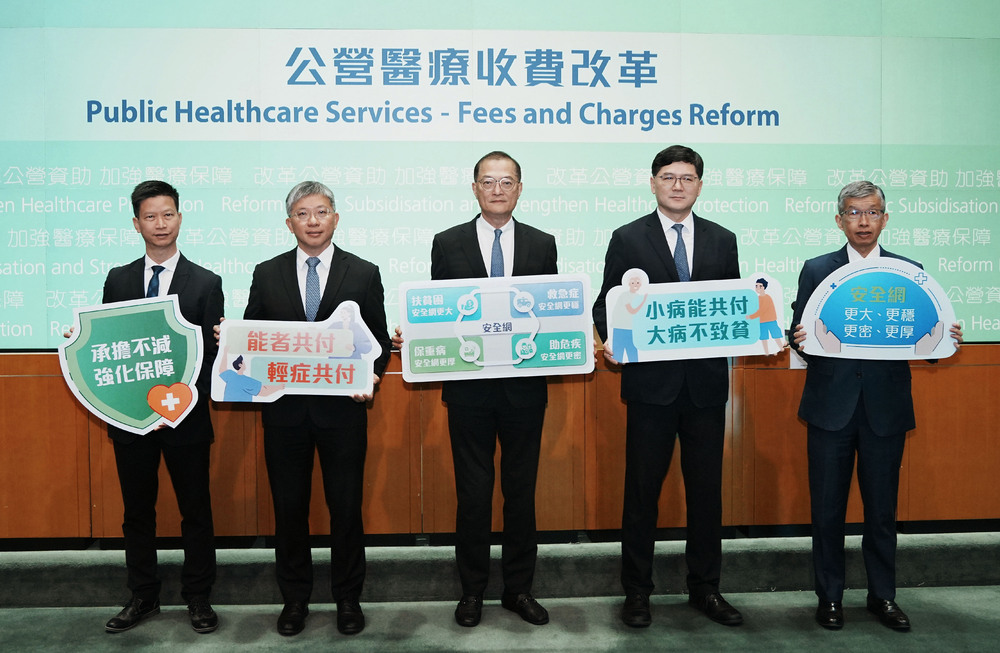
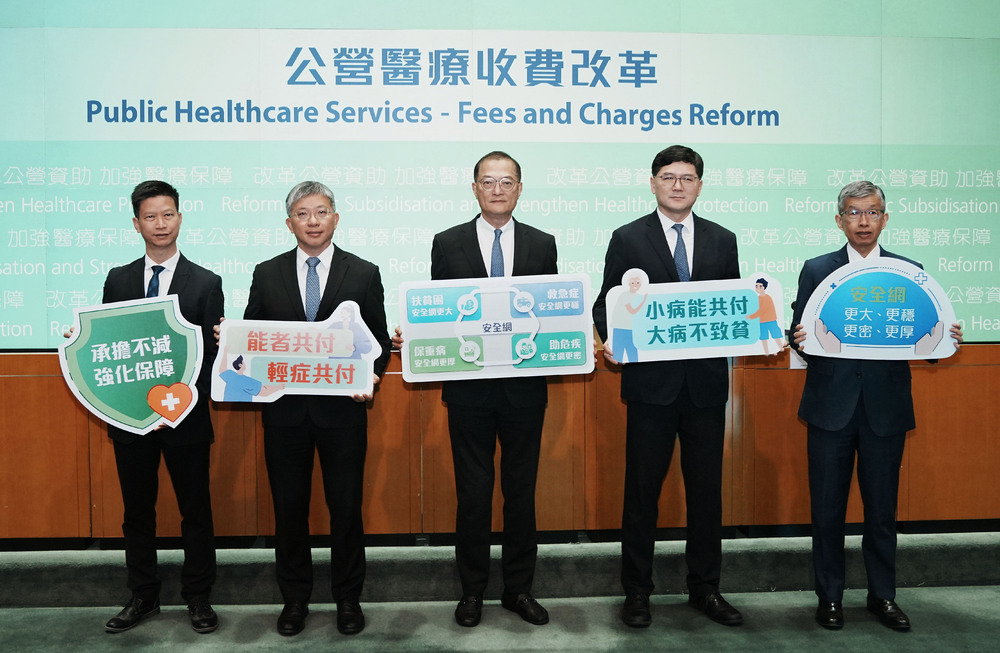
Secretary for Health Lo Chung-mau outlined five key principles for the reform, stressing that government support will not be reduced while upholding concepts of “affordable users co-pay” and “mild illnesses co-pay.”
He stated that there would be both upward and downward adjustments to the fees while maintaining a high funding level of 90 percent.
He also indicated that considering public affordability, the reform will be “step by step,” aiming to achieve its goals over five years. The first phase of adjustments will be implemented in 2026, with subsequent reviews of the fee levels every two years based on existing mechanisms.
The HA will introduce a “co-pay by services” model for non-urgent radiology and pathology diagnostics, charging from HK$50 to HK$500 for advanced and high-end services while keeping basic services free.
A yearly fee cap of HK$10,000 per person will be implemented by public hospitals, with the HA covering any excess costs, except for self-paid medications and devices. This change is expected to benefit around 70,000 critically ill patients.
The medical fee waiver mechanism will also relax application qualifications and asset restrictions to align with the standards for public housing applications, revising the definition of a family and raising eligible individuals from 300,000 to 1.4 million.
Furthermore, the Safety Net criteria will be expanded to include more middle-income families.
Regarding the HK$400 charge for non-urgent A&E patients, HA Director of Cluster Services Simon Tang Yiu-hang emphasized that the distinction between exempt and non-exempt patients is clear and not easily confused.
He explained that healthcare staff will classify patients based on their medical condition and vital signs, using professional judgment as the basis for their decisions.
Tang stated the new A&E charges cannot be compared to private clinic fees, as public hospital A&E fees encompass all consultation and medication costs.
Lo added that compared to over a thousand dollars of A&E charges in Western countries, “It’s reasonable for Hong Kong to raise [the fee] to HK$400; this approach is just to emphasize the emergency function of A&E services.”
Hospital Authority chief executive Tony Ko Pat-sing stated that 50,000 critically ill patients in Hong Kong need to pay for drugs on their own, with 2,000 spending over HK$100,000 annually and some exceeding HK$1 million, potentially causing patients to forgo treatment due to costs.
“Therefore, it is essential to reform the overall funding structure to allow citizens to contribute a reasonable co-payment, reversing the current situation where treatment for mild conditions is affordable while that for serious conditions is costly,” he said.
The spokesperson for HB noted at a technical briefing session that the overarching principle of the reforms is to keep a “relatively low” funding rate for outpatient services and a “relatively high” rate for inpatient services.
The spokesperson added that the HK$10,000 cap requires patients to proactively apply to Medical Social Services when they feel “strained” by accumulating certain costs in public hospitals.
(Cheng Wong)
SINGTAO