Read More
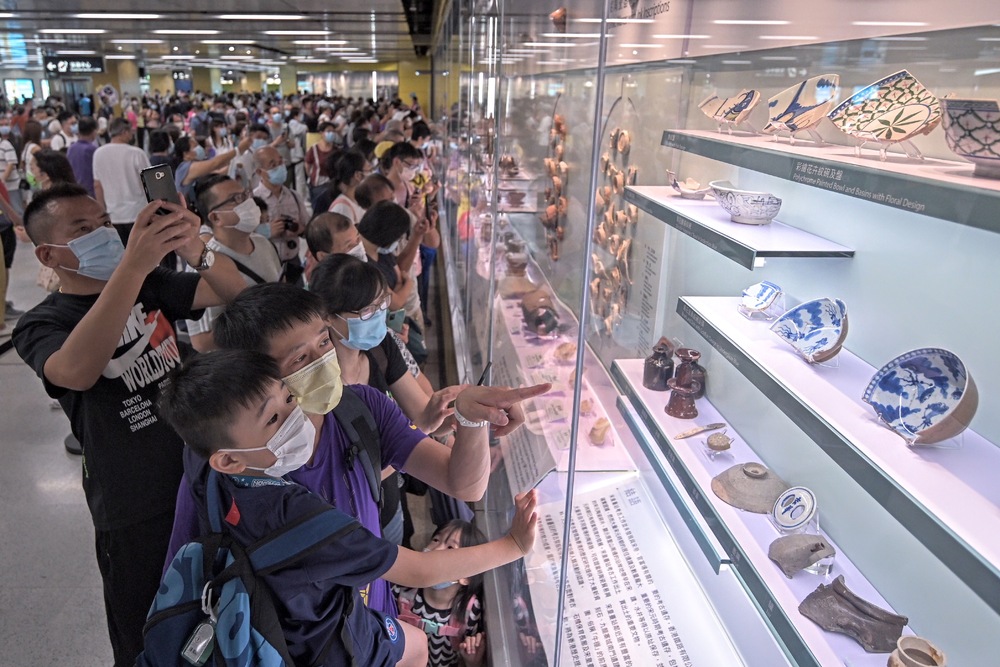
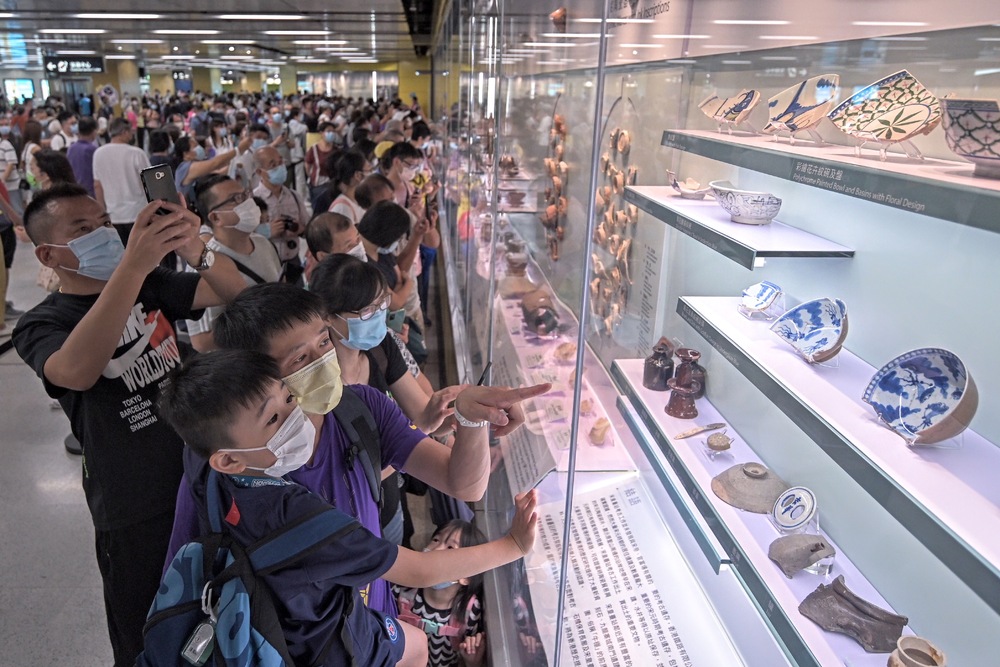
Citizens spent 30 minutes queuing to look at ancient artifacts exhibited at the new Sung Wong Toi station.
ADVERTISEMENT
SCROLL TO CONTINUE WITH CONTENT
As the crowd grew inside the station yesterday, passengers were reminded that they must leave the station within 150 minutes.
A man surnamed Ngan from the Northern district was one of the first ones to catch a glimpse of the new station. “The environment of the station is acceptable, but I think there can be more cultural relics on display on the platform,” he said.
The station will be the first in Hong Kong to include facilities to exhibit artifacts, which will display around 400 artifacts that could be dated back to the Song and Yuan dynasty, which means those artifacts could be over 1,000 years old.
The exhibition at Sung Wong Toi station will display around 400 of the 700,000 artifacts unearthed during the construction of the station.
The exhibits were chosen by the Antiquities and Monuments Office, which includes two Celadon Incense Burners with Eight Trigrams Pattern, that were dated back to the Yuan dynasty, which could be 750 years old.
The office believes that the two incense burners may be related to the worship of the “well deity” as they were unearthed from a pit near a well.
Also on display were debris of ceramic vases, ancient coins and daily necessities from the late-19th to mid-20th centuries will also be displayed in the station, according to the MTR.
MTR earlier said Sung Wong Toi has a rich historic background and numerous relics were excavated during the station's construction, therefore the station design has incorporated a number of archaeological elements.
A stone well which could be more than 1,000 years old was found there and will be preserved at the site. But passengers will not be able to see the ancient well when the station opened yesterday as in-situ reinstatement has yet to be finished.
Part of the station's ceiling will be converted to a transparent panel, allowing passengers to view the well - from below - in the future.
During Song times, a salt field was established in Kowloon Bay, and the young emperor and prince of Southern Song stayed at the salt field for a few months to flee the Mongol onslaught.
A hillock which overlooked the coast of Kowloon Bay was described as the “Sacred Hill” and a large boulder on the hillock was inscribed with words “Sung Wong Toi” which translates to Hill of the Kings of the Song dynasty.
During the Japanese Occupation, part of Sacred Hill was removed by the Japanese in order to expand the military airfield, and the remainder was levelled by the government in the 1950s to create the Kai Tak Airport.