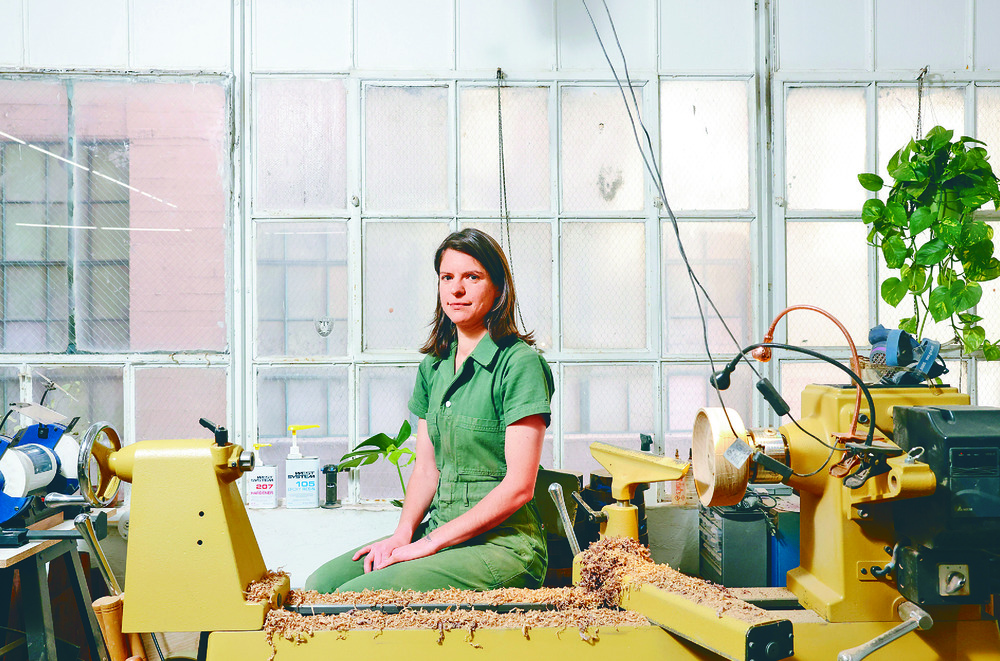
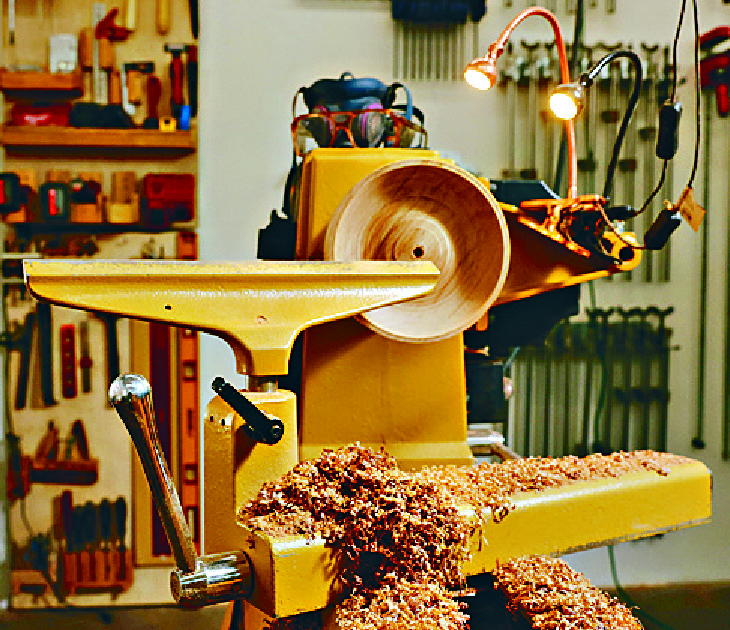
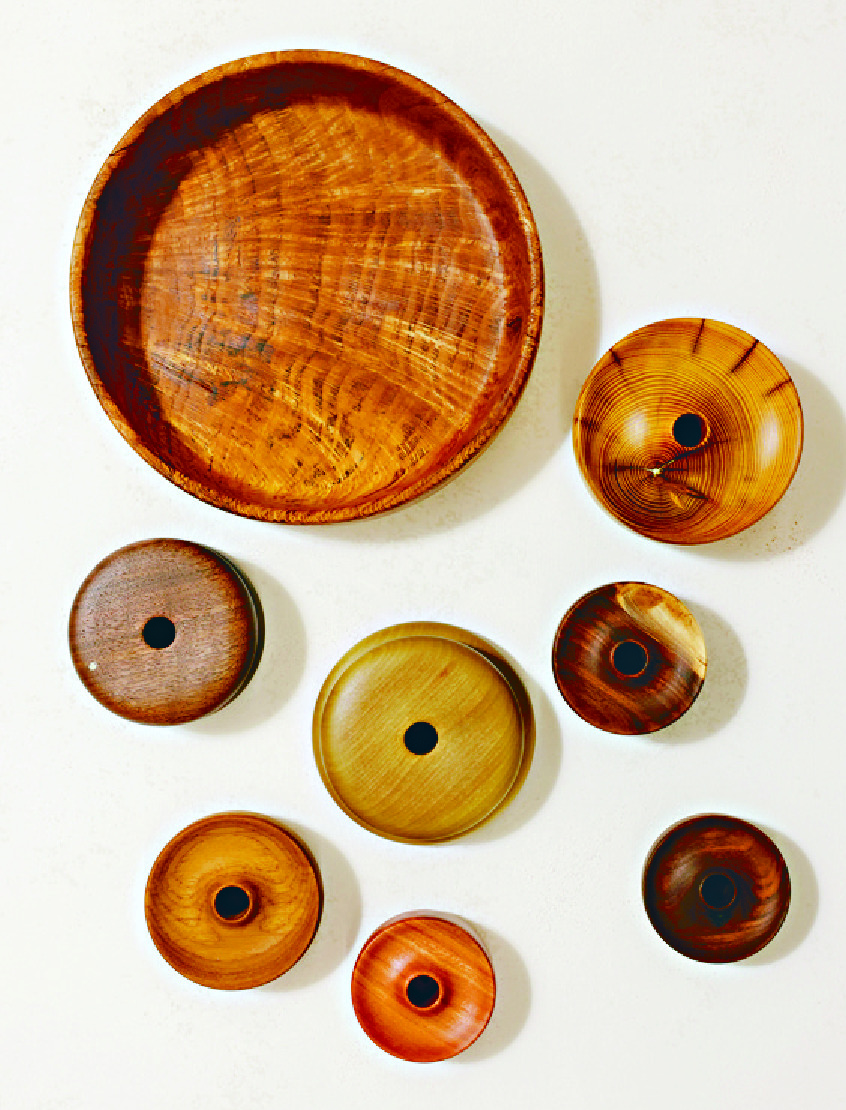
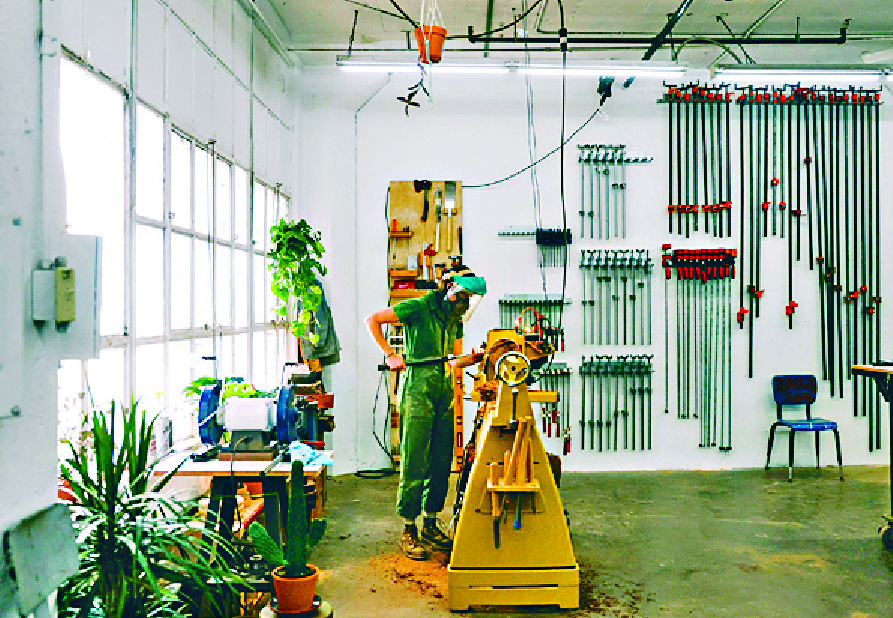
Standing on a blanket of sawdust in the Los Angeles Fashion District woodshop she shares with two other woodworkers, Julie Jackson puts on a protective face shield and turns on her lathe.Armed with a turning chisel called a bowl gouge and dressed in a green jumpsuit, Jackson proceeds to mold the rough-hewn piece of black walnut similar to a potter forming a vessel on a potter's wheel.
ADVERTISEMENT
SCROLL TO CONTINUE WITH CONTENT
After a few moments of turning, the subtle grains of wood begin to emerge, and the block of wood begins to resemble a dry vase.
"I enjoy all of the things that I do with wood, including making furniture, but turning is definitely my favorite," said Jackson. "I like things to look and feel soft. I also like the idea of making ordinary things beautiful. I keep subtracting until it's the right shape."
The journey to becoming a designer of finely turned wood lamps and delicate vases and bowls began with the childhood projects she created with her grandfather in Michigan. "Ever since I was little, I wanted to be an artist," said the 35-year-old. "I'd make birdhouses with my grandfather, who was a carpenter, and then I'd paint them with my grandmother. He was so encouraging. It was the best."
Working with her hands as a child inspired Jackson to major in art at Indiana University-Purdue University Indianapolis, but she transferred to environmental science after a year because she was worried about supporting herself as an artist. "I just didn't know what form being an artist would take," she recalled. "I thought I'd be a painter. Looking back, I wish I'd stayed in the art department. I think I would have had a lot more fun."
After graduating from college, she worked at a nonprofit recycling company that would ultimately influence her direction as an artist. "It was more of a passion than a career," she said. "But I would later implement what I learned from them into my artworks."
Sitting at a computer and doing data entry eight hours a day made her miss working with her hands, so in 2014 she apprenticed with her brother, woodworker Josh."I love sculpture and making three-dimensional functional art," she said. "I finally found the art that I wanted to make: wood."
In addition to her apprenticeship, she learned a lot about woodturning by watching videos on YouTube and attending her local chapter of the American Association of Woodturners. "The clubs are all over the country and are usually free to join. I highly recommend it for anyone wanting to learn how to turn wood. "
Following her apprenticeship, she and husband Jonathan Meador, established Surcle Wood, a sustainable brand devoted to creating custom wood furniture and accessories from recycled wood.
Jackson and Meador were working on custom projects for several restaurants when the Covid-19 pandemic hit. "It was scary," she said.
But the Covid-19 shutdown also gave her time to focus on woodturning and creating smaller home decor items.
When she offered her made-to-order River Rock lamps (US$265 or HK$2,067 a piece without lampshades) and Surcle Wood vases (US$38 to US$110) on the online marketplace Etsy, they took off.
"Etsy has been huge for me," she said. "I was living in a small town in Indiana. All of a sudden I was shipping lamps to Hong Kong and England. It opened up a bigger audience for my work."
When the shutdown ended and businesses began to reopen, her custom work returned, along with renewed interest in her smaller pieces. "It felt like there was an even greater appreciation for handmade things at that time," she said. "People wanted to support small businesses."
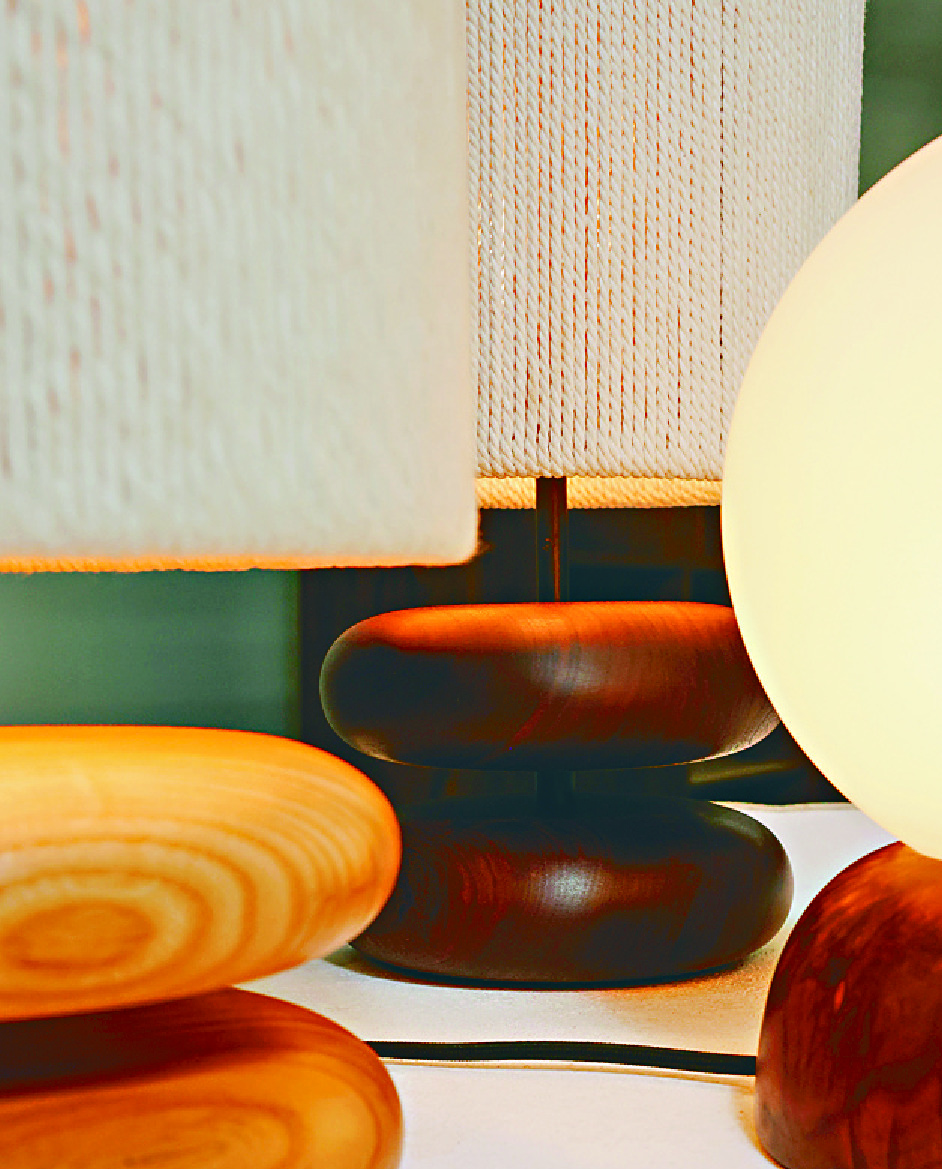
Her profile got another boost when her River Rock lamp, an elegant piece composed of two stacked wooden ovals turned on a lathe, was chosen as a finalist at last year's Etsy Design Awards.
Etsy's trend expert Dayna Isom Johnson, one of the jurors for the awards, is not surprised, given the increased demand for handmade wood gifts and home decor on the site. "As our world becomes increasingly automated, many shoppers are embracing handcrafted styles - celebrating both craftsmanship and individuality - and turning to items like Julie's as an alternative to mass-produced pieces," she said.
They are also interested in supporting small businesses who offer eco-friendly goods. "Julie's shop takes the environment into consideration by re-purposing existing wood - instead of adding to deforestation - which resonates with sustainably-minded shoppers," she added.
Jackson's brother, Josh, who co-founded Arbor Exchange in 2010, said her commitment to sustainability is evident in every aspect of her business. "While she thoughtfully sources lampshade frames from a local artisan and uses 100 percent compostable components for shipping, it's the wood she utilizes in her designs that highlight her unwavering dedication to the environment," he said. "Her use of reclaimed wood and slabs from locally downed trees is a testament to this dedication but also to the originality of each and every piece that passes through her hands."
Jackson sources wood from urban wood recycling programs. She also uses offcuts from her shop mate's custom furnishings as well as orange from her grandparents' farm and black walnut from downed trees.
While her lamps are minimal by design - she recently added a Moon Wake lamp, a glass globe cradled in walnut ripples (US$190) - they are also incredibly complex because of the precision involved in the turning process.
Jackson, who also does custom furniture commissions, said that woodturning frees her to experiment with unexpected wood varieties, from red gum eucalyptus to antique poplar.
"With furniture, everyone wants the same wood - oak and walnut," she said. "But there are so many different woods out there. Throughout the life of a tree, many factors - the amount of rain, sunlight, and storms, the insects and animals that made the tree their home, its location being urban or rural - take part in creating a unique piece of wood. These patterns, cracks and lines in the grain created over a lifetime being revealed by my chisel is thrilling and inspiring. It's like unwrapping a present."los angeles times (tns)