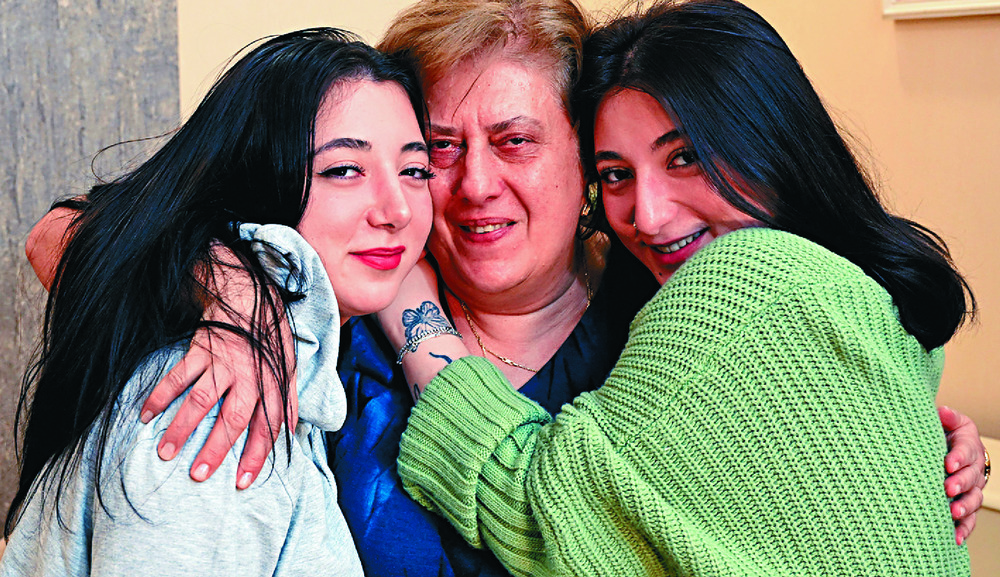
Georgian student Elene Deisadze was browsing TikTok in 2022 when she stumbled across the profile of a girl, Anna Panchulidze, who looked exactly like her.
Months later, after becoming friends, they separately learned they were adopted, and last year decided to take a DNA test.
It revealed they were not only related but identical twins.
"I had a happy childhood, but now my entire past felt like a deception," said Anna, an English student at university.
Far from an innocent case of separation at birth, they are among tens of thousands of Georgian children who were illegally sold in a decades-long baby trafficking scandal.
The scheme, uncovered by journalists and families searching for lost kin, saw babies stolen from mothers, many of whom were told they had died, and then sold to adoptive parents in Georgia and abroad.
The illegal adoptions took place over more than 50 years, orchestrated by a network of maternity hospitals, nurseries and adoption agencies that colluded to take the children from parents, falsify birth records, and place them in exchange for cash.
Elene and Anna, now 19, began unravelling their hidden past two years ago.
"We became friends without suspecting we might be sisters, but both of us felt there was some special bond between us," said Elene, a psychology student.
Last summer, the girls' parents independently told them they had been adopted - revelations they had long planned to make.
"I struggled to process the information, to accept the new reality - the people who had raised me for 18 years are not my parents," said Anna. "I feel no anger whatsoever, only immense gratitude for their raising me and joy at finding my flesh and blood."
The DNA test was arranged with the help of journalist Tamuna Museridze, who runs a Facebook group dedicated to reuniting babies stolen from their parents.
It has over 200,000 members. Museridze set it up in 2021 to find her own family after learning she had been adopted.
She soon uncovered the mass baby-selling operation.
"Mothers were told their babies were buried at a hospital cemetery," Museridze said. "In fact, hospitals had no cemeteries, and babies were being secretly whisked away and sold to adoptive parents."
The new parents were often unaware the adoptions were illegal and told fabricated stories about the circumstances.
"Some, however, consciously chose to circumvent the law and buy a baby" to avoid decade-long waiting lists, Museridze said.
She says she has evidence that at least 120,000 babies "were stolen and sold" from 1950 to 2006, when anti-trafficking measures by reformist president Mikheil Saakashvili eventually quashed the scheme.
In Georgia, new parents would pay the equivalent of many months' salary, while babies trafficked abroad were sold for up to US$30,000 (HK$234,000).
Elene's adoptive mother, Lia Korkotadze, and her husband decided to adopt after learning they couldn't have children. "Adopting from an orphanage seemed virtually impossible due to incredibly long waits," the 61-year-old economist said.
In 2005, an acquaintance told her about a six-month-old baby available for adoption from a hospital - for a fee. "They brought Elene right to my house," she said, never suspecting there was "anything illegal."
Anna and Elene's tale mirrors that of twins Anna Sartania and Tako Khvitia.
They managed to reunite years later after finding each other on social media.
More than 800 families have been reunited thanks to Museridze's group.
Successive Georgian governments have made multiple attempts to investigate the scheme and have made a handful of arrests over the last 20 years.
Prime Minister Irakli Kobakhidze said last in parliament that Tbilisi is among the world leaders in combating trafficking.
But Museridze says the state's response has been lacking. "The government did nothing tangible to help our efforts."
AGENCE FRANCE-PRESSE
Anna Panchulidze, left, and Elene Deisadze with Elene's adoptive mother, Lia Korkotadzeo. afp