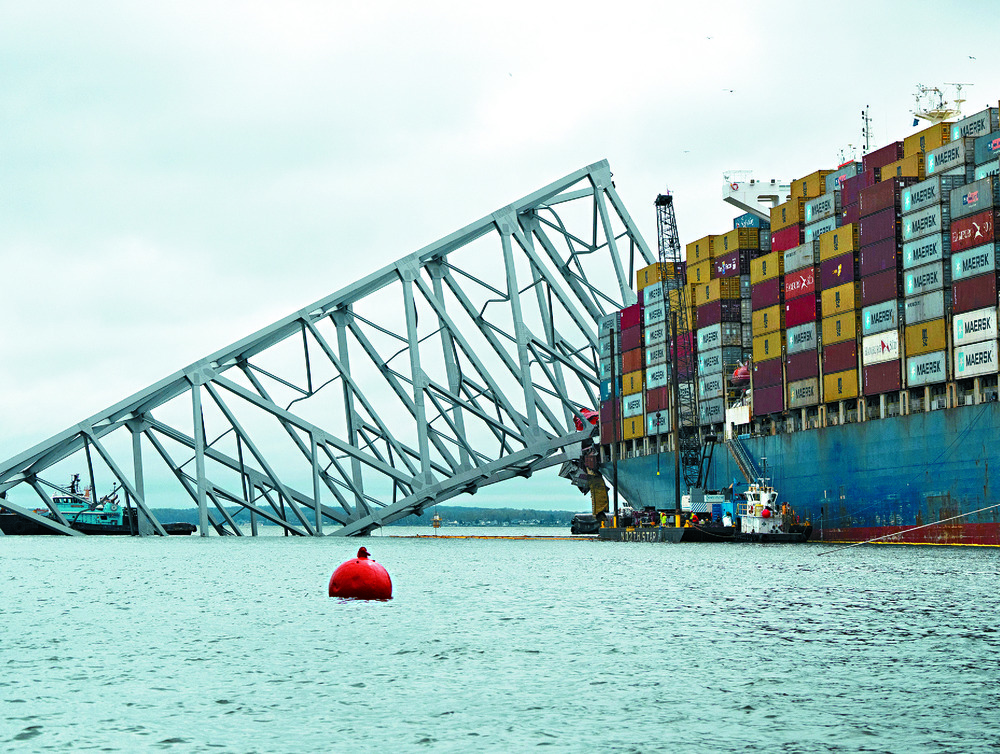
The collapse of the Francis Scott Key Bridge in the United States, after container ship Dali crashed into it, is one of the world's worst marine transport disasters.
It not only cost at least six lives and blocked the marine passage from Port of Baltimore, but also denied the essential east-west connection across Maryland.
The import and export of goods through this narrow marine channel from the port will be severely paralysed for at least three months as it will take time to remove the debris. Reconstruction of the bridge will take many years.
The bridge was built in the 1970s and is of a continuous steel frame construction for the benefit of light weight, but at that time the marine vessels were much smaller.
There were two pylon supports for the bridge structure at the two ends of the marine passage, and small concrete fenders were built at water level to protect the base of the frame from perceived marine vessel impact from river boats.
The weakness of a continuous steel frame bridge is that, should one component fail, the entire steel frame may collapse altogether.
Modern bridge supports at marine passage have robust concrete fenders to protect them from direct impact.
To provide additional protection, "dolphins" or concrete islands are often built in front of the bridge support to further lessen the possible impact of marine vessels to the bridge support piers.
They need to be very heavy and substantial to balance the impact momentum of the huge container ships now weighing over 100,000 tonnes.
The bridge decks of modern bridges are generally of modular construction so that, in the event of impact, one part of the bridge may collapse but the main bridge structure can remain intact.
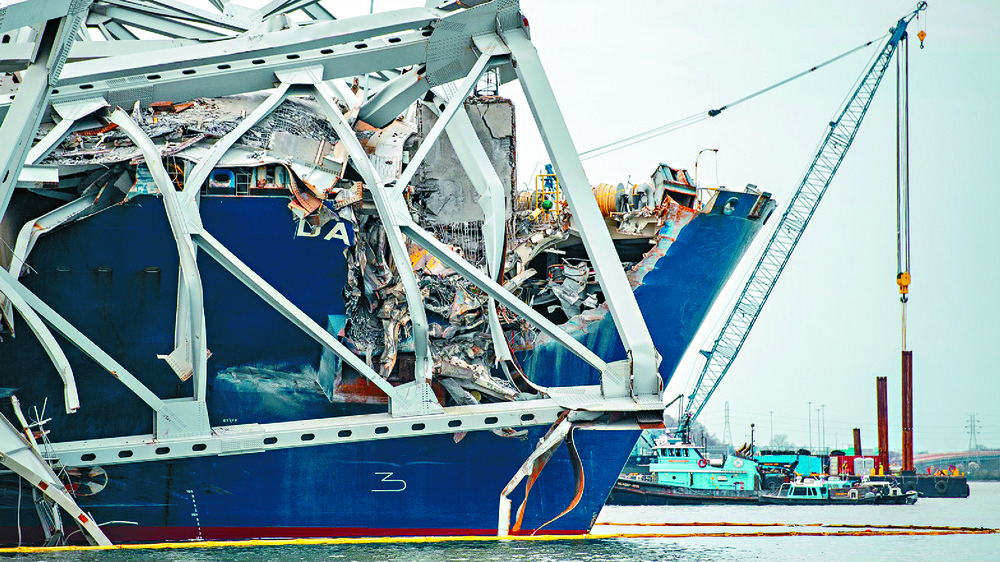
The Baltimore bridge collapse left at least a 300-meter length of steel frame, weighing over 3,000 tonnes, resting on the bow of the container ship.
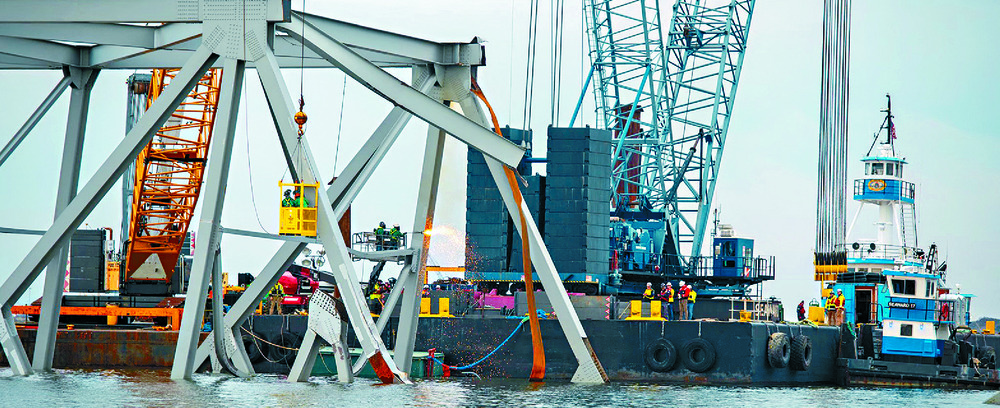
One can imagine the complicated process of cutting out the steel frame to be removed from the river estuary, with lifting barges that can only lift a maximum of 1,000 tonnes at short reach each time.
It is equivalent to dropping the Eiffel Tower on its side in a harbour and trying to cut it up for removal.
It would be a most arduous task and will take enormous time and effort.
I shall try and explain how the container ship lost control to hit the bridge support in my next article, but for now, I shall focus on the bridge and the consequences of the incident.
Baltimore is a major port for the eastern US, exporting coal and motor vehicles, and importing essential raw materials from overseas.
The loss of service for three months will have an adverse impact to the US economy as there is no obvious alternatives for exporting the goods.
On top of that, the loss of the bridge connection will cause significant delays to vehicle traffic across the river estuary as the alternative road link will mean many extra hours of travel.
Rebuilding the bridge, with modern provisions to prevent repeat occurrence, will require substantial changes to the design and maybe a new alignment, and will take at least three years to complete.
This disaster points out to the urgent need to review all major transport links in the US to seek out those with fracture critical components, to remove the risks of paralyzing essential transport links.
A huge investment budget will need to be created to quickly amend such weakness as it will risk huge economic loss, and in extreme cases, threaten security provisions due to the loss of critical transport links, obstructing quick access to certain locations such as military and naval bases.
Efficient transport infrastructure, both land and marine, are key components for modern living.
People may not notice it when they use it habitually while the facilities are available, but when they are damaged, the resulting inconvenience will have very serious effects on daily life and even threaten safety.
Updating them to match current operations will be a necessary and continuous process.
Edmund Leung Kwong-ho is a veteran engineer with a wealth of experience across the power, manufacturing and construction industries.
The disaster left at least a 300m length of steel frame resting on the bow of the ship. AP, AFP
Demolition crews cut the top portion of the north side of the collapsed bridge into smaller sections for safe removal by crane. Salvage teams use an exothermic cutting torch to systematically separate sections of the steel bridge, which will be taken