Ants can be found in nearly every location on Earth, with estimates suggesting there are over 10 quadrillion. That's one followed by 16 zeroes, or about one million ants per person.
Ants are among the most biologically successful animals on the planet.
A surprising part of their evolutionary success is the amazing sense of smell that lets them recognize, communicate and cooperate with one another.
Ants live in complex colonies, sometimes referred to as nests, that are home to a wide range of social interactions. One or more queens are responsible for all the reproduction within that colony. The vast majority of colony members are female workers - sisters that never mate or reproduce and live only to serve the group.
Ants need to defend their colony, seek food and take care of offspring. To accomplish these tasks some ant species domesticate other insects. Others create agricultural systems, harvesting leaves from which they grow edible fungal gardens. Successfully coordinating all these intricate tasks requires reliable and secure communication among nestmates.
Our recent work shows how their societies depend on the exchange of reliable information which, if disrupted, spells doom for colonies.
Human communication relies primarily on verbal and visual cues. We usually identify our friends by their voices and face or clothes they wear. Ants, however, rely primarily on their acute sense of smell.
An exterior shell, an exoskeleton, encases an ant's body. This greasy coat carries a unique scent that varies from individual to individual and gives each ant a unique odor signature that other ants can detect. This odor can communicate important information.
The queen, for example, will smell slightly different from a worker and thus receive special treatment within the colony.
Importantly, ants from different colonies smell slightly different from one another. The detection and decoding of these differences is vital for defense and can trigger aggressive turf wars between colonies when ants catch a whiff of intruders.
For ants and other insects, receiving chemical information begins when an odor enters the small hairs located along their antennae. These hairs are hollow and contain special receptors, chemosensory neurons, that sort and send the information to the ant's brain.
Odors such as those given off from an ant's greasy coat act like chemical keys. Ants can smell these keys only if they are inserted into the correct set of chemosensory neuron locks. A neuronal lock remains shut to any odors except its particular key.
When the correct key binds to the correct neuronal lock, though, the receptor sends a complex message to the brain. The ant's brain is able to decode this sensory information to make decisions that ultimately lead to cooperation between nestmates - or battles with outsiders.
To better understand how ants detect and communicate information we use laboratory tools such as targeted drugs and genetic engineering to manipulate their sense of smell. We are especially interested in what happens when an ant's sense of smell goes wrong.
For example, when we prevent an odor key from opening a chemosensory lock it prevents the chemical information from reaching the brain. This would be like plugging your nose or standing in a completely dark room - no scents or sights would register.
We can also open all the locks at the same time, which floods the neurons with too many messages. Both of these scenarios dramatically compromise an ant's ability to detect and receive accurate information.
When we messed with ants' sense of smell - whether shutting down or flooding their odor receptors - we found they no longer attacked non-nestmates. Instead, they became less aggressive. In the absence of clear information ants exercised restraint and opted to accept rather than attack a fellow ant. Put another way, ants ask questions first and shoot later.
We believe this social restraint is hard-wired and gives ants an evolutionary advantage. When you live in a colony with tens of thousands of sisters a simple case of mistaken identity or miscommunication could lead to deadly infighting and societal chaos, which is potentially very costly.
When ants in our experiments lose their sense of smell and their ability to detect accurate information becomes compromised they no longer stick together in a cohesive colony.
Not only do they fail to recognize and attack foes they also stop cooperating with friends. Without nurses to take care of the young or foragers to collect food the eggs dry up and the queen goes hungry.
We discovered that without an accurate means of communicating and receiving chemical information ant societies collapse and a colony quickly dies. Miscommunication or the lack of accurate information affects other highly social animals, including humans, as well. For ants, it all depends on their sense of smell.
Laurence Zwiebel and Stephen Ferguson, biologists at Vanderbilt University
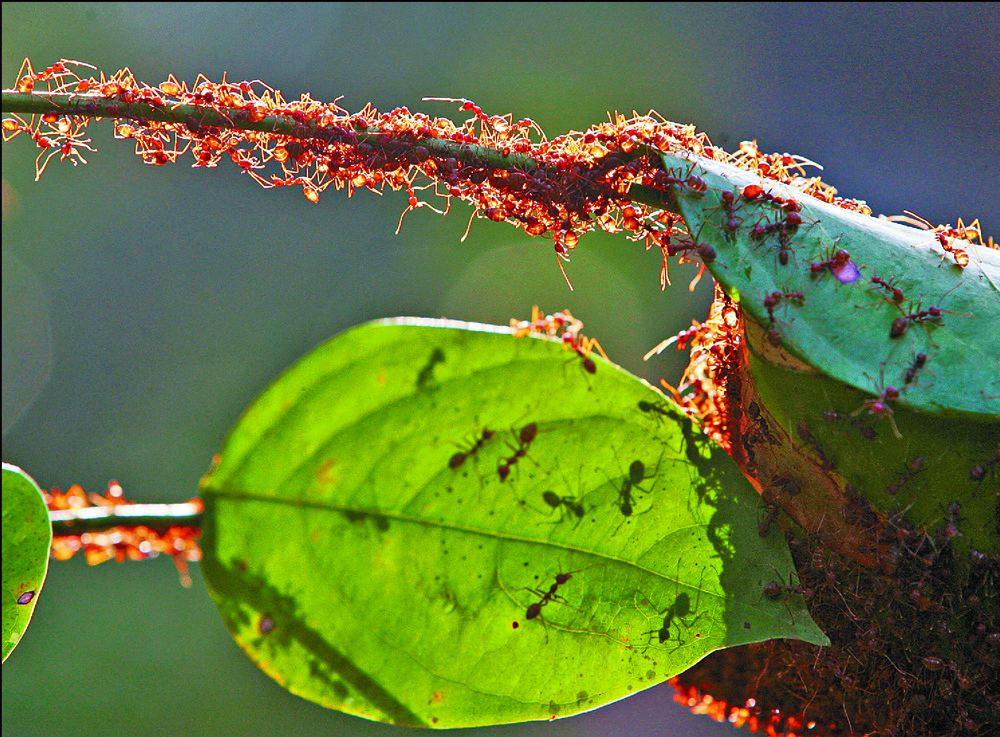
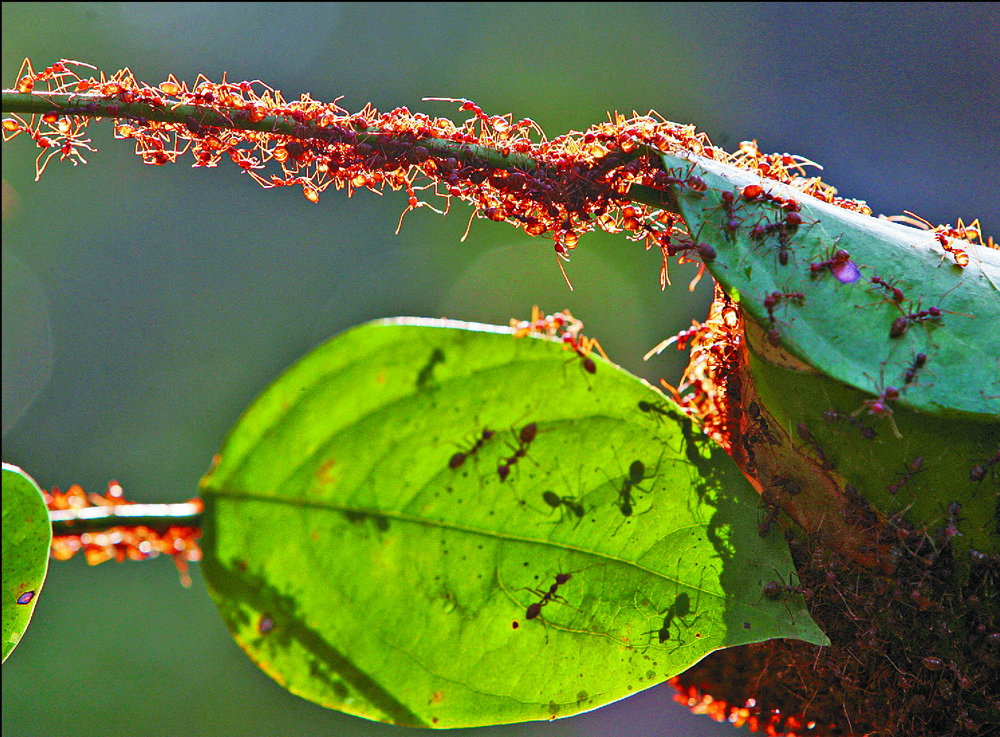
Weaver ants build a nest from leaves in Malaysia. Right: ants make for interestingobservations for a Nanjing resident. Far right: Leafcutter ants live up to their name.