Every Chinese of my generation adored the actress Lin Dai. Long after her tragic death at a much too youthful age she remained everyone's sweetheart. Her beauty was legendary. During my childhood my family eagerly awaited her new films, which were many and filled every cinema to capacity.
Very sadly, her only son and the heir to her and her husband's distinguished families died last Sunday, also at a much too youthful age. As the only child, his death marks the end of an era.
Lung Tzong-hann (1963-2022) was a mere 59 when a heart attack took his life.
No doubt his many years of heavy smoking of his beloved Marlboro cigarettes must have taken their toll. Even though he was my godson I could not prevail upon him to give up the life-threatening habit.
Ah-Lung, my oldest godson, always had to live in the shadow of his parents' famous families. It was not easy for him.
In 1964 he was but a baby when his mother tragically died at the tender age of 29. She had become a household name throughout the Chinese-speaking world, her great beauty and artistic talents having launched her to rapid stardom. Just seven years before her death, in 1957, she had won the best actress award for her performance in the film Golden Lotus.
Her legions of fans relished every film she made. Probably her most remembered film was the musical drama The Kingdom and the Beauty. It was my father's favorite .
He would listen over and over again to the songs played out on our crackling loudspeaker. The plot relates the tragic love affair of a naive country girl and an emperor who falls in love with her at first sight.
Lin Dai was the only child of the distinguished patriot Cheng Siyuan, who had earlier in life supported the Kuomintang but later returned to Beijing and was elevated to be vice-chairman of the standing committee of the National People's Congress.
I recall meeting Cheng a number of times in Beijing, and both Lung and I attended his elaborate funeral in 2005.
His remains are buried in the Babaoshan Revolutionary Cemetery, where the highest ranking heroes of the revolution rest.
Another post-1949 hero was Lung's paternal grandfather, the legendary Lung Yun. During the civil war Lung Yun carved up a kind of kingdom for himself.
So powerful was he that he became the governor and warlord of Yunnan from 1927 to 1945. In those early years he was a key member of the Kuomintang but after liberation he duly supported the communists and was rewarded with many high offices, including as governor of Yunnan and as a member of the standing committee of the National People's Congress.
Ah-Lung was particularly proud of his family connections with Yunnan.
I recall an occasion when he insisted I accompany him on a sentimental trip to places associated with his grandfather and ah-Lung was himself honored with appointment to the provincial Chinese People's Political Consultative Conference.
He much regretted that he never knew his grandfather as Lung Yun died in Beijing in 1962, a year before ah-Lung was born.
Lin's death cast a shadow over his early life and his father Lung Shengxun lived a rather reclusive life and spent substantial periods out of Hong Kong. He died in 2007.
Lung Tzong-hann's passing will no doubt bring back nostalgic memories for my more senior readers and it made me recall his mother's most famous song, immortalized in the 1961 film Love Without End. Directed by the renowned Doe Ching it depicts the tragic love story of a poor songstress who willingly sacrifices her happiness and life for the man she loves. The song's lyrics express the sorrows and tears of parting with love ones.
Ah-Lung was the most loyal person, stubborn, and blunt. Perhaps he acquired his disciplined approach to life from his years at Eton College in England and service with the Correctional Services Department.
Cheng Huan is an author and a senior counsel who practices in Hong Kong
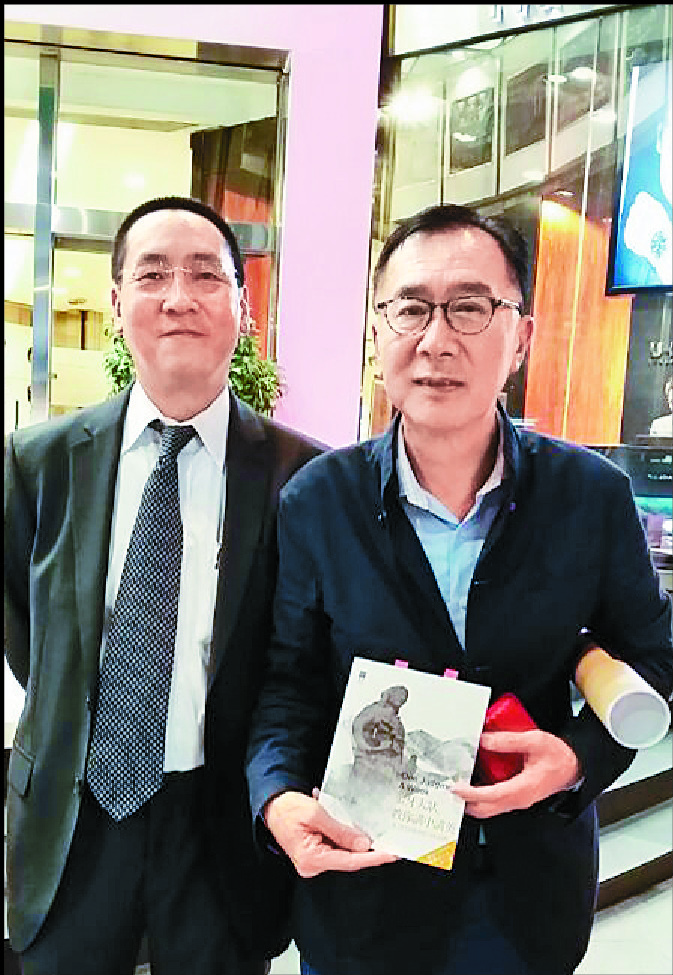
Lung Tzong-hann with his mother Lin Dai, father and godfather.