Read More








Right to a trial without a jury | To The Point | Cheng Huan
15-06-2026 00:07 HKT


Man attacked, robbed of $7 million worth of gold at airport car park
18-06-2026 03:48 HKT
Having described airfield markings and lighting in the last two articles, let us look at a more important facility at airfields: the pavement.
Pavement surfaces are generally flat and level, not only to facilitate smooth aircraft movements but also to ensure good visibility for pilots over a considerable distance.
However, providing efficient drainage of surface water for a large, level area can be a challenge, especially in Hong Kong where rainfall can be heavy. Sufficient gullies for drainage must be provided and covered by robust gratings that can withstand aircraft loads.
Airfield pavements are constructed partly as stressed and partly as non-stressed. Stressed pavements are used for runways, taxiways and parking aprons. Areas not normally used by aircraft are non-stressed for cost reasons.
Stressed pavements are built much stronger than those for roads as the weight of an aircraft is not only much heavier but also concentrated in the lesser number of wheels of the landing gear compared to terrestrial vehicles.
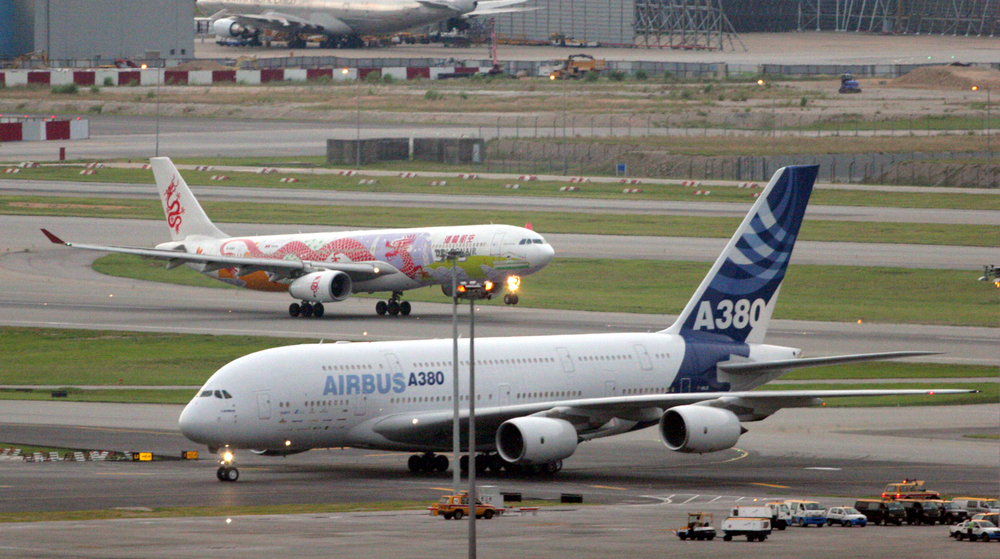
A fully loaded Boeing 747-400 has a total weight of 400 tonnes supported by just 18 wheels. Also, the pressure for aircraft tires is six times higher to cater for much heavier loads.
There are two types of stressed pavements: rigid and flexible.
Rigid ones are more expensive to construct but more durable as they are made from hard concrete that resist wear and disintegration from spilled jet fuel.
They are constructed in panel grids of lengths shorter than six meters so the width of construction joints between slabs, even at perceived maximum contraction due to temperature and other effects, will be narrow enough to ensure smooth aircraft travel across joints.
Flexible pavements are made of asphaltic or bituminous concrete that provides a continuous cushioned surface for more comfortable rides, especially during takeoffs or landings, but they require repaving periodically as surfaces tend to wear a lot quicker than the rigid type.
The subgrade supporting both types of stressed pavements are strongly constructed to avoid any settlement caused by heavy loads transferred from pavements. It can either be a thick layer of graded rock and granular materials or well-compacted soil, and proof-loaded by a 100-tonne-proof road-roller passing over with no noticeable depression.
Where it is necessary for a stressed pavement to pass over a stream, road or other facilities it must be supported by a structure such as a bridge.
We had a highly visible taxiway bridge in the old Kai Tak airport, built to connect with an extended apron at Kowloon Bay to provide more aircraft parking bays for fast-growing demand prior to the Chek Lap Kok opening.
Built over Kai Tak nullah, it had a shallow structure to provide clearance for maintenance vessels to navigate under it.
Commissioned in the early 1990s, this bridge, with a length of 225 meters and six rows of marine columns, was one of the longest of its kind in the world then.
The runway and apron of Kai Tak has now become the new Kai Tak Development for residential and municipal use, housing hospitals, government offices and the Cruise Terminal.
The development was made easy as most of the site is on flat land with same elevation and on robust foundations, minimizing the need for site formation.
Airports may seem like a large piece of flat land, but a lot of engineering considerations go into it to make it efficient and safe for landings and takeoffs for large aircrafts and convenient for passengers.
Veteran engineer Edmund Leung Kwong-ho casts an expert eye over features of modern living