Undoubtedly, the visual memory of anyone fascinated by ancient Egyptian civilization is inextricably linked to the dazzling golden mask of the young King Tutankhamun. The allure of this mask, coupled with the discovery of his fully intact tomb, has overshadowed nearly every other artefact, no matter how extraordinary.
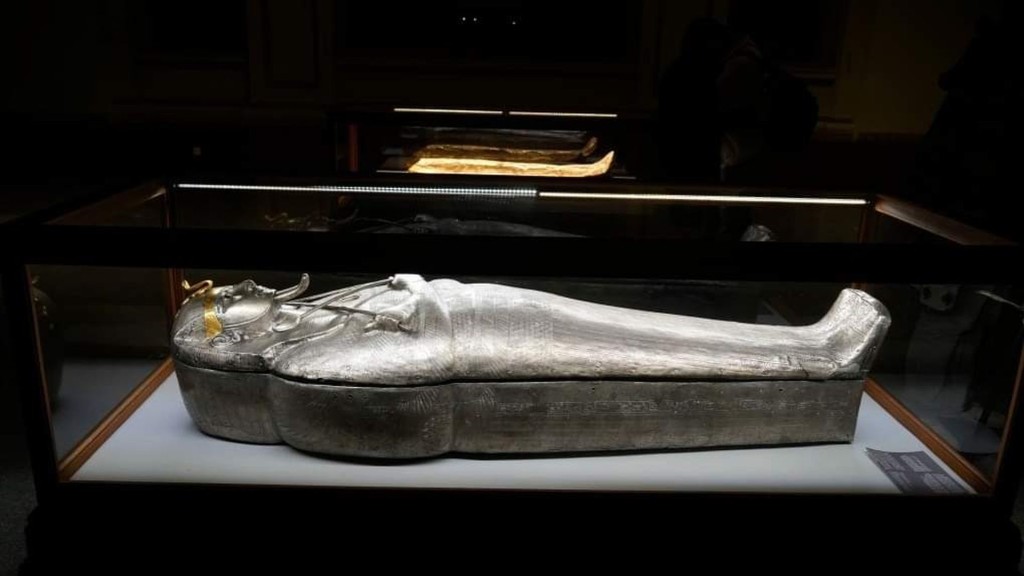
Yet, hidden in the shadows lies a treasure of equal magnitude but lesser fame, the pure silver sarcophagus of King Psusennes I. Defying the tradition of using gold, which ancient Egyptians believed represented the flesh of the gods, this king chose silver, symbolizing the gods’ bones, to craft his eternal resting place. In 1939, a remarkable archaeological discovery unfolded in Tanis, in Egypt’s eastern Delta. The popular belief that Tutankhamun’s tomb is the only intact resting place ever found is not entirely accurate. There, French archaeologist Pierre Montet unearthed the pristine, perfectly preserved royal necropolis of the 21st and 22nd Dynasties.
Alongside lavish funerary furniture and heavy stone sarcophagi, four golden death masks, strikingly similar to Tutankhamun’s, were found resting upon the royal mummies. However, the crown jewel remains the silver sarcophagus of King Psusennes, safely nested within an inner black granite sarcophagus and an outer pink granite one. This artifact is exceptionally significant because silver was far rarer than gold in ancient Egypt. Unearthing a complete, pure silver coffin is a staggering, unparalleled discovery that offers a rare glimpse into royal wealth. The king’s face is elegantly sculpted, highlighted by delicate gilding around the headdress and the royal serpent on his forehead.
Tragically, the outbreak of World War II eclipsed this monumental find, denying it the profound global fame and attention it truly deserved. But the time has finally come to recognize its extraordinary legacy. Today, resting quietly in the Egyptian Museum, this masterpiece stands as a silent witness to the “Silver King,” the monarch who chose to slumber into eternity embraced by the bones of the gods.
Amjad Refai is the director of the Arabic Programme at the University of Hong Kong