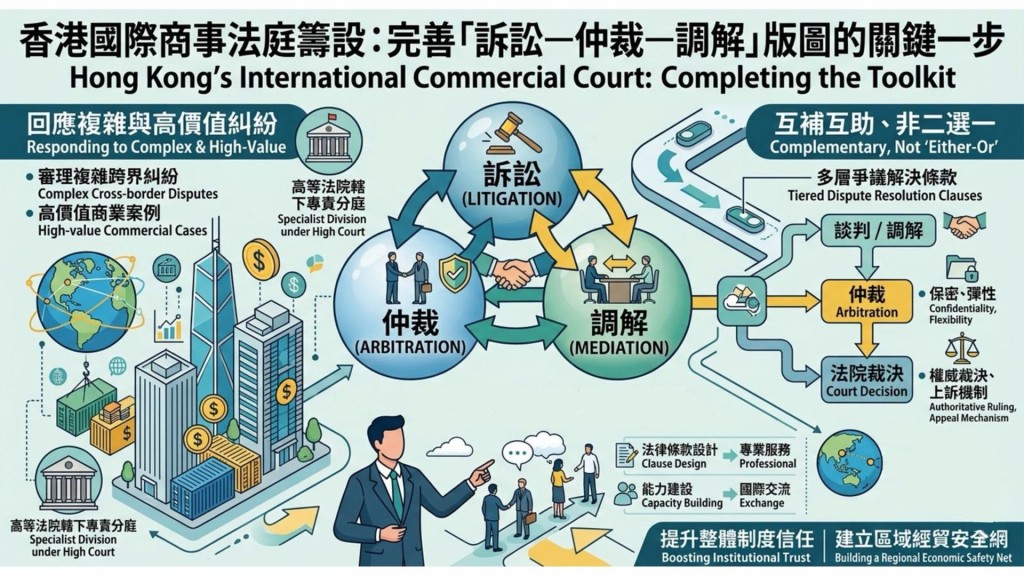
On May 28, the Judiciary announced a plan to establish the Hong Kong International Commercial Court as a specialist division under the High Court to hear complex, high-value international, and cross-border commercial disputes. The move responds to the growing sophistication of cross-border commerce and adds another institutional pillar to Hong Kong’s standing as an international financial center and a dispute resolution hub.
In the global market, arbitration remains popular for its confidentiality, procedural flexibility and party autonomy. Yet for high-stakes disputes involving multiple jurisdictions, multiple parties and extensive evidence, users also value a forum that offers authoritative, transparent determinations, and a structured appellate mechanism. The proposed International Commercial Court strengthens Hong Kong’s overall “litigation–arbitration–mediation” toolkit, enabling parties to choose processes more precisely based on the nature of the dispute, time and cost constraints, confidentiality needs, and enforcement strategy – rather than being forced into a one-size-fits-all route.
Importantly, the court should not be viewed as an “either-or” alternative to arbitration. Many cross-border contracts already adopt tiered dispute resolution clauses (starting with negotiation or mediation, then moving to arbitration or litigation). In that framework, Hong Kong’s advantage lies in predictable, workable interface among mechanisms: arbitration can address highly technical disputes or matters requiring confidentiality, while litigation can deliver authoritative outcomes with procedural safeguards where appropriate. Properly aligned, these mechanisms can reduce incentives for parallel proceedings and tactical delay, and can improve overall efficiency.
Within this ecosystem, AALCO Hong Kong Regional Arbitration Centre plays a practical role in translating institutional strengths into on-the-ground professional support. This includes assisting corporates and counsel in designing clearer dispute resolution clauses, selecting suitable procedures and arbitrator profiles, and advancing capacity-building and international engagement – so that more Asia–Africa and wider cross-regional commercial activity can rely on solutions in Hong Kong that are credible, usable, and enforceable. As the International Commercial Court develops specialist procedures, adopts technology and builds a body of decisions that enhances international visibility, Hong Kong’s arbitration platform should also benefit from a strengthened baseline of institutional trust – creating a mutually reinforcing cycle.
In an era of geopolitical complexity and supply-chain realignment, businesses need predictable rules and mechanisms that work in practice. If implemented with professionalism, efficiency and international orientation, the proposed International Commercial Court – together with Hong Kong’s established arbitration and mediation framework – can help convert “institutional trust” into a genuine safety net for regional commerce and investment.
Nick Chan is Director of Asian-African Legal Consultative Organization Hong Kong Regional Arbitration Centre