Ocean Park is in dire straits, with huge capital outlays in the course of its transformation from a theme park to a destination resort while it now faces uphill challenges in its recovery due to the sudden loss of visitors from the mainland.
My focus is not on the theme park's financial situation, but on the innovative and efficient transport systems that, in its heyday, served hundreds of thousands every day.
The park consists mainly of the Waterfront, otherwise known as the Lowland, and the Summit, also known as Headland.
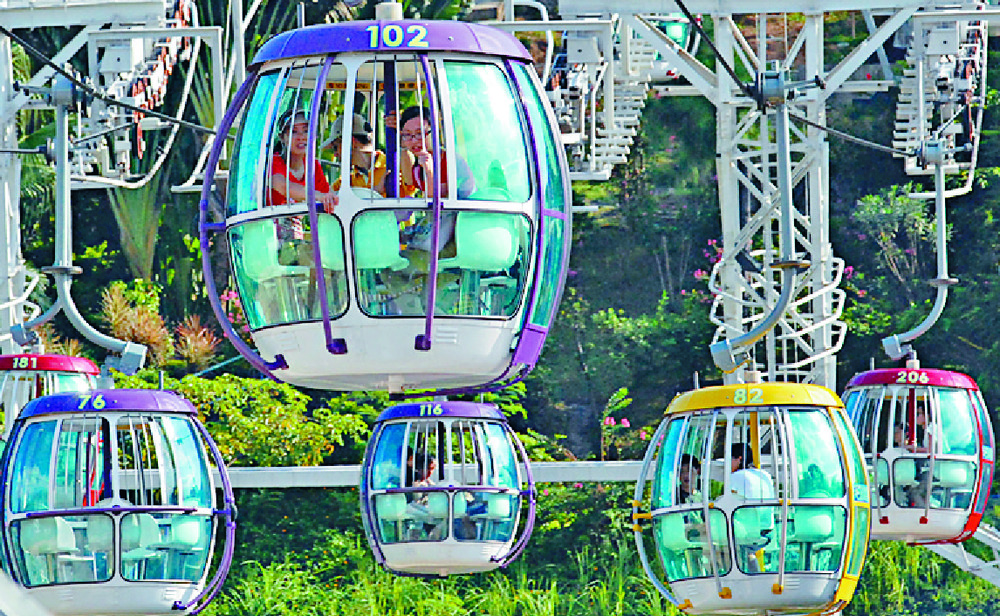
As there is a large valley between them, it is natural that a cable car system was used to transport visitors from one part to the other.
Each car carries up to six passengers, and that was deemed adequate to facilitate quick transport when built some 40 years ago.
As the park expanded, a funicular railway was built to augment transport needs.
Ocean Express, akin to an underground railway and with capacity for 5,000 passengers per hour, provides a rapid alternative access to the Summit but in theory lacks the charm of the cable car, which provides breathtaking bird's eye scenic views of the park.
As befits a theme park, artificial scenes of underwater settings to mimic an underwater journey are projected onto cabin walls to enhance the experience for tourists, providing some amusement during the otherwise plain three-minute journey, before the scenic views across the Summit unfolds when they disembark.
Younger visitors may not be aware that, before the advent of Ocean Express, the park was heavily dependent on the cable cars.
When high winds and bad weather prevailed, forcing cable car operations to be suspended, access to the Summit was occasionally interrupted.
A bus service - which normally provides essential transport for park staff along the narrow lanes of Nam Long Shan - would be used temporarily to transport passengers, especially for those stranded on the Summit.
As we can imagine, such a transport system was slow and inefficient and caused a lot of inconvenience and complaints. So, construction of Ocean Express was actually more for transport relief than to create a tourist attraction in essence.
There is another innovative means of transport to the Summit.
To help tourists climb its slopes, a long escalator ride was installed.
At 225 meters, it was the longest escalator ride in Hong Kong until the Mid-Levels escalators were built.
The lowest flight is within the current construction site of the Water Park at Tai Shue Wan. It has been temporarily taken out of service, but will resume service upon the latter's opening.
Externally, Ocean Park was not easy to access in its early days.
Shuttle buses from Admiralty were the easiest link apart from cars and taxis.
With the South Island line of the MTR system in operation in the past few years, Ocean Park station now provides easy and quick access from town, as the journey from Admiralty now takes only about six minutes, making journeys from most parts of town almost as convenient as those of the "next-door" variety.
It took almost 40 years of Ocean Park's history to perfect the transport system, both internally and externally, but just as the transport facilities become almost fault-free and convenient to all, out came the financial woes.
Operating primarily as a not for profit organization that aims to provide elements of entertainment, education and conservation at an affordable price is a daunting task, especially in the present socioeconomic climate.
Strong community support would be vital for its survival.
Veteran engineer Edmund Leung Kwong-ho casts an expert eye over Hong Kong's iconic infrastructure
Cable cars were once the main mode of transport between Ocean Park's Waterfront and Summit. sing tao