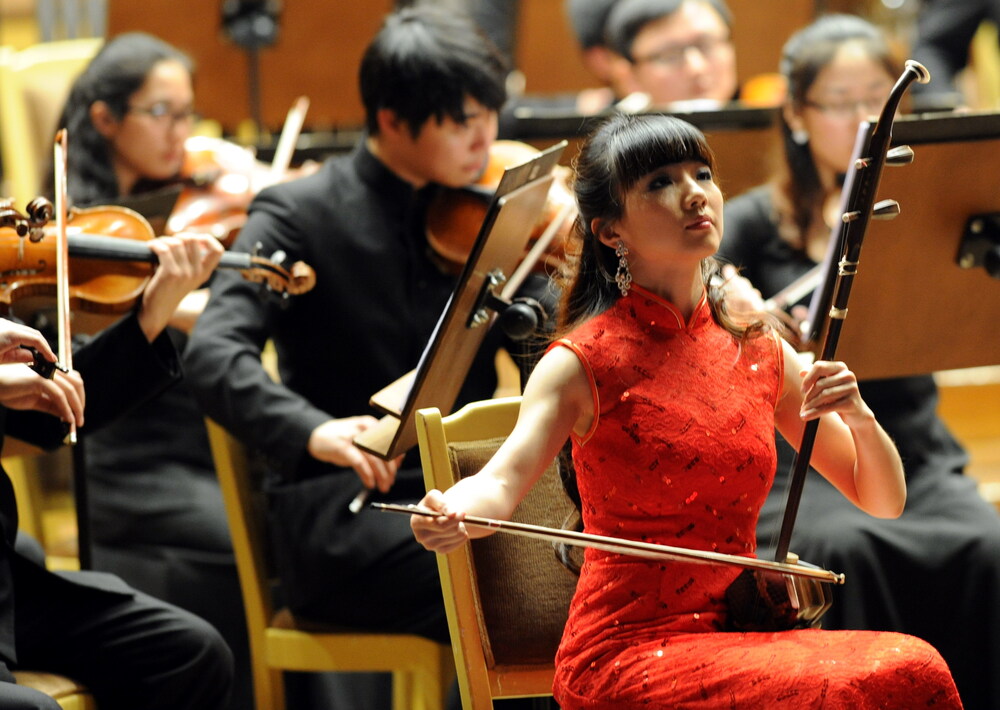
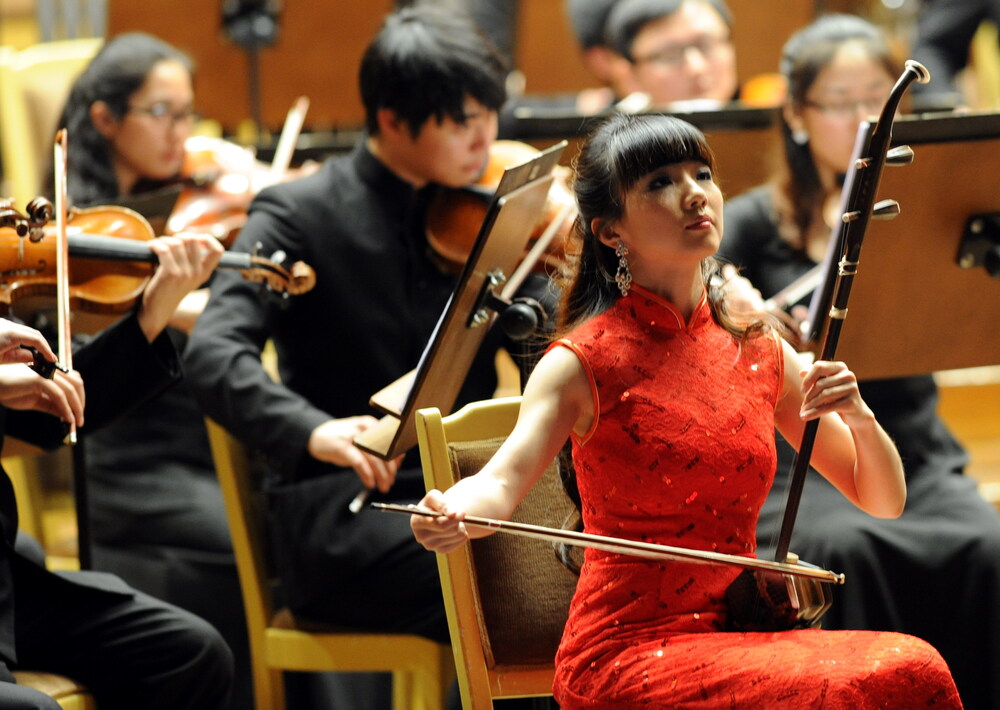
The erhu was brought into China during the Tang dynasty (618-907 AD) as one in a series of bow-string instruments called huqin. That means musical instruments from the Hu people, a tribe from the north-western periphery of China at the time.
Compared with the others, the erhu can produce a wider range of notes from middle-high to high pitch. This makes it ideal for solo performances and good for orchestral music. Others in the huqin family include the gaohu (huqin with the high pitch notes) and the zhonghu (huqin with the middle pitch notes).
While the western violin, viola, cello and double bass can cover the whole spectrum of orchestral music, the Chinese huqin set could only provide high- to middle-pitch notes. Cellos and double basses were used to fill the low-pitch gap at Chinese orchestras until the gehu and bass gehu were developed in the last century.
Many people consider the erhu to be the Chinese equivalent of the violin, but they differ in many ways.
First, the erhu has only two strings to the violin's four. The hair of its bow is sandwiched between the two strings and hence the bow actions are much more restrained to generate different sound effects. When the strings are excited by friction from the bow hairs, the musical notes produced are transmitted from the bridge, a tiny piece of wood pressed against the membrane, to the sound box for amplification and projection.
Second, the erhu has no fingerboard. Notes of different pitches are produced by pressing the strings at various positions to vary their vibrating length, but to control the pressing forces without the help of a fingerboard can be quite demanding. So some regard the erhu to be a harder instrument to play than the violin.
Perhaps the most distinct difference is the sound box.
While the sound box of the violin is of sophisticated shape and construction, the erhu's has a simple circular, octagonal or hexagonal box with a membrane mounted at one end. Hence, the sound generated has a unique tone, often felt to be more appropriate for sad pieces.
Traditionally, the membrane used was made from snake skin, which is now regarded as ecologically unfriendly.
Anyway, being a natural material that is tanned and preserved to be the erhu membrane, they could come in a wide range of thicknesses, pliability and other characteristics, which tends to result in varying sound quality.
The tendency of natural skins to absorb moisture and expand with heat also affected the sound quality in different climatic conditions.
The Hong Kong Chinese Orchestra has pioneered and patented a development of an alternative, made from synthetic materials, to provide a more consistent quality. It is eco-friendly, and therefore eliminates problems of clearing customs and applications for special exemption when one is being carried overseas, as some skins were made from what are now protected species of snakes.
It is also thermally stable and moisture resistant, once more improving the consistency of notes produced.
So we see again how technology plays a vital part in everyday life. That includes what is commonly regarded as an art not related to technology.
The fact Hong Kong can develop a new membrane to substitute for a natural material without significantly affecting the quality of sound makes us proud to claim that technology can help the development of traditional musical instruments, and at the same time improve environmental friendliness.
Veteran engineer Edmund Leung Kwong-ho casts an expert eye over features and forces in modern life
Hong Kong Chinese Orchestra in a Shanghai concert. Above: huqin virtuoso Xu Hui plays the erhu in Madrid.