Read More
As artificial intelligence (AI) continues to evolve, Nobel Prize-winning scientists cautioned that it cannot match human intelligence and called for youths, especially Hong Kong youngsters, to equip themselves with a strong foundation in fundamental science.
ADVERTISEMENT
SCROLL TO CONTINUE WITH CONTENT
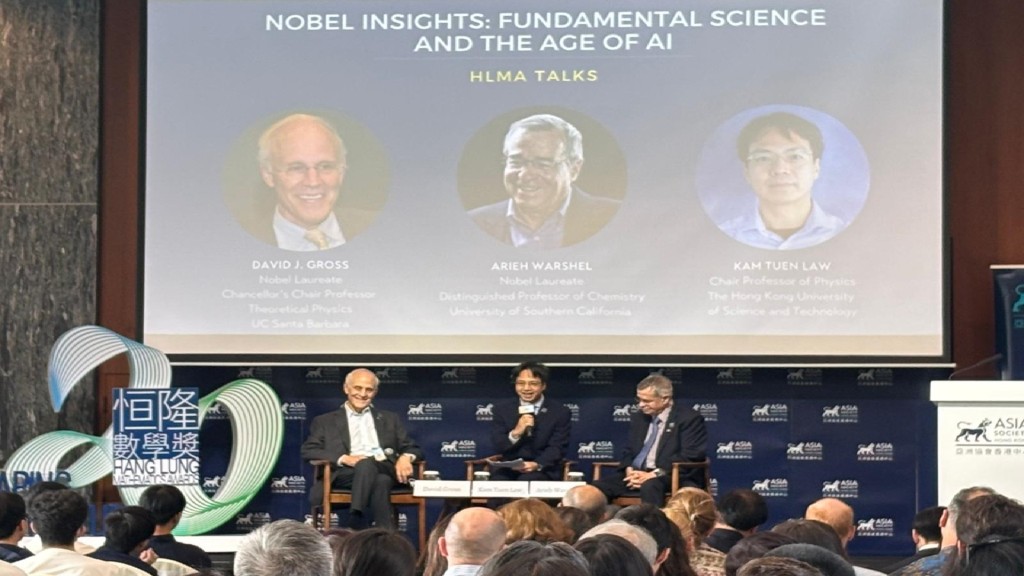
During a discussion session hosted by Hang Lung Mathematics Awards on Sunday, David J. Gross -- who received the Nobel Prize in Physics in 2004 -- expressed optimism for the city’s potential in advancing scientific development.
“I am happy to see more emphasis on science and technology than on business,” he said, highlighting that Hong Kong’s robust educational system and intelligent youths could help drive innovation.
Still, he expressed skepticism about the current hype surrounding AI.
He explained that although AI can analyze vast amounts of data and make reasonable conjectures, it often produces inaccurate information and lacks the ability to verify its outputs.
Gross reflected on the evolution of computational tools in science, noting that AI is another step in this progression, akin to the advancements seen from slide rules to modern computers.
Last year, both the Nobel Prizes in Physics and Chemistry recognized work involving AI.
John J. Hopfield and Geoffrey Hinton were honored in Physics for their contributions to machine learning through artificial neural networks. In Chemistry, John Jumper and Demis Hassabis from Google DeepMind received accolades for developing AlphaFold, an AI tool that predicts protein structures.
While acknowledging AI’s effectiveness, Arieh Warshel -- Nobel Prize-winner in Chemistry in 2013 -- warned against becoming overly dependent on AI, urging researchers to stay critical to evaluate AI-generated results.
“AI does not tell you the reason, it tells you what is the result based on many predications,” he said.
He emphasized the importance of learning mathematics, physics and chemistry as foundational skills and encouraged Hong Kong students to learn these subjects early in life.
“Try to stick to physical studies, because otherwise you will be the slave of AI,” he added.
Meanwhile, Gross underscored the necessity of curiosity-driven fundamental research under a fast-paced society.
He cited the example of the breakthroughs in quantum mechanics leading to significant technological advancements, such as lasers and semiconductors, stressing that fundamental research has far-reaching implications for society.
“We are still at the beginning of the exploration and understanding of the quantum world,” he said, adding that many phenomena are yet to be unraveled.