Read More



Hong Kong stocks close lower on Wednesday
12 hours ago


Hong Kong a conduit for mainland, French firms
26-05-2026 06:00 HKT
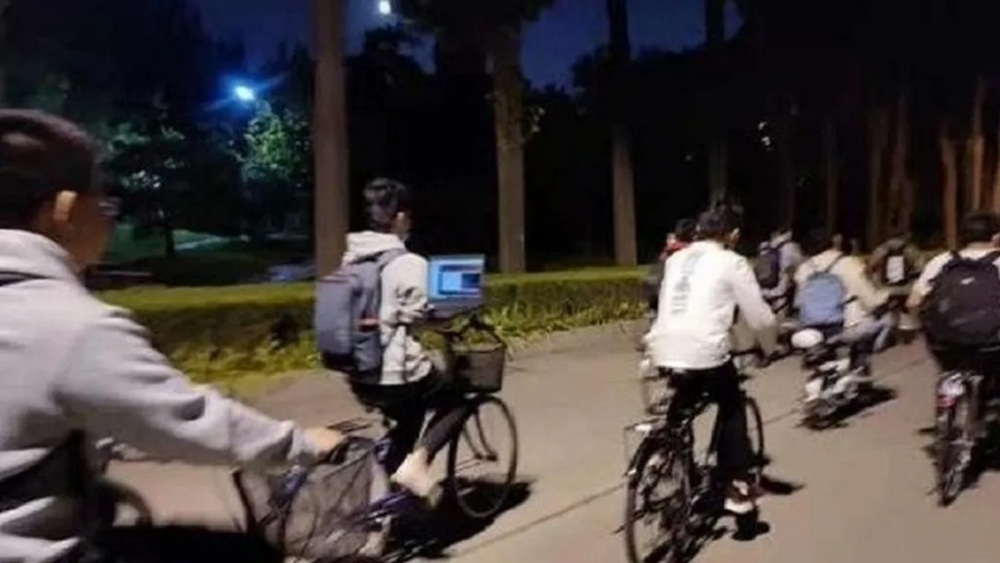
A teen riding a cycle while browsing through his laptop is a stunt one might expect to see on America's Got Talent or Tik Tok.
But five years ago, an image of a Tsinghua University student operating his laptop while pedaling away into the night ignited the Internet and became the face of China's tortured students who were taking hard work to extremes in a bid to get ahead in the rat race.
A rarely used term from the sixties, involution found new meaning in 2020 when the Chinese word neijuan - which loosely translates as curling inward - started trending, especially among Gen Zers who were burning themselves out to cope with the pressures of education and entering the working world.
They vented their frustrations on social media, with memes galore about the cyclist dubbed "Tsinghua's Involuted King." Pictures of students with piles of textbooks went viral, and hashtags on involution on the Twitter-like Weibo drew more than a billion views.
Today, involution continues to plague China across the economy amid oversupply, price wars and market stagnation. Last week, as China's central economic work conference wound up, Beijing's leaders pledged they would crack down on "rat-race" style neijuan by regulating local governments and businesses.
RECORD EXODUS
While our swotting cyclist has long faded into cyberspace, involution in education remains alive and kicking amid the downturn, high unemployment and fewer jobs.
Every year, hundreds of thousands of young mainlanders flee China to get a degree aboard, escaping the dreaded gaokao, as it is called in Chinese - billed as the world's toughest college entrance exam - and what they perceive as pointless competition with little reward.
And they pay through the nose just to do so.
The total cost of an overseas degree in the US, UK, Australia and Canada - four of their favored destinations - ranges from US$109,314 (HK$852,659) to as much as US$165,231, according to HSBC China's website.
That's at least twice the total cost of a degree in the mainland which the bank puts at around US$50,000.
A degree in Hong Kong would similarly set them back by US$139,000, it shows.
The number of Chinese students abroad rose dramatically from 117,300 in 2003 to 703,500 in 2019 before the pandemic broke, according to data from the Ministry of Education.
In a report released in July, the Economic Intelligence Unit, put the growth from 2010 and 2019 at an average annual rate of 9.5 percent before the Covid pandemic sent it plummeting by 36 percent.
But post-pandemic, the numbers have bounced back, with a record 1.03 million mainlanders studying abroad in 2022, the most among any nation, Unesco data shows.
BRIGHT LIGHTS, BIG CITY
Hong Kong's schools and colleges have been growing in popularity among mainlanders.
Fei Nanxi, one among the tens of thousands of mainland students in the city, came to Hong Kong to "get away from involution and find more opportunities."
She 's studying for master's in journalism to boost her prospects, after failing to pass the postgraduate entrance exam and struggling to find work in the mainland.
Fei is not alone in her struggle to find work in China. Youth unemployment hit a record high of 21.3 percent last year in June, leading the National Bureau of Statistics to stop publishing data until January this year, when it tweaked the way it was calculated to exclude students.
Still, the number remains alarmingly high, with unemployment among youth between 16 and 24 stuck above 17 percent since July.
Before joining university, Fei interned at over 10 firms, including tech giant NetEase (9999) and a family office in the city.
She had earlier declined two offers in Beijing, which offered salaries between 7,000 yuan (HK$7,498) and 10,000 yuan a month, slightly below the average monthly income of 10,342 yuan for new graduates in China, according to recruitment platform Liepin (6100).
Fei had also applied for a trainee position at TikTok-owner ByteDance, which required no prior experience and offered a salary between 8,000 and 10,000 yuan a month.
Tech giants like ByteDance are highly sought after by young job seekers, who believe that working at such companies is invaluable for career growth, even if the pay is modest.
But though the position as a content reviewer was not in high demand, Fei found herself "competing with master's and even doctoral graduates from prestigious colleges like New York University."
Fei considers Hong Kong, a city where east meets west, the ideal destination for her to graduate.
"It offers me the chance to explore opportunities in other countries or return to the mainland if things don't go well," she says.
Many more mainlanders are thinking on the same lines, with 56,000 currently studying in Hong Kong, according to China's Education Minister Huai Jinpeng.
In Fei's class, all 20 students hail from the mainland.
The post-pandemic period was a turning point in the lives of young students, she says.
"Before 2019, studying abroad was just one of the many options we had to improve our career prospects. However, life has become harder after Covid, from getting into a top university to finding a job, and this has forced us to look overseas."
And the battle is getting harder: this year's gaokao drew a record 13.4 million students, beating last year's record of 12.9 million.
RED CARPET WELCOME
While other nations clamp down on overseas students, despite them making a significant impact on their economies, Hong Kong has stepped up efforts to become an international hub for higher education.
Quotas for non-local students at publicly-funded universities were doubled to 40 percent from this academic year, with Hong Kong Baptist University reporting that its number of first-year undergrads has tripled.
There were 64,200 non-local students in the city in 2023-24. Of the 23,100 in the eight universities funded by the University Grants Committee, 14,800 were undergrads.
In 2023-24, mainlanders accounted for 26 percent of those pursuing full-time public and self-funded programs in the city. Among UGC-funded ones, 17.6 percent were from the mainland.
Master's student Ma Mengmeng says these numbers are understandable, given China's large population. "My friends who study in the UK or Australia also find most of their classmates are from the mainland," she says.
Gao Qianxi, who completed her master's in film-making, adds that having large numbers of fellow students from China also helps, as they offer each other mutual support.
The city's schools are also witnessing an influx from across the border and there's been a 27 percent rise in the number of mainlanders applying to sit for the Hong Kong Diploma of Secondary Education exam next year.
The DSE is said to be much easier than the gaokao and also offers a better chance of winning a seat in college.
HOME TRUTHS
The influx of students has driven up demand for housing in Hong Kong.
Private residential rents rose by nearly 5.7 percent in the first 10 months of 2024 - just 1.2 percent below the 2019's historic high, driven by mainlanders arriving for the new academic year and foreigners entering under various immigration programs, says Midland's chief analyst Buggle Lau Ka-fai.
Commercial buildings and hotels are being turned into student digs to meet the demand.
In 2022, Wang On Properties (1243) and private equity fund TPG Angelo Gordon purchased the Pentahotel Hong Kong for HK$2 billionand converted it into student housing, offering 720 rooms and 1,450 beds.
Also, property agent Centaline is investing billions in a project that will provide 2,000 beds for students over the next two to three years.
Gao expects professionally-run accommodations will be popular among fellow students who believe there's safety in numbers.
"Right now, it's a matter of luck whether you get a good landlord or roommate," she says.
However, mainlander Tang Shunlei fears the new dorms may be priced out of reach for most students. Similarly, undergrad Jiang Junzhe points out that serviced apartments are five times more expensive than on-campus dorms.
The average price of on-campus dorms starts from HK$16,120 a year.
But for private accommodation, the YOT Hub student hostel in Kowloon City, for instance, offers 80 rooms and 160 beds at rates ranging from HK$4,500 to HK$4,650 a month.
And students who share a flat can pay anything from HK$5,000 to HK$11,000 a month.
Centaline predicts that the number of non-local students in the city's top five universities will exceed 67,900 by 2027-28, but only 17,800 student beds will be available on campus.
A COSTLY AFFAIR
Tuition fees for mainlanders are also significantly high. Fees for popular one-year post-graduate business majors for non-locals reach up to HK$428,000 a year, while science and engineering master's degrees can cost more than HK$214,000.
In contrast, fees for locals doing a master's start from around HK$150,000 a year.
Liu Yueling, who did her master's in journalism, describes her time spent in Hong Kong as more of an experience than an investment. "You can't expect much from a Hong Kong degree but it's worthwhile if you want to explore the city," she says.
OVERSEAS CURBS
While Hong Kong has rolled out the red carpet, mainlanders will find it harder to study in some of their favorite destinations from 2025, which are battening down despite the windfalls they earn from international students, especially the Chinese.
Latest data from NAFSA: Association of International Educators, shows that 1.1 million international students contributed as much as US$43.8 billion to the American economy during the last academic year.
In the UK, a report from analysts London Economics showed they boosted the economy by 42 billion (HK$414.7 billion) in 2021-22.
But the drawbridges are being raised.
In the US, major universities including Cornell University, Princetown University and the University of Pennsylvania have told foreign students who are currently away over the Christmas break to get back to campus before Donald Trump is sworn in as president on January 20, as there's no telling how he may clamp down on student visas.
Australia will limit the number of foreign students in 2025 to 270,000, a 16 percent decrease compared to 2023, in a bid to crack down on record migration that is said to have led to a surge in housing prices.
Chinese students currently make up 22 percent of Australia's international students, and the Mitchell Institute estimates they contribute US$11 billion to the Aussie economy.
Canada will further reduce its cap on foreign students by 10 percent to 437,000 in 2025 and 2026, amid a backlash over soaring housing prices. While their numbers have dipped over the last three years, Chinese students pump an estimated US$5 billion into Canada's economy each year.
In the UK, a British Council report shows that the number of visas issued to Chinese students increased by 5.8 percent in 2023 mainly due to a recovery of outbound students in the first full year after the end of Covid lockdowns.
But the UK is now banning foreign students from bringing their family members with them, in a crackdown on immigration.
Will China's student exodus ease off in the near future?
The EIU believes that China's slowdown, unfavorable demographics and its complex ties with other nations will "significantly affect China's outbound study market, leading to much slower growth."
It also states that while intense competition in university entrance exams has fueled the exodus, China's shrinking population will "ease significantly competition in tertiary education."
But that's of little comfort to Fei and her peers. "A year in Hong Kong won't help us escape involution in the mainland. It's not just about getting an overseas degree. There are far too many of us chasing too few opportunities; China needs to make the cake bigger."