Read More
The Hong Kong Monetary Authority has picked 16 firms to participate in the e-HKD pilot program to explore its potential use in six categories while stressing that it has not yet made a decision on whether and when to introduce the digital currency.
ADVERTISEMENT
SCROLL TO CONTINUE WITH CONTENT
The pilots will take deep dives into cases including full-fledged payments, programmable payments, offline payments, tokenized deposits, settlement of Web3 transactions, and settlement of tokenized assets, the HKMA said yesterday. It aims to share the results with the public in November and to conduct more rounds of pilots in the future.
Some of the proposed cases may involve real transactions with existing payment tools with selected customers to mimic the payment scenarios, the de facto central bank said.
It will look at if there are scenarios where the e-Hong Kong dollar can be applied in the scenarios and if there is a real demand for using it during the trial, the regulator said, adding that the outcomes and insights gained from each pilot would help enrich the HKMA's perspective and refine its approach to the possible implementation of the digital dollar.
The HKMA also emphasized that it is not yet at a point where a firm decision can be made to introduce e-HKD.
Participants in the scheme include the Hongkong and Shanghai Banking Corporation, Standard Chartered Hong Kong, BOC Hong Kong (2388), Hang Seng Bank (0011), Alipay Hong Kong, Visa, Mastercard, and others.
HSBC said it will partner with the Hong Kong University of Science & Technology to develop an e-HKD payment ecosystem at the campus in the coming months, aiming to lower transaction costs and enhance customer experience.
The bank and Hang Seng will collaborate with Visa to explore the feasibility of tokenized deposits. It will also study the viability, key design considerations, and interoperability of commercial bank-backed deposit tokens.
BOCHK plans to use e-HKD to offer prepaid services for retail businesses and customers.
Our Hong Kong Foundation suggests the authorities allow e-HKD to be used for the subscriptions of green bonds and silver bonds when it is launched to increase its popularity.
Other proposed uses include property transactions, merchant reward programs, investment and government grant disbursement.
The pilot is a key component of rail 2 under the HKMA's three-rail approach in paving the way for the possible implementation of e-HKD in the future.
China started its e-yuan trial in cities like Shenzhen and Suzhou in 2019 and has now extended to 26 cities. The digital currency in circulation reached 13.6 billion yuan (HK$15.1 billion) by the end of last year. Changshu in Jiangsu province has even started to use it to pay salaries to civil servants since this month.
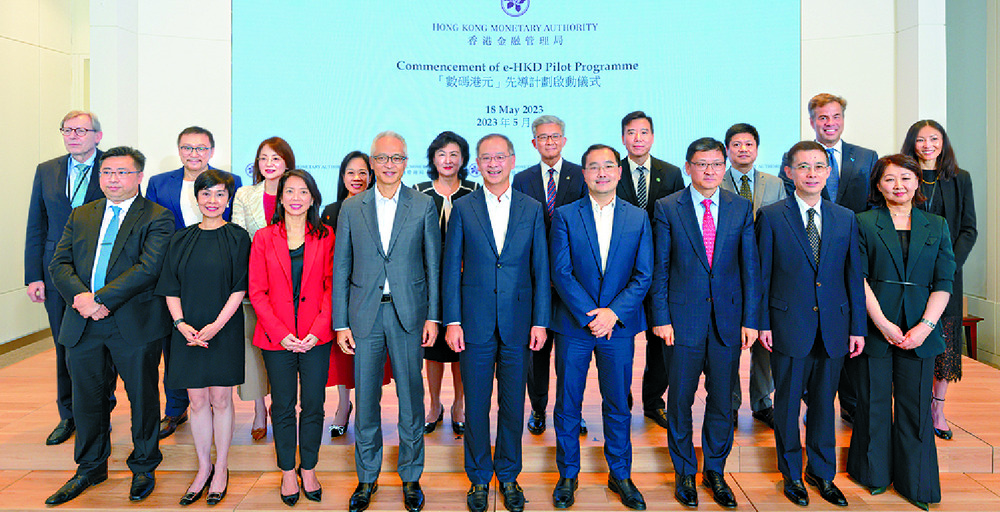
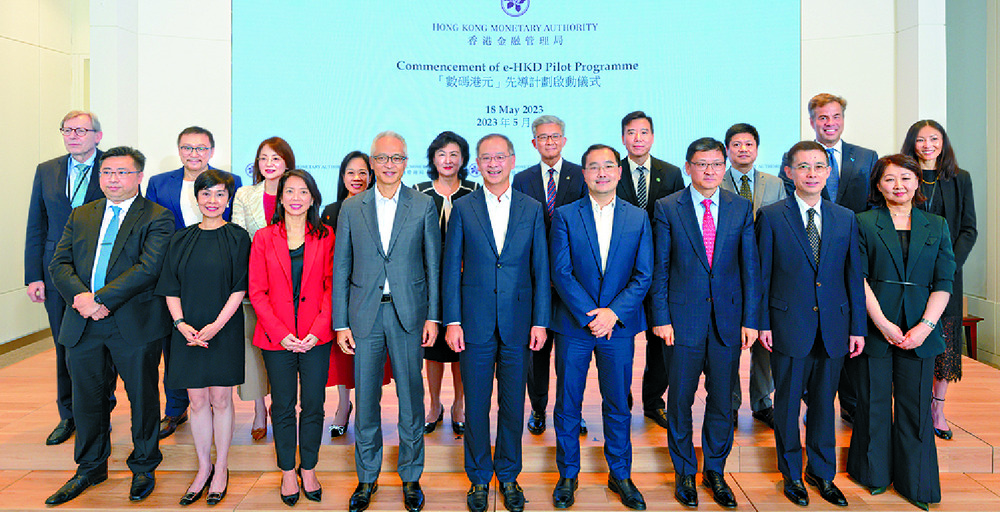
Eddie Yue, center, and other HKMA officials and executives of the participating firms at the launch of the pilot program.