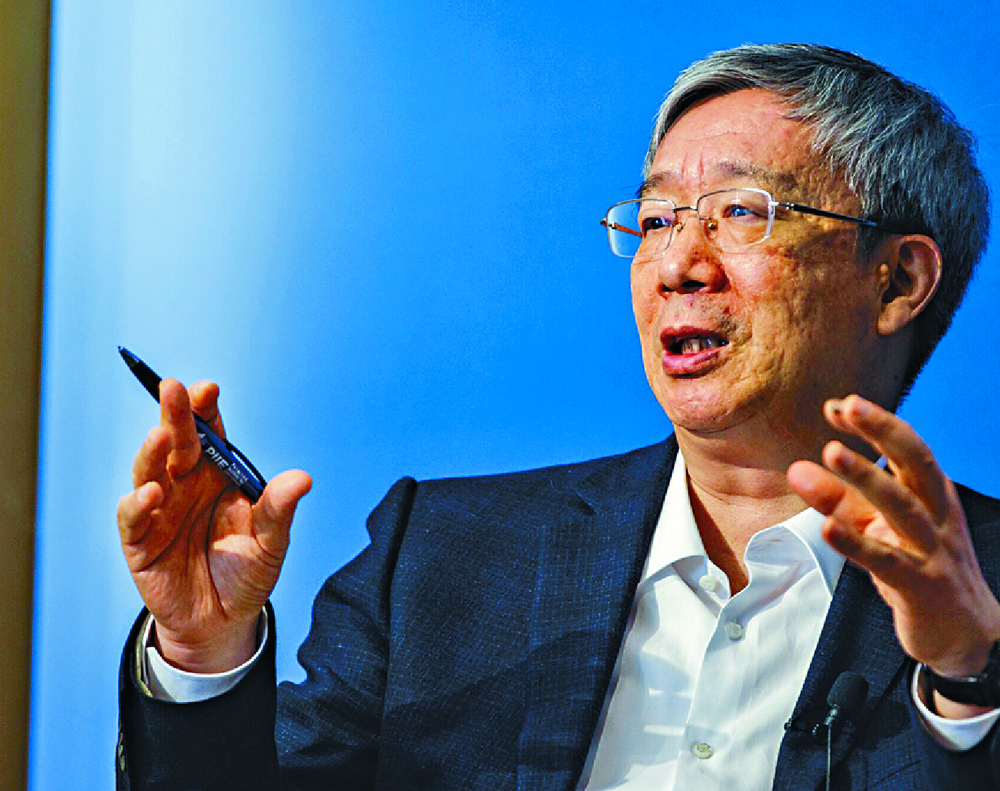
People's Bank of China Governor Yi Gang said that Beijing has largely ended regular foreign-exchange intervention, and pursues a policy aimed at enhancing the ease of use of the yuan for Chinese households.
PBOC officials still "reserve the right" to intervene in the market, Yi said in a speech at the Peterson Institute for International Economics in Washington on Saturday.
"I haven't announced" that there is no intervention, he said.
But he said his own perspective is that history shows that "sooner or later" the market defeats the central bank.
A slide in Yi's presentation at the PIIE showed that "in recent years, PBOC has by and large exited from regular intervention."
In its semiannual foreign-exchange reports, the US Treasury Department has consistently criticized China for a lack of transparency in how the country manages its exchange rate. The latest, in November, highlighted that China is an "outlier" in its lack of disclosure.
Beijing offers limited information on things including even the "policy objectives of its exchange rate management regime," the Treasury said.
"Basically you can still call it a managed, floating regime, but it has to be primarily determined by market," Yi said of China's foreign-exchange policy. "It's still working."
While Yi, in answering questions, said "I don't have a date" for when the yuan could be made freely convertible, the basic policy is to enhance the ease of use of the currency. Yi, who studied and taught economics for years in the US, shared with his audience a personal tale of frustration in a younger age of having to turn to a friend to change yuan into foreign currency.
By contrast, today, Chinese individuals can exchange as much as US$50,000 (HK$390,000) a year into foreign currency, and 99 percent of them don't use up that quota, Yi said. That means the quota isn't imposing a constraint, he said
More broadly, the US-China exchange rate is in "equilibrium," with no sudden, large capital flight, Yi said. He added that China isn't pursuing a capital-account surplus.
In a somewhat technocratic presentation, the PBOC chief - who was unexpectedly reappointed governor in March - said that China's central bank has "twin pillars" of pursuing price and financial stability. In practice, over time, the aim is for the inflation-adjusted interest rate to average slightly below the real economic growth rate.
Meanwhile, Yi met with Indonesia's finance minister Sri Mulyani when he was in Washington to discuss the global economic and financial situation and bilateral financial cooperation.
Yi also met Agustin Carstens, general manager of the Bank for International Settlements, and exchanged views on financial cooperation between the BIS and PBOC.
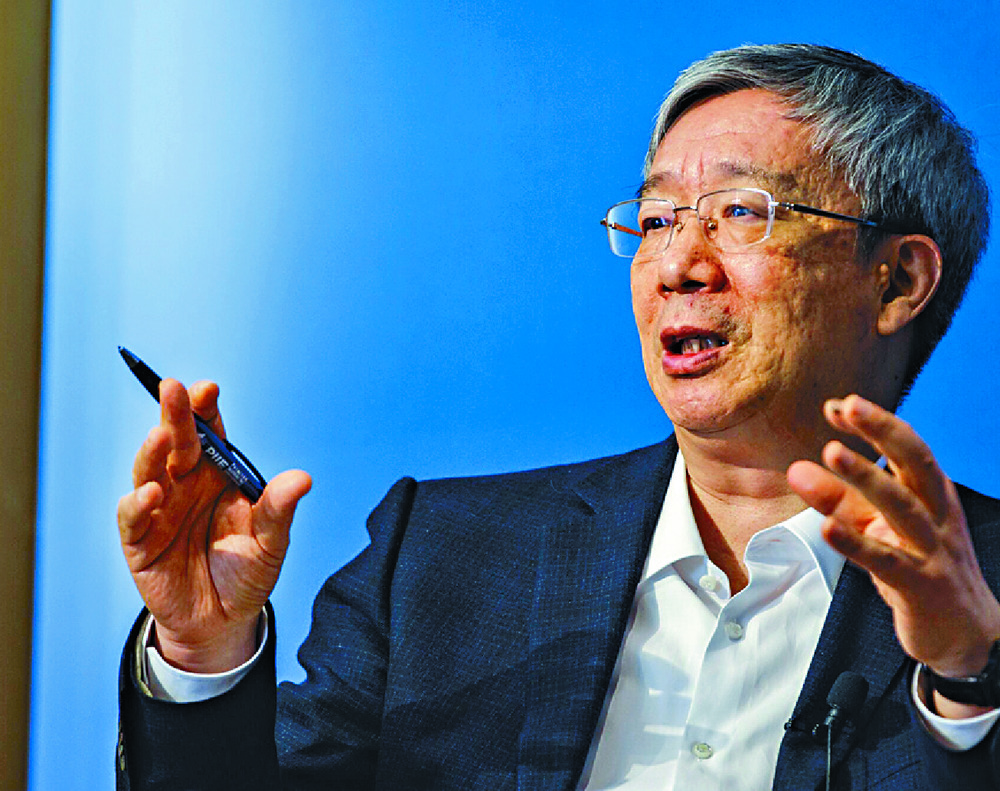
Yi Gang says forex quotas are not constraining people in China. REUTERS