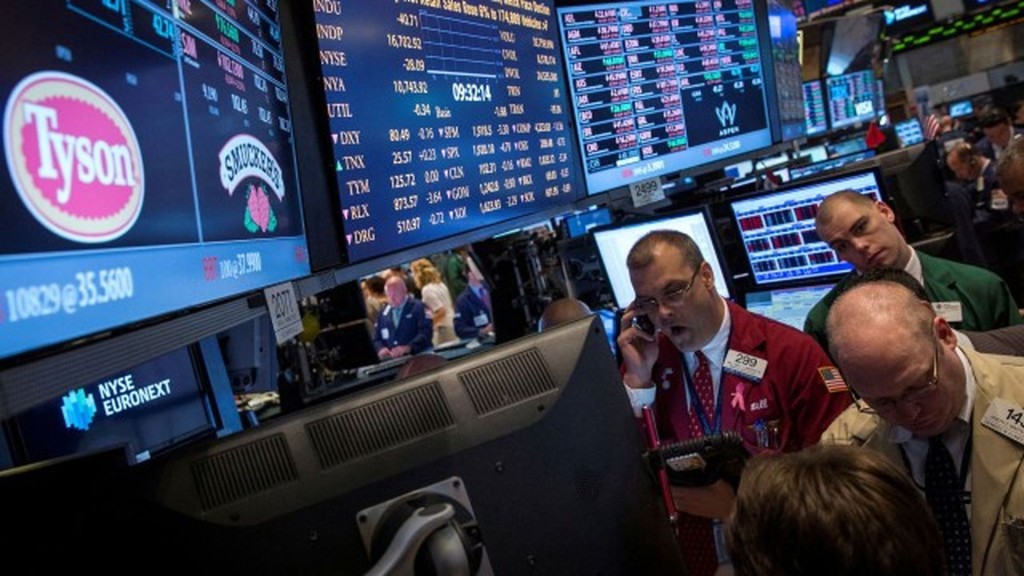
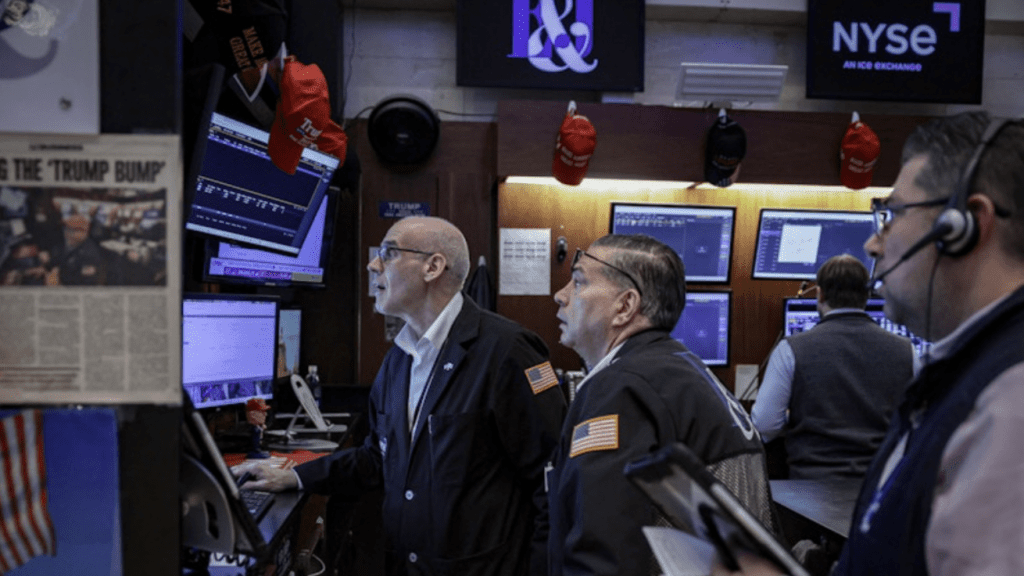
U.S. stocks weakened on Monday, with Wall Street turning the page on a volatile month as a war-related jump in crude prices revived inflation fears and raised the likelihood of tighter monetary policy.
Spiking oil prices dampened investor risk appetite and sent benchmark U.S. Treasury yields higher, as investors processed U.S. Federal Reserve Chair Kevin Warsh's hawkish tone on Friday in his speech at the Jackson Hole Symposium.
Despite the broad sell-off, all three major U.S. stock indexes posted monthly gains. The Nasdaq showed the largest percentage growth for August as the AI trade remained alive, despite recent weakness. The blue-chip Dow nabbed its fifth consecutive monthly advance.
"We heard from Warsh last week, and the odds now favor a rate hike in September," said Peter Tuz, president of Chase Investment Counsel in Charlottesville, Virginia. "Throw that into the mix of continued hostilities in the Middle East.
"And the week before Labor Day, there's a lot of people who are out of the office, so weird things can happen," Tuz added. "There was no reason to come into work today thinking it’s a great day to buy stocks."
Iran's President Masoud Pezeshkian said Tehran is still seeking a negotiated solution to the war, after days of renewed airstrike exchanges and mounting hostilities following U.S. President Donald Trump's implementation of costly economic sanctions.
The protracted impasse and the related closure of the Strait of Hormuz is fueling fears that upward pressure on energy prices could metastasize into broader, systemic inflation that could force the Fed to hike interest rates as soon as next month.
Financial markets are currently pricing in more than a 65% likelihood of the central bank implementing a 25-basis-point rate hike at the conclusion of September's monetary policy meeting, according to CME's FedWatch tool.
"Investors are revisiting some of the comments that Warsh made at Jackson Hole as well and what that may mean for interest rates, what that may mean for inflation," said Paul Nolte, senior wealth advisor & market strategist at Murphy & Sylvest in Elmhurst, Illinois. "If they do not hike rates in September, I think you will see a dramatic reaction in the markets because it's been prepped now for quite some time that they're going to raise rates."
The Dow Jones Industrial Average .DJI fell 374.09 points, or 0.70%, to 53,185.90, the S&P 500 .SPX lost 25.62 points, or 0.33%, to 7,686.14 and the Nasdaq Composite .IXIC lost 31.53 points, or 0.12%, to 26,370.89.
Among the 11 major sectors in the S&P 500, energy shares .SPNY enjoyed the largest percentage gains, with a boost from surging crude prices CLc1, <LCOc1>. Utilities .SPLRCU lagged on the heels of an amendment to a bill in the California senate, which did little to solve grid operators' exposure to wildfire liabilities.
Within the energy space, Halliburton HAL.N and Valero Energy VLO.N both advanced 1.9%. In utilities, California's PG&E PCG.N plunged 20.1%, its largest percentage loss in over six years.
In other movers, GameStop's GME.N shares rose 2.9% after the company said it would pay about 27% of a previously announced $1.4 billion debt exchange through cash on hand instead of issuing new stock, preventing further share dilution.
Declining issues outnumbered advancers by a 1.95-to-1 ratio on the NYSE. There were 112 new highs and 234 new lows on the NYSE.
On the Nasdaq, 1,859 stocks rose and 2,931 fell as declining issues outnumbered advancers by a 1.58-to-1 ratio.
The S&P 500 posted 5 new 52-week highs and 11 new lows while the Nasdaq Composite recorded 40 new highs and 146 new lows.
Volume on U.S. exchanges was 15.65 billion shares, compared with the 15.58 billion average for the full session over the last 20 trading days.
Reuters