Read More
Hong Kong is seeking to reform its initial public offering process to protect the retail investor and attract more listings in the city.
ADVERTISEMENT
SCROLL TO CONTINUE WITH CONTENT
The push comes amid mind-boggling margin loans that have run into hundreds of billions of dollars for some share sales, and disappointing debuts that might have been badly overpriced.
But do the proposals go far enough, and will the crackdown on margin loans and a lower retail cap make the sponsor's work harder?
Currently, IPOs that are highly oversubscribed can allot as much as 50 percent of the shares to retail investors.
But bourse operator Hong Kong Exchange and Clearing now wants to lower it to 20 percent.
Both HKEX and the Securities and Futures Commission, the market's regulator, believe some oversubscriptions have been exaggerated.
This has led to some stocks flopping badly on debut despite the overwhelming response.
But the IPO market involves multiple stakeholders and a balance has to be struck as government and exchange officials work to enhance the market's attraction to investors.
The current practice allowing up to 50 percent of new shares to be clawed back it is less than desirable as recent IPOs involved brokerages offering clients margin financing that beggared belief.
For instance, Chinese toymaker Bloks's IPO last month was reported to have raked it more than HK$833.4 billion through margin loans, with the retail tranche 5,724 times oversubscribed.
Such levels of margin financing is just extraordinary, more than enough to inflate public subscription to a level unrealistically high to activate the clawback.
One of the outcomes has been that these heavily oversubscribed shares were vulnerable to being priced well above what they were worth.
SFC chief executive Julia Leung Fung-yee has expressed concern about heavily oversubscribed deals and the regulator is now reviewing eight brokerages and their margin financing practices.
The 20 percent cap would allow a higher stake in the hands of the institutional investors who, given their bargaining power and expertise, can help optimize the price of a company.
As a result, volatility as witnessed in overpriced IPOs after listing can be reduced.
In this respect, it is true that retail investors can see their interest better protected.
Nonetheless, the proposal is bound to harm smaller brokers. Futu Securities, for instance, was reported to be opposed to the proposal, saying this would greatly limit the chance of retail investors securing a fair share in popular listings.
Another point to consider is that IPO sponsors will be under pressure to sell more to institutional investors.
One of the most eye-catching upcoming listings is China's leading battery manufacturer Contemporary Amperex Technology, whose expected US$5 billion (HK$39 billion) listing could be the city's biggest IPO in more than four years, a gold mine no brokerage would miss.
But IPO sponsors and book runners claim that this would mean an increased stake in the institutional tranche, making it more difficult for them to look for investors amid a sluggish market. On the other hand, this would also mean more profit for them should more shares be sold in a bullish market.
The clawback cap would make popular new listings more attractive to institutional investors at the expense of retail investors.
HKEX is also looking at allowing the offer price to fall below the indicated price range if the market is sluggish so that the sale does not fold up - also a way to avoid trading below the offer price. However, a company will not allow to raise price higher than the indicated range even it is highly oversubscribed, unlike markets in the United States which have a more sophisticated mechanism.
Caution is needed to strike a balance so that the outcome would be acceptable to all.
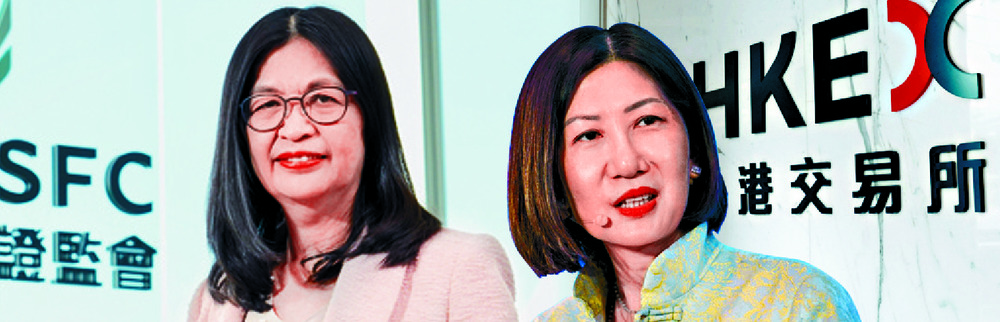
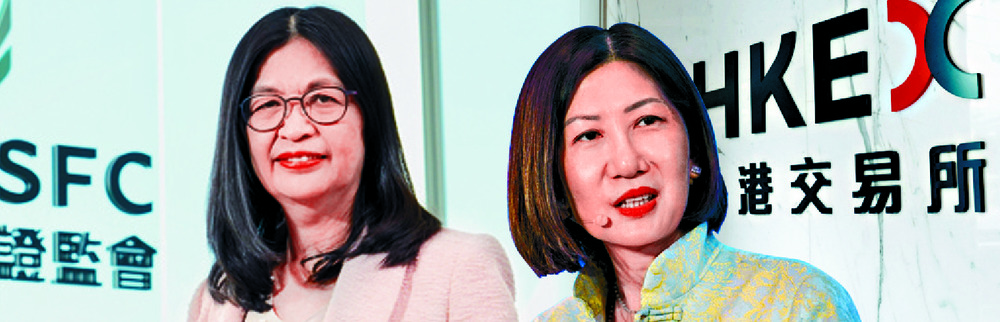
SFC head Julia Leung, near right, and Hong Kong Exchanges and Clearing chief executive Bonnie Chan. STANDARD GRAPHIC