Read More
If anyone had assumed that Donald Trump was merely bluffing when he threatened to impose tariffs on Canada and Mexico - while generally accepting that he would be tough on China - it is now perfectly clear that this was just wishful thinking.Trump could not afford to step back as, if he had done so, his dire warnings would have lost their effect and he would no longer be taken seriously.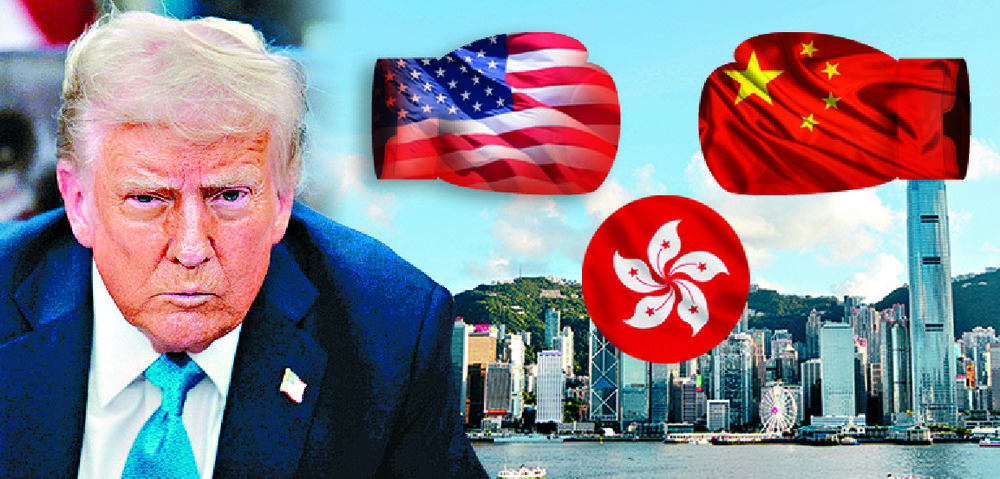
From today, goods from America's neighboring countries will be slapped with 25 percent tariffs.
ADVERTISEMENT
SCROLL TO CONTINUE WITH CONTENT
That would have undermined his attempt to reshape the global order, with America at its center.
Losing no time, Trump has signaled the European Union as his next target.
The big stick wielded against Mexico and Canada should end any illusion the Europeans may still have that they will be spared.
Brussels officials will have to grapple with the stark reality of what Trump 2.0 is all about.The Financial Times branded what is happening as "the absurdity of Donald Trump's trade war," while a Bloomberg columnist tried to count "how stupid this trade war is." The Wall Street Journal, meanwhile, called the tariffs "the dumbest trade war in history."
Yes, it could be argued that Trump is absurd - but it is also difficult to imagine how such a supposedly "dumb" person could have achieved so much in Manhattan and other major cities before running for - and twice winning - the top office.Trump is trying to redefine the existing international order, including US relationships with trading partners not limited to countries considered rivals - like China - but also traditional allies like Europe as well as Canada and Mexico.
It is also increasingly clear that trade balance - or imbalance - is the major score card he will use in defining this relationship.So, in a nutshell, as markets grapple with yesterday's volatility due to Trump's trade war, nations seeing sizeable surplus from trading with the US may follow Canada, Mexico, China and the EU to be included in the tariff list.
The world economy is entering a new period of uncertainty as authorities scramble to understand a new variable that has immense implications.This was felt strongly in financial markets yesterday as investors dashed for safety by buying US dollars, selling stocks and expressing worries about inflation after the tariffs kicked in.
Financial professionals, including Hong Kong Monetary Authority chief executive Eddie Yue Wai-man, are fully aware of the increased likelihood of the US Federal Reserve postponing an interest-rate reduction in light of the uncertainty over a strong US dollar and the inflationary pressure that Americans will face as a result.This is believed to be the "short-term pain" that Trump referred to yesterday - but only time will tell whether or not the pain will indeed be short term.
It would be unrealistic to think Hong Kong will be minimally impacted even though the tariffs are aimed at Canada, Mexico and China for now and the EU in the near future.What is going on bodes ill for Hong Kong since interest rates are expected to stay high for a longer period than anticipated.
This is most unwelcome as real estate developers and companies are under pressure to refinance debts because of a devaluation in collateral and slow turnover.Buckle up as Trump's tariff bandwagon is set into motion and picks up speed.Donald Trump's
25 percent tariffs on Canada and Mexico kick in from today.