






Read More







Tuen Mun beach drowning claims life of husband 5 days after wife
13-08-2026 01:04 HKT
HK swaps scorching sun for a rainy week, possible typhoon ahead
12-08-2026 15:08 HKT


Hong Kong's current drive to expand its global media footprint is often framed as a novel policy response to shifting geopolitical dynamics, yet it represents the revival and modernization of a deep-seated historical legacy. When The Standard – originally launched as the Hong Kong Tiger Standard in 1949 – was founded by Aw Boon Haw, it was built on an inherently cross-border vision. Aw, the overseas Chinese entrepreneur behind the Tiger Balm empire, operated seamlessly across Singapore, Malaya, and Hong Kong. His media network, spanning Sing Tao and Sin Chew Jit Poh, pioneered a commercial and cultural information corridor linking Southern China with Southeast Asia. Today, as Hong Kong media organizations establish new strategic alliances across the Association of Southeast Asian Nations and Central Asia, they are updating this historical blueprint for the modern digital era, proving that the city's narrative power has always depended on regional connectivity.
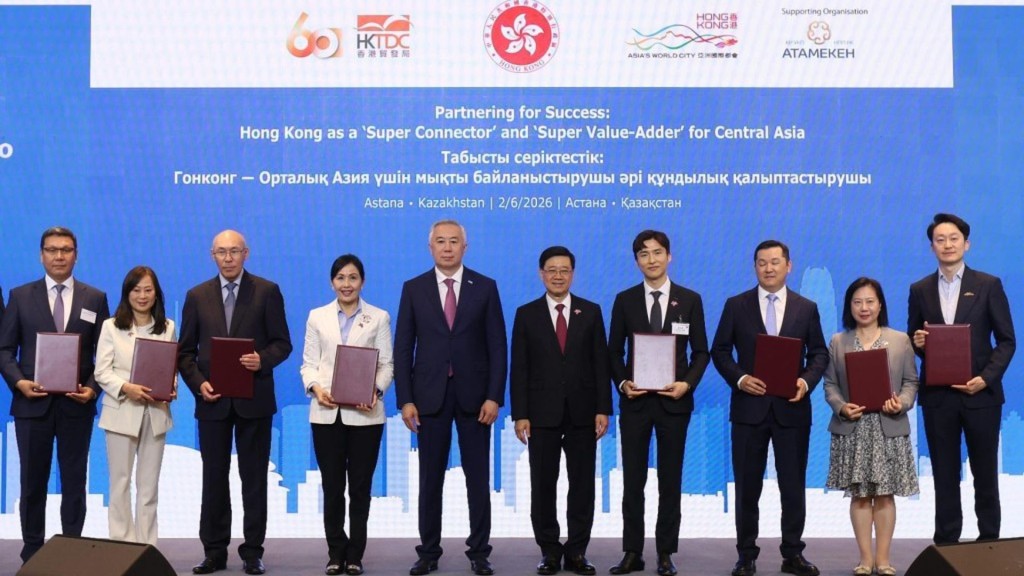
The future strategy of Hong Kong media outreach moves well beyond traditional regional comfort zones, executing a deliberate, market-driven push into emerging Eurasian economic corridors. A prime example unfolded during Chief Executive John Lee Ka-chiu's official delegation to Kazakhstan and Uzbekistan, where local media institutions actively accompanied business leaders to cement cross-border ties. Beyond high-level commercial and technology pacts, The Standard executed memorandums of understanding in Astana and Tashkent, mirroring broader efforts to connect Hong Kong directly with Central Asian nodes.
In emerging markets across Central Asia and the Middle East, global news coverage is often mediated by Western news wires that provide limited, secondary insights into local industrial transformation. By establishing direct, hub-to-hub information pipelines with municipal governments, trade bodies, and technology hubs, Hong Kong media outlets position themselves as primary intelligence conduits. They provide corporate leaders, investors, and policymakers in both the Guangdong-Hong Kong-Macao Greater Bay Area and Eurasia with real-time, high-fidelity reporting on regulatory changes, logistics links, capital flows, and joint-venture opportunities.
To convert these regional outposts into enduring soft power, Hong Kong's media strategy relies on three concrete operational pillars. First, institutional embeddedness ensures that outlets forge reciprocal, long-term partnerships with localized press bodies and municipal organizations. These frameworks facilitate talent exchanges, joint reporting, and shared understanding of complex regional regulations rather than unilateral broadcasting. Second, technological scalability plays a pivotal role in maintaining newsroom agility. By integrating generative artificial intelligence workflows, automated translation engines, and multi-platform publishing systems, Hong Kong newsrooms can efficiently localize economic coverage into multiple languages across diverse audience nodes without incurring unsustainable operational overhead. Third, effective media outreach operates in direct synergy with capital flows, aligning coverage with Hong Kong's core strengths in green finance, intellectual property arbitration, and technology commercialization.
Ultimately, building sustainable soft power – fulfilling the broader objective of "telling Hong Kong stories well" – cannot be achieved through defensive messaging. It demands institutional rigor, technological adaptation, and strategic alignment with global trade realities. By leveraging their rich historical ties to Southeast Asia while aggressively establishing new footholds across Eurasia before the rest of the world, Hong Kong's media organizations are building an autonomous, credible information network. In doing so, they ensure that the city asserts itself not merely as a global financial transit point, but as an indispensable, trusted narrative bridge on the global stage.