Read More












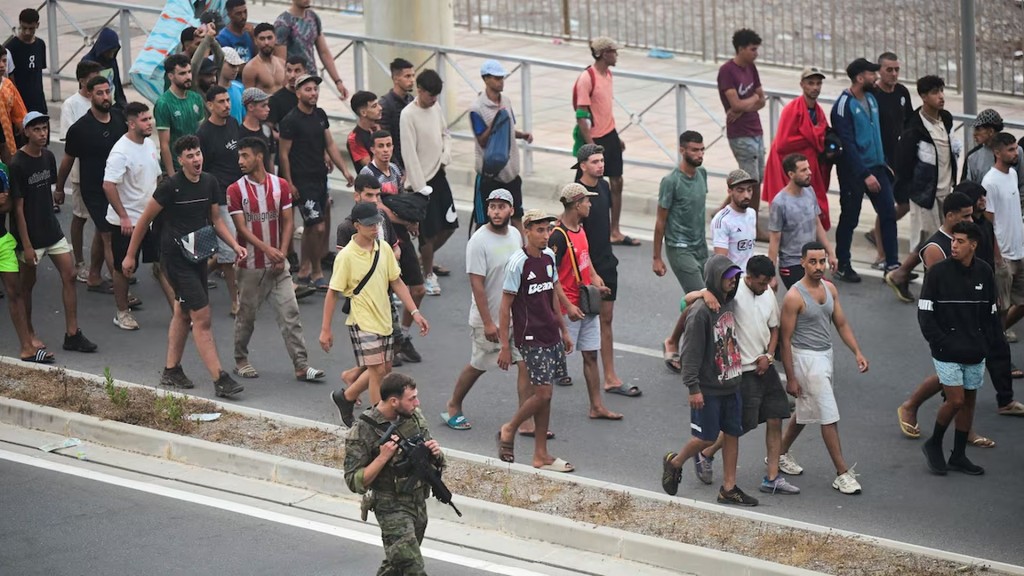
Exploited by human trafficking networks leveraging a narrow Spanish Supreme Court ruling on maritime deportations and amplifying viral social media disinformation, an extraordinary wave of roughly 60,000 migrants attempted to cross from Morocco into the Spanish enclave of Ceuta, leaving at least 88 dead in the border surge. While Madrid rapidly restored order through emergency returns and floating physical barriers, the crisis exposed deep structural vulnerabilities at the edge of the continent.
Echoing the historic 2015 migration shock – when over 1.3 million asylum seekers entered the European Union following post-Arab Spring instability – the tragedy in Ceuta has reignited intense political polarization, fueling anti-immigration populism, and threatening the fragile cohesion of the European bloc.
At the core of this sudden influx was a coordinated online campaign. Traffickers exploited false rumors regarding the Spanish government's proposed initiative to regularize up to 500,000 undocumented migrants, effectively transforming viral social media posts into physical border rushes.
The resulting political fallout spread rapidly across Europe, prompting neighboring states like Italy to temporarily suspend borderless travel under the Schengen Agreement to prevent secondary migrant movements. This unilateral policy friction exposes how localized enforcement gaps quickly cascade into broader European political strain.
This systemic breakdown underscores why the EU must move beyond reactionary crisis management toward a cohesive, centralized doctrine. Individual member states cannot implement unilateral legal amnesties or regularizations without inadvertently creating powerful "pull factors" that destabilize the entire borderless bloc.
Achieving long-term stability requires the full, uncompromising execution of the EU Pact on Migration and Asylum. This framework mandates rapid, standardized border screening at entry points, fast-tracking legitimate asylum claims, and accelerating the immediate deportation of irregular economic migrants who fail to meet international protection standards.
Securing Europe's perimeter demands institutional evolution and deeper operational integration. Center-right European leaders are increasingly demanding that Frontex, formally known as the European Border and Coast Guard Agency, be granted direct command authority and physical enforcement powers to lock down external frontiers when national border authorities are overwhelmed.
Yet physical barriers and law enforcement alone cannot mitigate a digital threat. To counter the weaponization of social media algorithms by human smugglers, Brussels must heavily invest in targeted "pre-bunking" campaigns and fact-checking infrastructure across North and West Africa to dismantle dangerous narratives before vulnerable people risk their lives.
Ultimately, managing migration requires addressing its root causes across the Mediterranean. Europe cannot treat border security in isolation from the political instability and economic hardship driving trans-African migration.
Brussels must deepen strategic cooperation with key transit nations – such as Morocco, Tunisia, and Libya – through intelligence sharing, joint maritime patrols, and targeted financial development assistance aimed at stabilizing local economies. Given Europe's severe demographic decline and persistent labor shortages in high-performing economic sectors, the continent will continue to require foreign labor.
However, replacing chaotic, illegal border surges with a controlled, institutionalized, and law-bound migration framework remains the only viable path forward for the European project.