
Read More
The murder case of 18-year-old Polish-British student Henry Nowak in Southampton has sparked nationwide outrage and intense political debate in the UK, reflecting that racial tensions in the country have reached a boiling point.
ADVERTISEMENT
SCROLL TO CONTINUE WITH CONTENT
Nowak’s death
Nowak was stabbed with an eight-inch Indo-Persian dagger by 23-year-old British-born Vickrum Digwa, a man of Sikh background, after a quarrel. The dagger was initially mistaken for a kirpan, a small Sikh ceremonial knife deemed a religious item. This led to a backlash against British laws which allow people to carry large blades for religious or cultural reasons.
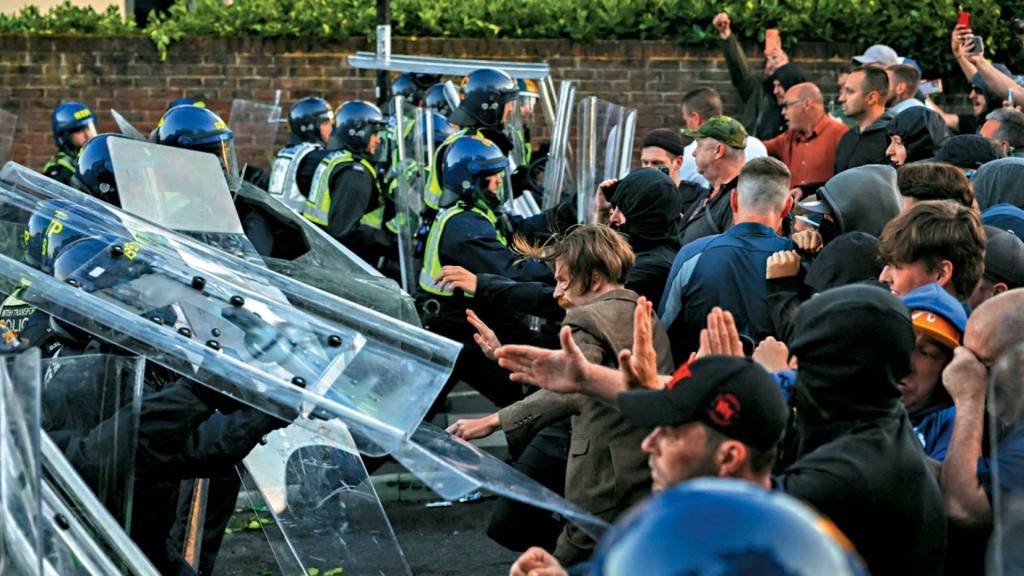
Critics and political figures have also raised concerns over so-called “two-tier” policing. They claim officers prioritized hate-crime allegations over saving a dying victim. This is because police believed Digwa’s false claim that Nowak had racially abused him, and they handcuffed and arrested Nowak while he lay dying on the ground after being stabbed. The case has since been heavily politicized. Angry protests outside Southampton Central Police Station erupted into violent riots, leaving 11 police officers and a police dog injured. The case also led to a heated debate in Parliament, with Reform UK leader Nigel Farage calling out “two-tier” policing and Prime Minister Keir Starmer hitting back by accusing Farage of inciting rage.
The case has also been internationalized, as US right-wing figures such as vice president JD Vance and Elon Musk used the tragedy to galvanize anti-immigration sentiment in Europe. Vance said Nowak’s death showed how European elites failed to stand their ground against a “mass invasion of migrants”, while Musk criticized Western authorities for caring more about accusations of racism than murder.
The UK’s problems
Nowak’s death has exposed long-standing, underlying racial tensions, as immigrants from vastly different ethnic, cultural and religious backgrounds have caused friction within the social fabric of the previously largely homogenous European nation-states.
The conflicts have been further intensified by the long economic decline of the West, which has never fully recovered from the economic stagnation of the global financial crisis in 2008.
The economic downturn has since been worsened by the Covid pandemic, the subsequent chronic inflation crisis, as well as rising prices due to the global oil shock caused by the US-Israel war with Iran.
The UK finds itself in a much worse situation than its Western European counterparts. This is due to its much further deindustrialization under the Thatcher era, the self-inflicted, disastrous austerity policies after the 2008 recession which killed economic growth under the Cameron era, and, more importantly, the catastrophic decision to leave the European Union through a carelessly conducted referendum.
The rise of the anti-immigration Reform Party, which has topped the voting intention polls for more than a year, is a direct response to the accumulation of failed policies by both the Conservative and Labour parties in the past decades. The party looks for easy targets and scapegoats to blame.
Britons, however, must realize that blaming immigrants or different ethnic groups who have lived in the UK for generations will not solve the deep-rooted problems facing the country. What the country needs is a complete rectification of its short-sighted, short-term profit-driven, and emotion-driven politics.