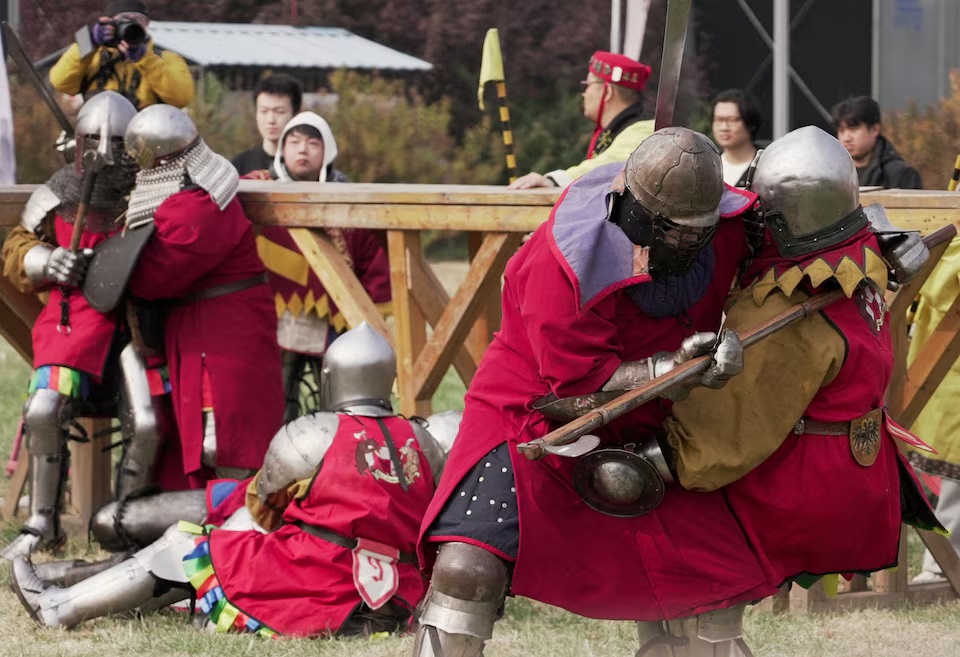
Around 80 fighters in steel armour stormed across a Beijing park on an otherwise quiet Saturday, their swords, axes and polearms clanging against shields in a spectacle that echoed a medieval battlefield.
Among them was Guan Xiaoqi, nicknamed "Postman", who traded his desk job for 30 kilograms (66 lb) of steel armour and a passion for participating in full-contact medieval combat tournaments.
Now a martial arts coach, Guan is helping to grow China's medieval combat community, hoping to turn the niche pastime into a widely recognised sport.
"It's a sport that can bring excitement and passion to young people," he said, adding that participation had risen steadily in recent years.
Guan said the physically demanding combat tests not only strength but mental endurance, with competitors battling in heavy armour until their opponents are brought down.
"We're all equally exhausted. If you think you're the most tired, you're probably just making excuses for yourself. If others can persevere, so can I," said participant Zhang Chao, describing the sense of achievement that comes with every contest.
Known internationally as "buhurt", the modern sport emerged from medieval re-enactment communities in Eastern Europe and has grown into a global competition circuit. It arrived in China about a decade ago and has since attracted a small but growing following in cities such as Beijing and Shanghai.
With overseas teams joining the competition, Guan said the event in Beijing, Shanhe Cup Full-Contact Armored Combat Open, offered Chinese athletes a rare opportunity to measure themselves against more experienced opponents from countries includingItaly, Russia and France.
While acknowledging the Chinese athletes' shortcomings, he remained optimistic about the country's progress.
"Now that we've seen where we fall short, we know what we need to work on to close the gap," he said.
Reuters