When Mughal emperor Shah Jahan built his royal palace in Delhi, which opened in 1648, he inscribed the words of Persian poet Amir Khusrau (1253-1325 AD) on the wall of the Diwan-i-Khas or the hall of special audience in the Lal-Qila, now known as the Red Fort.
While Khusrau’s famed quote – “If there is Paradise on earth, it is this, it is this, it is this” - is said to have been inspired by the beauty of Kashmir, the emperor is thought to have used it to describe the grandeur and majesty of the Mughal empire, which experienced a golden age of art and spanned the reigns of its three greatest emperors: Akbar (1556-1605), his son Jahangir (1605-1627), and his grandson Shah Jahan (1628-1658), who built of the majestic Taj Mahal.
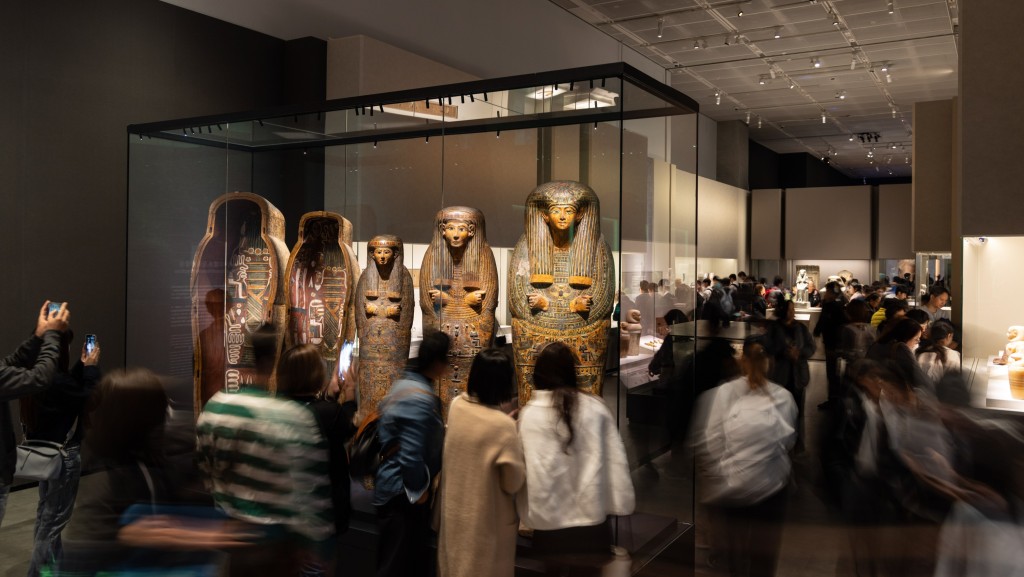
Works of art from this 7 golden age are now enthralling lovers at an exhibition titled “The Hong Kong Jockey Club Series: Treasures of the Mughal Court from the Victoria and Albert Museum,” underway at the Hong Kong Palace Museum.
The Mughal dynasty was founded by Babur, a Central Asian ruler, in the 16th century after conquering northern India from his base in Kabul. Yet the empire’s start was fragile and his successor Humayun was exiled to Persia. There, Humayun absorbed the sophisticated Persian culture that would define his dynasty’s aesthetic.
Inspired by the Persian charbagh, a quadrilateral garden with four parts, where flowers symbolized love and spirituality -- Mughal art embraced floral motifs. Gardens were recognized as earthly paradises and the Taj Mahal, the majestic mausoleum that Shah Jahan built for his favorite wife, Mumtaz Mahal, who died in 1631 while giving birth to their 14th child – stands as the ultimate embodiment.
The three emperors were great patrons of culture. Akbar’s support for religious tolerance and arts attracted master craftsmen from across India, Iran, Central Asia and even Europe who created a vibrant blend of styles and techniques in Mughal culture.
The Mudhals were so influenced by Persian culture that they used Persian as their imperial language and this connection is epitomized by a manuscript of the Gulistan in Akbar’s reign – a masterpiece copied by renowned calligrapher Muhammad Husayn, known as the “Golden Pen,” and adorned with gold illumination and elaborate patterns.
Miniature paintings, a Persian art form also flourished during Akbar ‘s time.
His official chronicle, the Akbarnama, is richly illustrated with these paintings, vividly narrating history and forging a unique Mughal style, while retaining Persian traditions like ornate floral borders.
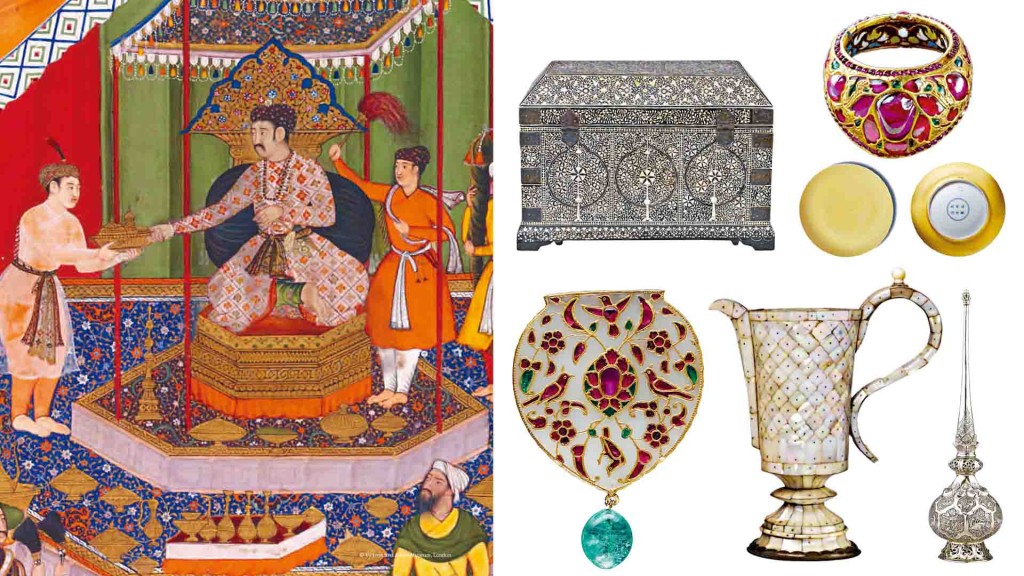
Exquisite miniature paintings on show include a double-page illustration of Akbar receiving Iranian ambassador Sayyid Beg in 1562. The left part shows court servants preparing a feast with Chinese blue-and-white, celadon and white-glazed porcelain, reflecting the Mughal appreciation for Ming dynasty wares.
Arts under Jahangir blend naturalism with Persian styles, as seen in paintings of exotic animals such as the North American turkey, which shows borrowings from Chinese animal paintings as well.
In the late 16th century, goldsmiths fused Indian kundan techniques with European enameling. A pendant on show, believed to
have been worn by Jahangir, features hoopoes which represented Solomon’s wisdom in Persian culture. The piece is exceptionally detailed, with the birds’ eyes made of tiny emeralds set in kundan.
The Mughal court drew inspiration from China and Jahangir’s wine cup reflects the impact of China’s design. The dark green jade of this cup follows the tradition of Central Asian Timurid jades, while the bird-shaped handle is inspired by Chinese jade cups, which often featured dragon handles.
The other highlight is a yellow-glazed porcelain dish, whose color was exclusive to Chinese emperors. It was likely a Ming gift to Iran before joining Jahangir’s collection, as indicated by its Ming reign mark and Persian inscriptions.
Mughal art continuing to resonate today and to showcase this, HKPM features a mural by a Hong Kong artists’ collective led by Stanley Siu Kwok-kin. Inspired by Mughal artefacts, they combined art and architectural elements from the Mughal court and Hong Kong with shared or similar aesthetics and symbols, paying homage to these treasures.
The exhibition runs until February 23 next year, with tickets priced at HK$150 for adults and HK$75 for concessions.