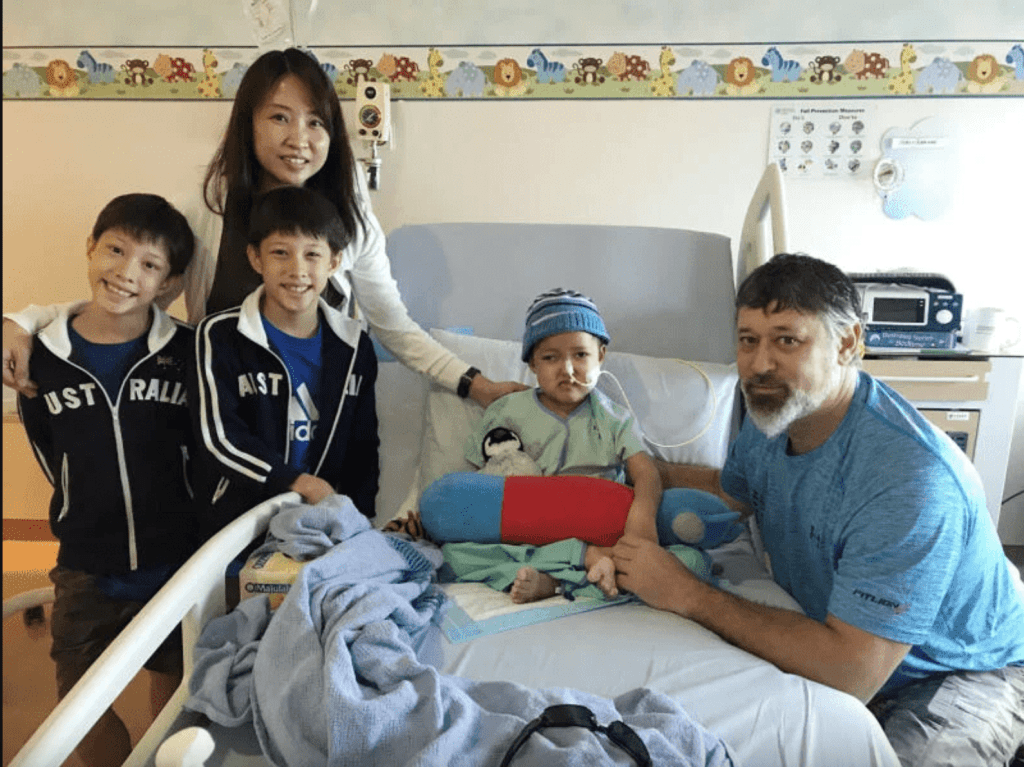
No one feels more heartache than parents when a child falls ill. A 13-year-old boy from Singapore was diagnosed with a brain tumor at the tender age of 4. After enduring brain surgery, 33 rounds of radiotherapy, four rounds of chemotherapy, and a stem cell transplant, he lost the ability to speak, eat, and walk, with his cognitive abilities regressing to that of a 2-year-old. Yet, with his family's unwavering support, he has risen from paralysis to stand once again.
An Active Boy Stripped of Movement and Speech
Singapore media Shin Min Daily News reports that in 2017, 4-year-old Toby Hine was diagnosed with medulloblastoma, a malignant brain tumor common in children. Toby's mother, Cai Huizhen, recalled her son before the illness: "Before surgery, he was just like any other 4-year-old—smart, lively, loved singing, dancing, playing with Lego, and running around with our dog." From the moment of diagnosis, the family's life was irrevocably changed.
The entire family was devastated upon learning their child had cancer. Knowing she couldn't afford to break down, Cai sought help from friends and consulted various doctors. "I often hide and cry for a few minutes, sometimes just for a few seconds," she shared. After wiping away her tears, she would continue caring for her family as if nothing were wrong, her tone calm yet resolute.
Enduring 33 Radiotherapy Sessions, 4 Rounds of Chemo, and a Stem Cell Transplant
Toby underwent 8 months of grueling treatment in the hospital, including 33 sessions of radiotherapy, 4 rounds of powerful chemotherapy, and a tandem stem cell transplant. He finally completed his treatment course in early 2018. However, discharge marked the beginning of another battle. After brain surgery, Toby developed posterior fossa syndrome, severely impairing his speech, leaving him unable to eat, walk, and entirely dependent on others for care. "He could barely move and was confined to his bed."
Learning to Survive, One Step at a Time
It took Toby a year to relearn how to eat and two years to stand again. "We made him practice standing every day and trained his swallowing step by step—starting with water, then pureed food, and slowly progressing to solids. It was like raising a baby all over again," Cai said. While some physical abilities gradually returned, Toby's cognitive and language skills have yet to show significant improvement. He remains unable to speak, and his behavioral development is impeded at the 2-year-old stage.
Currently, Toby attends a special education school every morning and receives home-based therapy twice a week, using games to enhance his motor skills and concentration. On this seemingly endless rehabilitation journey, Cai credits her family as her greatest support. "My husband, two older sons, and my parents—they are the pillars that keep me going." Toby's two older brothers have cared for him since childhood, never shying away from cleaning up his vomit or feces. Now 18, they still play with him, accompanying his growth in the simplest, most genuine way.
What Causes Brain Tumors and What Are the Types?
According to Hong Kong's Hospital Authority, the brain consists of the cerebrum, cerebellum, and brainstem. The cerebrum acts as the body's command center, with each hemisphere divided into lobes (frontal, parietal, temporal, occipital) controlling different functions. When local brain tissue undergoes abnormal cell division and proliferation, a mass can form—either benign or malignant (commonly referred to as brain cancer).
- Benign tumors grow slowly, rarely spread, and generally pose little threat.
- Malignant tumors grow rapidly, invade healthy brain tissue, affecting brain and bodily functions, and can be life-threatening.
Brain tumors are also classified as primary or metastatic:
- Primary Brain Tumors: Originate and grow in the brain itself. They can be benign or malignant and are usually named after the cells where they originate. Common types include gliomas (e.g., astrocytoma).
- Metastatic Brain Tumors:
- Local spread: Malignant tumors spread from nearby areas, commonly seen with nasopharyngeal cancer.
- Distant spread: Cancer cells travel through the bloodstream to the brain, forming one or more tumors, often from lung or breast cancer. These can be discovered long after the primary tumor is treated; 15% of patients have no prior cancer history.
The exact causes of brain tumors remain unknown, but risk factors may include:
- Age: Risk increases for those over 40, though some tumors (like medulloblastoma) occur almost exclusively in children.
- Gender: Males have a slightly higher incidence.
- Genetics: Family history of glioma.
- Chemical Exposure: Occupational exposure to radiation, formaldehyde, vinyl chloride, or acrylonitrile.