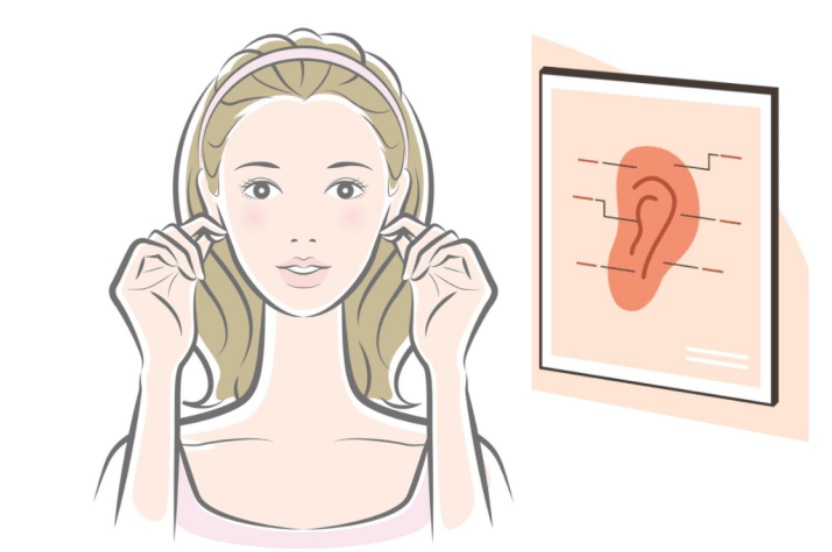
An expert shares a set of "1-minute ear exercises" involving simple pressure on multiple ear acupoints, which can achieve benefits like lowering blood pressure, boosting immunity, and relieving shoulder/neck pain and back pain. So, how should one press these ear points most effectively?
According to a report by Kaigo Post Seven, Japanese nurse and foot reflexology expert Ichino Saori shares a "1-minute ear massage technique." No tools or force are needed; just use your fingers to gently massage for one minute to achieve effects like lowering blood pressure and increasing immunity.
8 Ear Massage Techniques
1. Immunity-Boosting Ear Point
Relaxes the entire ear and warms the whole body, which can strengthen the immune system. This point stimulates the "Adrenal Gland" to secrete hormones, regulating blood pressure, blood sugar, water-salt balance, and promoting metabolism.
- Corresponding Area: Adrenal Gland
- Steps:
- Pinch the inner and outer sides of the indicated "Adrenal Gland" area with your index finger and thumb.
- Gently squeeze and press in a circular motion.
2. Shoulder & Neck Pain Relief Ear Points
Stiff neck and shoulder pain can sometimes originate from more distant areas like the wrists or arms. These two points (the helix and earlobe) stimulate the "Upper Limb Reflex Area," which includes the shoulders, upper arms, and wrists.
- Corresponding Area 1: Shoulder, Upper Arm, Wrist (Helix)
- Steps: Pinch the inner and outer sides of the helix with your thumb and index finger. Gently knead from bottom to top to release adhesions between skin and cartilage.
- Corresponding Area 2: Head (Earlobe)
- Steps: Pinch the inner and outer sides of the earlobe with your thumb and index finger. Gently knead.
3. Back Pain Relief Ear Point
Targets back pain caused by prolonged sitting and lack of exercise. Relaxes the cervical spine, sacrum, and coccyx, promotes blood flow to lower back muscles, and sends signals to restore elasticity. Recommended for morning massage while still in bed.
- Corresponding Area: Cervical Spine, Sacrum, Coccyx
- Steps: Use your thumb to push, press, and knead upward along the indicated concave blue area.
4. Migraine Relief Ear Point
The inner ear (eardrum, semicircular canals) is sensitive to weather and diet, which can trigger migraines, or they may be caused by cerebral vasodilation or overactive parasympathetic nerves. Requires strong stimulation of the sympathetic nerve for 10 seconds to constrict cerebral blood vessels. Perform on both ears.
- Corresponding Area: Sympathetic Nerve (indentation at the start of the helix)
- Steps: Pinch the inner and outer sides of the indicated "indentation at the start of the helix" firmly with your thumb and index finger. Apply maximum pressure for 10 seconds.
5. High Blood Pressure Regulation Ear Points
The ear has many nerves that influence blood pressure regulation. Individuals with high blood pressure are encouraged to perform ear massage more often. For those aiming to lower blood pressure, use gentle pressure to relax the "Blood Pressure Point" and the "Head" ear point.
- Corresponding Area 1: Blood Pressure Point (indicated concave area)
- Steps: Pinch the inner and outer sides of the concave area with your thumb and index finger. Knead slowly with light pressure to release adhesions between skin and cartilage.
- Corresponding Area 2: Head (Earlobe)
- Steps: Pinch the inner and outer sides of the earlobe with your thumb and index finger. Gently knead.
6. Improved Frequent Urination Ear Point
Applying stronger stimulation to the bladder and kidney reflex areas can help restore contraction strength and internal balance. Also effective for cystitis. Recommended for those with concerns: perform once daily on both ears.
- Corresponding Area: Bladder, Kidneys
- Steps: Press each reflex area toward the nose bridge (skull side) with your index finger. Knead in a circular motion.
7. Improved Constipation Ear Point
For constipation unresponsive to exercise, addressing cold body constitution, or dietary fiber supplements, strong stimulation of the large and small intestine reflex areas is needed. For stress-related constipation, relaxing the ears can also help ease the mind.
- Corresponding Area: Large Intestine, Small Intestine
- Steps: Press downward on the indicated concave area with your index finger. Knead in a circular motion.
8. Eye Strain Relief Ear Point
Stimulating the eye reflex area for those who overuse their eyes can promote the generation of quality tear film. Additionally, individuals with ear piercings should maintain cleanliness, as dirt can worsen eye strain, dryness, or affect vision.
- Corresponding Area: Eyes
- Steps: Pinch the inner and outer sides of the indicated area with your thumb and index finger. Gently knead to relax.
Limit to 1 Minute per Session; Use Tissue Paper to Gauge Pressure
She reminds that because ear acupoints are close to the brain, to avoid over-stimulation or damaging blood vessels and nerves, it's advised not to massage for more than 1 minute per session. Regarding pressure, use mainly gentle pressure, reserving stronger pressure only for migraine, frequent urination, and constipation points. A reference standard for pressure is as follows:
- Gentle Pressure: Imagine using your thumb and index finger to separate a double-layer tissue into two single layers.
- Strong Pressure: Imagine the force used to roll a piece of tissue paper into a paper cord.