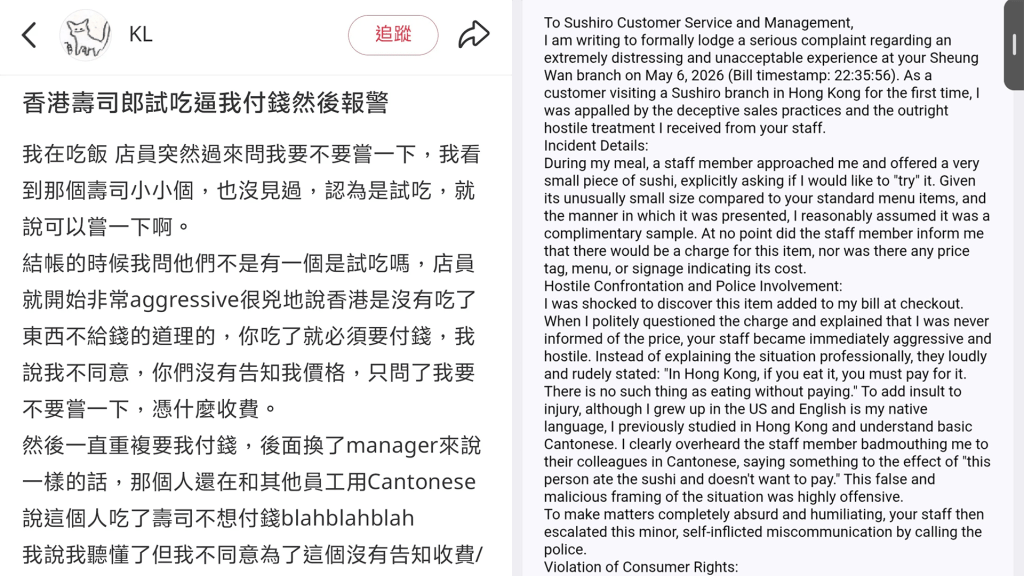
A customer complaint posted on social media has gone viral after a dining experience at Japanese sushi chain Sushiro in Hong Kong escalated into a payment dispute — and eventually a police call.
The diner said a staff member approached her during the meal and casually asked whether she wanted to “try” a small, unfamiliar-looking sushi item. She said she interpreted it as a complimentary tasting due to its size and the absence of any visible price label, and therefore agreed.
The misunderstanding only surfaced at checkout, when the item appeared on the bill. The customer questioned the charge, insisting she had not been informed that the item was payable and had only been offered a “try.” Staff, however, allegedly responded that there is “no such thing as eating without paying in Hong Kong,” and insisted that payment must be made.
According to the post, the situation escalated as both staff and a manager reiterated the same position, while the customer maintained that the pricing had not been clearly communicated. She also claimed staff discussed the incident in Cantonese, describing her as refusing to pay for food she had already eaten.
Police were eventually called to mediate the dispute. Officers reportedly told both parties they could not compel the restaurant to waive the charge, but advised the customer that she could file a complaint with the Consumer Council Hong Kong.
The customer also raised a possible language barrier, saying she communicated mainly in English while staff responded in Cantonese. She described the disputed item as a small rice-based piece topped with minced ingredients, saying it was not immediately recognizable as a standard sushi order.
The incident has sparked wider debate online over whether phrases like “want to try this?” should be more clearly distinguished from complimentary tastings.
Some users said such phrasing is commonly understood in Hong Kong as a sales recommendation rather than a free sample, while others argued that without explicit pricing, misunderstandings are more likely — particularly for tourists or non-Cantonese speakers.
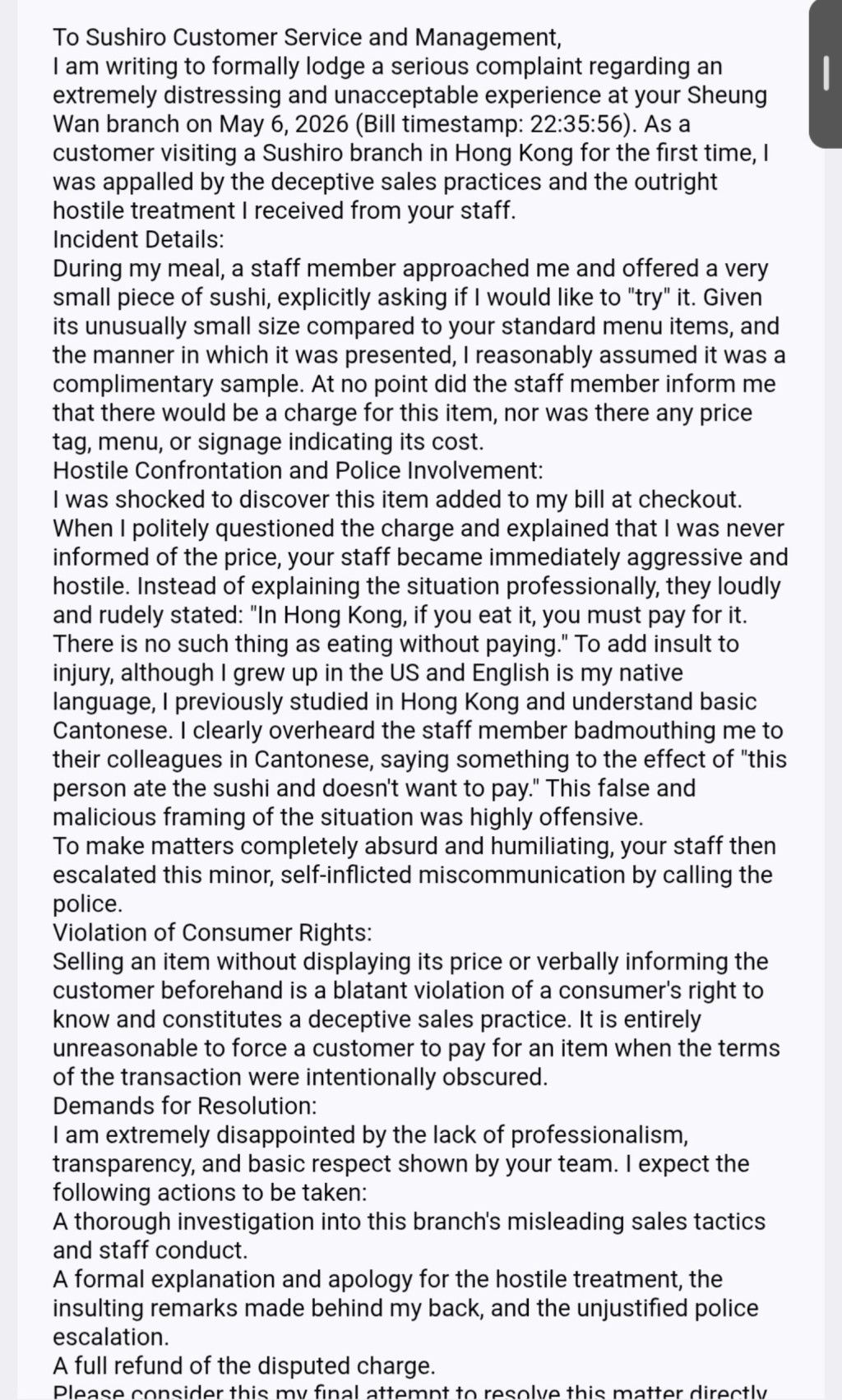
Screenshot of the customer’s complaint email submitted after the dispute. Source: Online