Read More






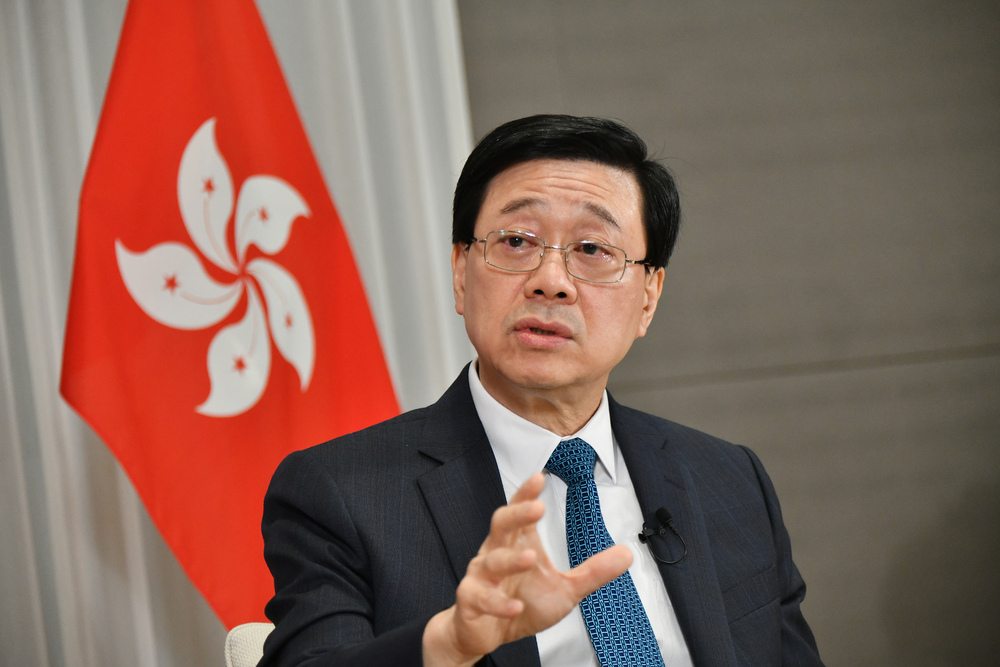
Chief Executive John Lee Ka-chiu says he needs to be cautious when enacting Article 23 as Hong Kong still faces external and internal risks and "soft resistance" activities exist.
In an interview with Sing Tao Group, Lee says it is not surprising that some foreign countries are using destructive means to keep the city from succeeding.
The government is preparing for the legislation of Basic Law Article 23 in a pragmatic manner and has finished the first phase of research, he said.
"Completing the legislation of Article 23 is not simply finishing a task. We need a suitable and effective law to safeguard national security. If we only want to get the job done and ignore certain risks, we will fail our constitutional duty, Hong Kong and our country," he said.
Lee said the government has to conduct thorough research on national security laws in overseas common law jurisdictions so that Article 23 will not have to be amended in the future.
For example, the United Kingdom has adopted harsh reinforcement measures to ban national security defendants from leaving certain places, he said, adding Hong Kong should refer to the effective measures abroad.
Hong Kong is still facing "soft resistance" and has yet to reach stability, Lee said.
"Some countries are targeting and suppressing the development of our country with unfriendly measures. We need to understand that under this kind of international environment it is not surprising that these countries are trying to keep us from succeeding," he said.
Hong Kong should stay vigilant for external destructive measures as well as internal risks, including action to sabotage the organ-donation scheme
"Some actions that do not violate the law are also destructive, including false and negative information that leads to social instability and lets people think irrationally. Those are also meant to prevent our success and we have to stay vigilant." But Lee said there is no need to enact a false-information law at this stage.
The mainland has amended its anti-espionage law to cover cyberattacks against national institutions and defecting to a spying entity or its surrogate. But Lee said spying activities can be regulated through Article 23 as it covers leaking national secrets.
"Spies and regular people can be at risk of leaking national secrets I think it's more important to target certain behavior rather than groups of people."
It is the country's job to safeguard national security and allow Hong Kong to enact Article 23 to criminalize seven types of offenses - including treason, secession, sedition, subversion against the central government and theft of state secrets. It shows the government's trust in the SAR.
Lee stressed the government will not draft a new law against fake news at the moment.
"The government has to consider the actual needs for the legislation before doing the work. Hong Kong is a free society after all and my opinion is we'd better not legislate if we don't have to do so. We won't treat a common cold using measures that treat cancer. That's not appropriate."
Lee said Hong Kong has advantages as it is an international hub for finance, trading, aviation and innovation as well as a center for arts and culture.
"Without innovation and technology, there is no future. Innovation can make Hong Kong stronger as it can also attract top and intelligent talent for the city, which will further boost the city's competitiveness.
"As an arts and culture exchange center, we can also attract talent from various races, religions and countries. I think Hong Kong's ability to bring together talent is better than any other place in the world."
Hong Kong has gone through the transition from chaos to order, and the city should work harder to advance from stability to prosperity, Lee said.
The city aims to attract 35,000 talent a year and has received 80,000 applications in the first five months - of which 60,000 have been approved.
Lee said the government does not aim to establish authority by taking back 32 hectares of land at Fanling golf course by September, adding he will only make decisions based on the city's overall benefits.
The government has to do everything with justification, he said.
Lee said the city already had gone through heated discussions before the previous government decided to take back the land and his government has to follow procedures.
He reassured that the authorities are willing to offer the land to the Hong Kong Golf Club to host international golfing events.