Read More
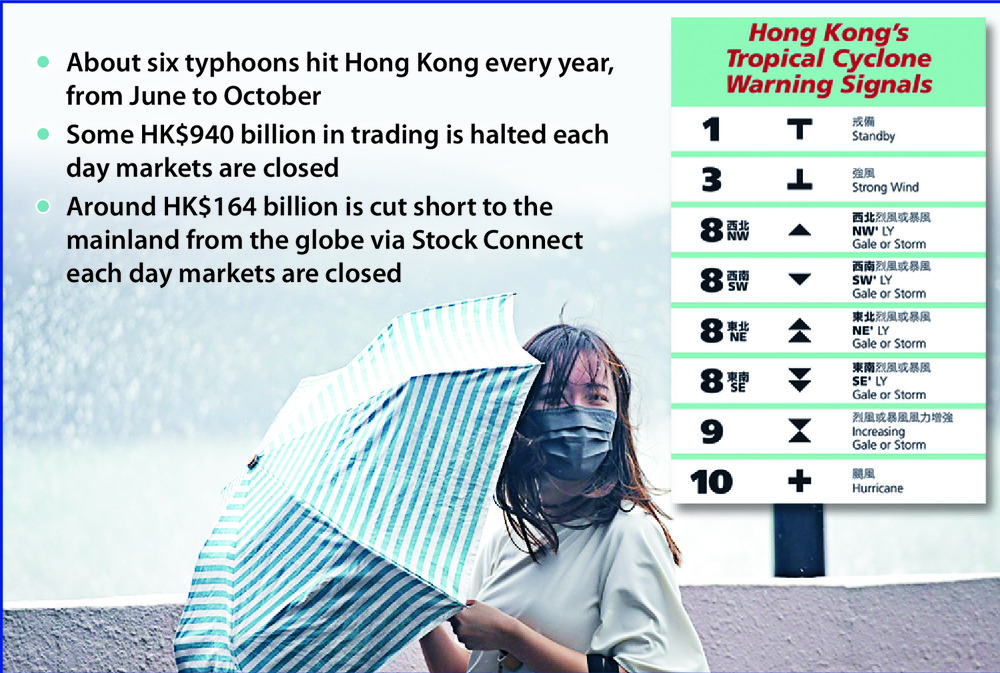
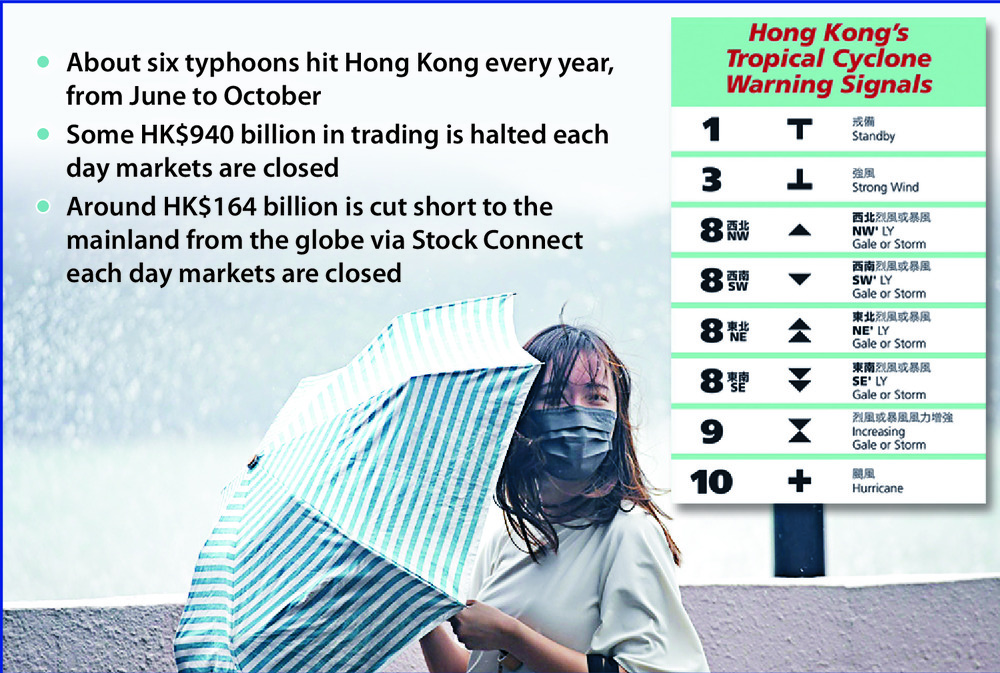
Hong Kong may backtrack on a plan to keep its stock market open during the most adverse weather and may stop trading when signals 9 and 10 - the highest typhoon alerts - are hoisted.
ADVERTISEMENT
SCROLL TO CONTINUE WITH CONTENT
But the stepback may be anyway unnecessary for traders who have digitalized their practice, top brokers say.
The only market in the world to close during bad weather, Hong Kong had earlier said it would continue trading even if typhoon signals 8 or above are hoisted, after a related consultation ended in January.
The Securities and Futures Commission said it backed the proposal to maintain trading during storms.
Last month, the government announced that HKEX aims to implement the reform by the middle of this year, with Secretary for Financial Services and the Treasury Christopher Hui Ching-yu emphasizing that Hong Kong is "catching up" with other peers.
But yesterday, the city was said to considering scaling back the plan, with one option that trading will still be suspended under typhoon signals 9 and 10, as small securities firms have "more trouble continuing operations during severe weather," Bloomberg reported.
Hong Kong Exchanges and Clearing said the bourse is reviewing feedback about the consultation.
Hong Kong's market turnover has been picking up in recent trading days, from the lows of less than HK$80 billion to over HK$100 billion. Phillip Securities (Hong Kong), one of the leading brokerages in the city, thinks the industry is basically ready for mobile operations as many practices have been digitalized over the course of the three-year pandemic.
As work can be done remotely, there is no huge difference between signals 8, 9 or 10 for the brokers, manager Jasper Chan Ying-kit said. But he added Phillip would support any decision made by the bourse.
Leung Wing-mo, former assistant director of the observatory, said HKEX's operations may not be impacted if most deals are conducted digitally, although he stressed he does not know the nitty-gritty of HKEX's operations.
Leung said signal 8 is for warning of gale or storm force winds, while signal 9, for increasing gale or storm force winds, is often a precursor for signal 10 when Hong Kong will be affected by hurricane force winds, the most devastating in the existing wind scale.
The meteorological expert added that wind and the associated adverse weather like heavy rain under every signal could be life-threatening, as Hong Kong once recorded injuries and even fatalities under signals 1 and 3 - the lowest in the tropical cyclone warning system.
Francis Kwok Sze-chi, vice chairman of the Hong Kong Institute of Financial Analysts and Professional Commentators, insisted the tradition of suspending trade under signal 8 or above should be kept to protect the life of employees in brokerages, as not all work can be completed at home.
Kwok said small firms may receive no or a few trade requests during stormy days, so it may be not worthwhile for them to continue business at the expense of staff safety.
The concerns about personal safety and transportation during adverse weather are often cited by those who disagreed with the reform.
The Hong Kong Securities & Futures Professionals Association, representing individual practitioners in small and medium-sized institutions, also argued it is impossible for hundreds of firms to upgrade their digital systems in the short run.
Since 2018, the Hong Kong market has been suspended 11 times due to the adverse weather regime.
Last year recorded four trading halts, including one during signal 10 in September, in which the HKEX was estimated to have lost HK$377.9 billion in turnover and about HK$42.7 million in trading fees.
themis.qi@singtaonewscorp.com
Editorial: Don't back off from typhoon-trading move