Read More
A crossdisciplinary science center has been established at Baptist University to discover the relationship between human brain activity and art and culture, as well as study therapeutic possibilities for brain diseases.
ADVERTISEMENT
SCROLL TO CONTINUE WITH CONTENT
Life Science Imaging Centre, which opened yesterday, is equipped with four kinds of advanced facilities to image brain structures, detect brain activities and study individual differences in brain functions.
It will be open to professors and students from different disciplines at the university, including physics, creative arts, Chinese medicine, social science and business to explore how the brain works in real-life scenarios.
For example, an electroencephalogram that can detect and measure neural activity from the scalp has been used to study connections between brain activity, human gut microbiome and food preferences.
Assistant physics professor Tian Liang, who led the experiment, said the study will help shape a healthy diet for people and promote a more sustainable diet.
"Many [people] suffer from obesity due to unhealthy diets, and imbalanced food consumption by humans has also hurt the environment," Tian said.
He used the equipment to detect brain activity when people are choosing foods.
"We can analyze the brain activity between when they see food and when they make a decision to eat it or not," Tian said, "if we know how the brain affects food preferences, we can know how to change it."
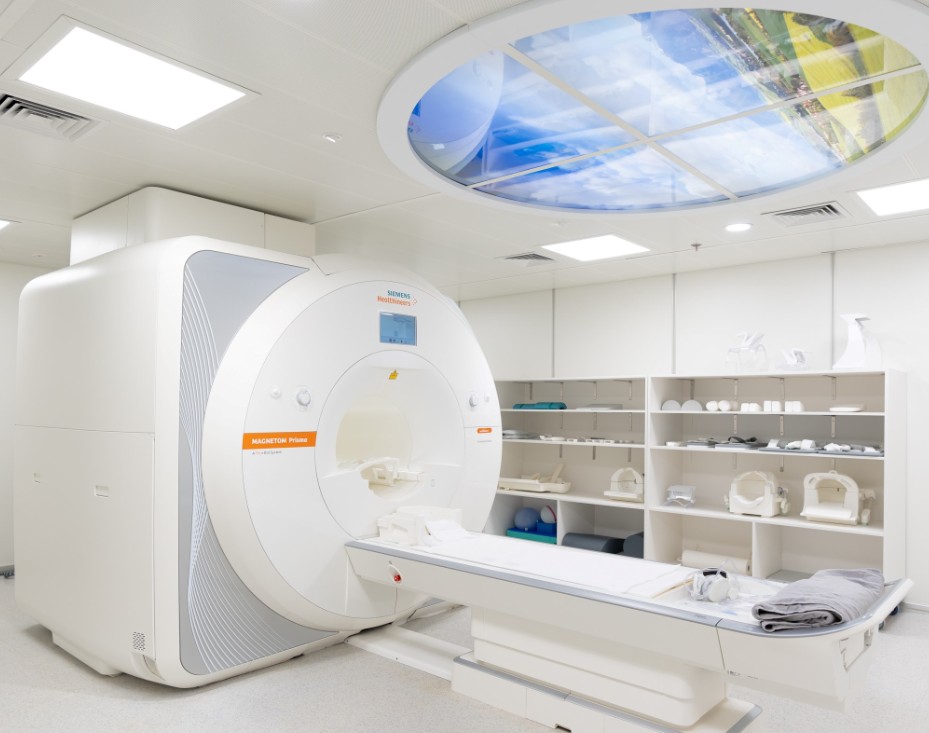
Other technologies at the center, including a magnetic resonance scanner, functional near-infrared spectroscopy and a transcranial magnetic stimulation system, have also been used to study the neural architecture of leadership, collaborative inter-brain behaviors in music ensembles and brain network strategies for treating brain diseases.
University president and vice-chancellor Alexander Wai Ping-kong said crossdisciplinary education and research are vital in this fast-paced era.
"The center is not just a research hub," he said, "it's the university's neural network, sparking connections across disciplines from neuroscience to arts, social sciences and humanities, science and technology, and beyond."
Wai hopes the crossdisciplinary cooperation that the center fosters can equip students with broader horizons.
University council and court chairman Clement Chen Cheng-jen said the center will be a "catalyst" for the institution to promote academic and research excellence.
"It is more important now than ever that our academics across disciplines work together to achieve greater synergy," he said.
The center was built under a 10-year plan, announced in 2017, to transform the university into a leading research-led liberal arts university in Asia.
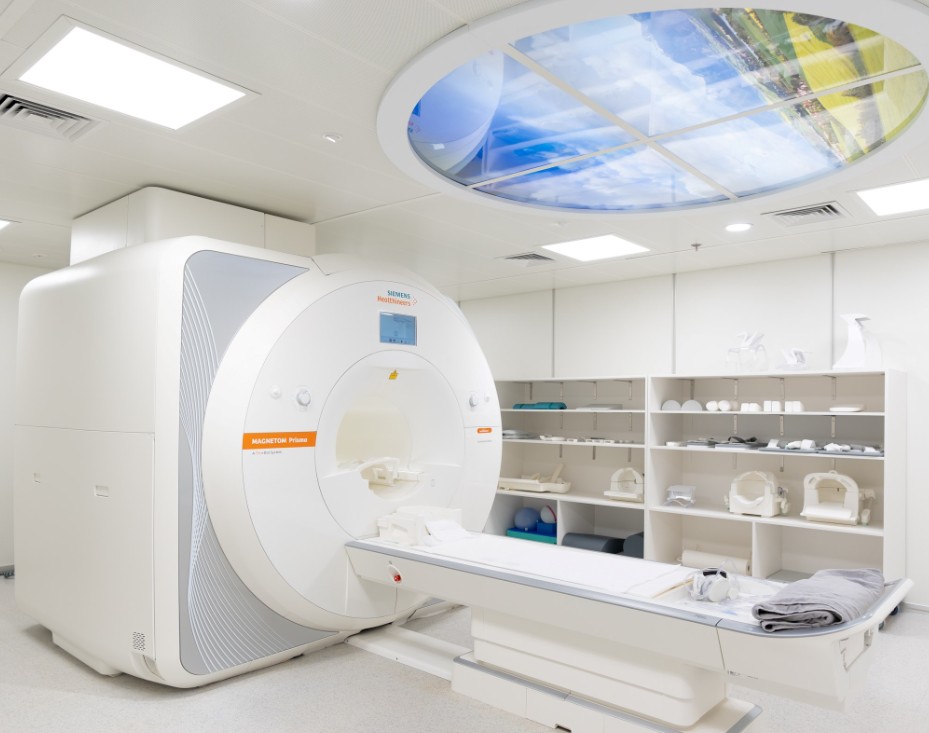
Alexander Wai and Clement Chen, center left, at the opening ceremony. Above: an MRI scanner.