Read More






Night Recap - September 15, 2026
9 hours ago



Seven arrested over Kwai Chung illegal gathering
14-09-2026 12:33 HKT
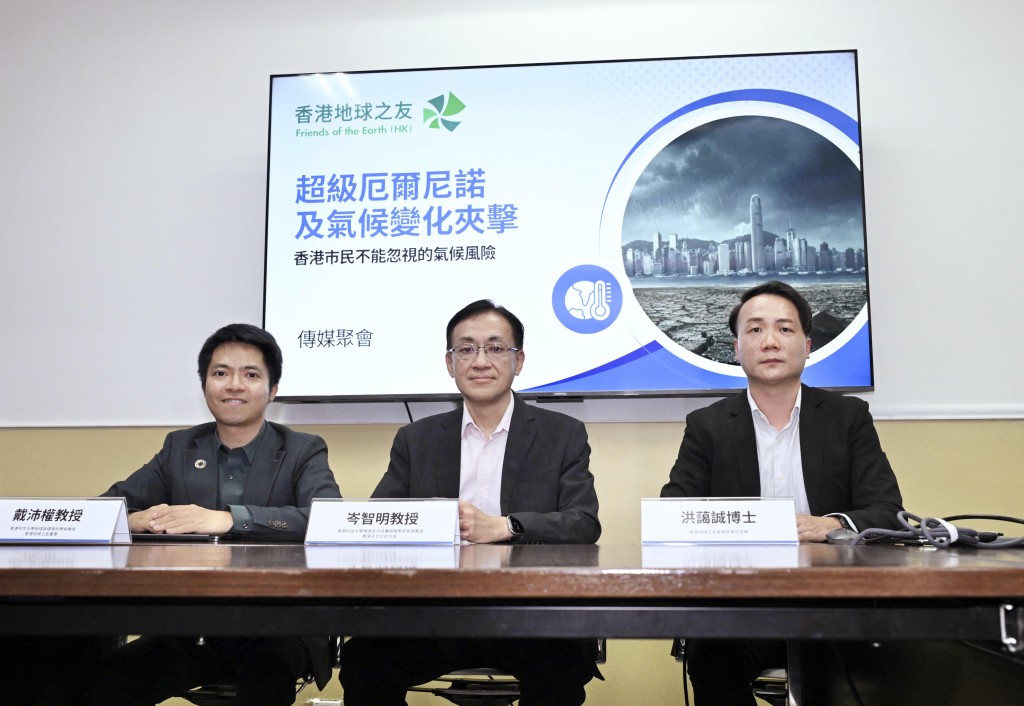
Hong Kong may face punishing heat waves and more extreme rainfall even as fewer typhoons approach the city, with environmental group Friends of the Earth (HK) warning yesterday that a possible super El Nino combined with global warming could intensify health and climate risks.
In a press briefing yesterday, the group’s board member Amos Tai Pui-kuen, also deputy chair of Earth and Environmental Sciences at the Chinese University, explained that El Nino is a natural phenomenon caused by the weakening of Pacific trade winds, which pushes warm water eastward and alters rainfall patterns and atmospheric circulation.
The World Meteorological Organization has forecast that this year’s El Nino has already formed, with more than an 80 percent chance of developing into a super El Nino between October and December, possibly lasting until spring.
Shun Chi-ming, visiting professor at the University of Science and Technology and former Observatory director, said a super El Nino is defined by sea surface temperatures in the eastern Pacific rising by at least 2 degrees Celsius.
He warned that such warming typically brings drought and wildfire risks to countries in the western Pacific, including the Philippines, Indonesia and Australia, while flooding strikes parts of the eastern Pacific such as the United States, Mexico, and South America.
Southern China, including Hong Kong, is also likely to see heavier rainfall.
Shun added that although fewer typhoons may enter the South China Sea, those that do could be stronger, as storms forming farther east have more time to intensify over open water.
He pointed to 2015, a previous super El Nino year, when most cyclones tracked northward near the Philippines, Taiwan, Japan and Korea, leaving Hong Kong with fewer storms but still vulnerable to a single super typhoon.
Both Shun and Tai stressed that global temperatures will rise under a super El Nino, increasing the risk of heat-related illness.
Shun cited a University of Hong Kong research which estimated that about 300 people die annually from heat stress, a toll higher than deaths from typhoons or floods, and warned that heat-related mortality is often underestimated.
Jeffrey Hung Oi-shing, chief policy research officer at Friends of the Earth (HK), said heatstroke, exhaustion, and dehydration can trigger or worsen illnesses and may be fatal. He urged residents to monitor forecasts, avoid prolonged outdoor exposure during extreme heat, stay hydrated and use ventilation, fans or air conditioning at home.
Hung added that people should not hesitate to seek relief in malls, community centers or libraries, stressing, “Don’t tough it out, because it can be deadly.”
Hung also warned that climate change is already affecting daily life in Hong Kong, with hotter and wetter conditions challenging households and communities.
He called for greater public awareness and stronger climate policies to build resilience against intensifying disasters.