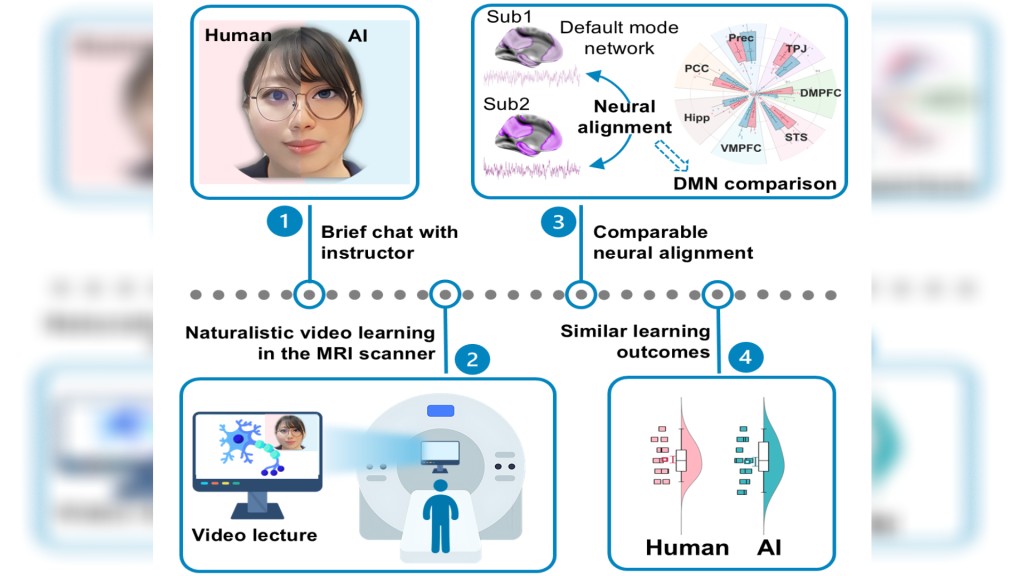
Pre-class interactions with artificial intelligence (AI) teachers yield learning outcomes comparable to those with human educators, a recent study by the Hong Kong University of Science and Technology (HKUST) has revealed.
The study showed that a conversation lasting eight to 10 minutes with an AI or human instructor prior to watching an online video lesson can effectively promote brain activity synchronization and enhance overall learning.
The AI teacher, powered by the GPT-4 model, featured a highly realistic appearance and voice and was capable of speech recognition and content generation.
After conversing with their assigned teacher briefly, the students immediately entered an MRI scanner to watch the video lessons, while researchers recorded their neural responses and eye-tracking data.
The results showed that students who had interacted with either a human or an AI teacher exhibited a higher degree of synchronized neural activity in brain regions responsible for information processing, cognitive resource allocation, and socio-emotional responses while watching the videos.
In contrast, students who had no pre-class social interaction did not display this synchronized neural activity pattern, and their learning outcomes were noticeably inferior to those of the students who had interacted beforehand.
The study also identifies certain differences between the two experiences, even though the learning outcomes driven by AI interaction were comparable to those with human teachers.
Students interacting with the AI reported a lower sense of social closeness and displayed less visual focus during the lectures.
However, researchers noted that this gap does not compromise their ultimate learning effectiveness. They concluded that AI can deliver strong teaching results without perfectly replicating human interaction and is well-equipped to effectively support student learning.