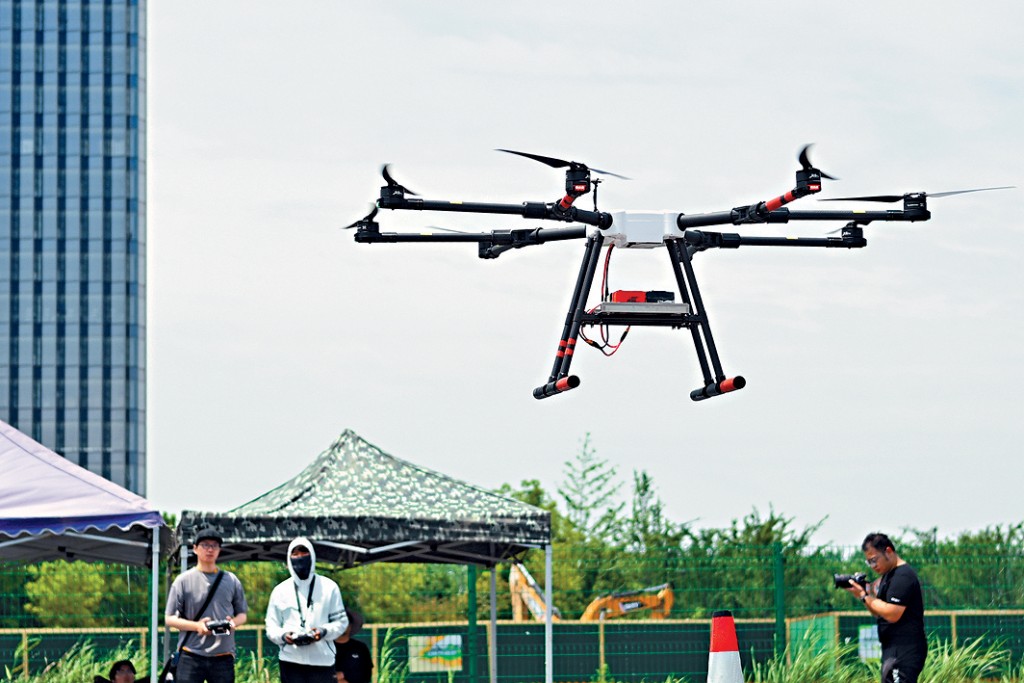
Hong Kong will introduce an upgraded regulatory sandbox — dubbed “Sandbox X” — and a strategic action plan next year to accelerate the development of its low-altitude economy, Deputy Financial Secretary Michael Wong Wai-lun announced at the International Low-Altitude Economy Summit.
Wong, who chairs the Working Group on Developing Low-Altitude Economy, said on Thursday that a dedicated communication spectrum for low-altitude operations will be established by the end of this year, paving the way for more sophisticated pilot projects, including cross-border flight routes.
He acknowledged that Hong Kong has fallen behind other Greater Bay Area cities in low-altitude innovation and stressed the need to catch up. So far, 38 sandbox projects have been approved, with 17 already implemented and another 11 set to launch this month, he added.
The government also plans to trial passenger-carrying unmanned aerial vehicles (UAVs) weighing more than 150 kilograms, following recent regulatory updates for smaller drones between 25 and 150 kilograms.
The summit, co-organized by the Working Group on Developing Low-Altitude Economy, the Hong Kong Polytechnic University, and the Greater Bay Area Low-Altitude Economy Alliance, featured a technology showcase where drone firm RightPick demonstrated AI-powered systems capable of detecting air pollution and odours, with potential uses in emergency response and elderly care.
CelestiLink founder Yiu Chung-ki unveiled an AI-driven air traffic management system designed to automate flight routing and reduce manpower workload by up to 70 percent.
The technology could potentially double Hong Kong’s flight capacity while helping to ease congestion and delays at Shenzhen Airport, according to Yiu.
Industry representatives at the event, meanwhile, urged the government to relax licensing restrictions for indoor drone operations and to encourage cross-sector collaboration to fully unlock the potential of low-altitude innovation in Hong Kong.