
Read More
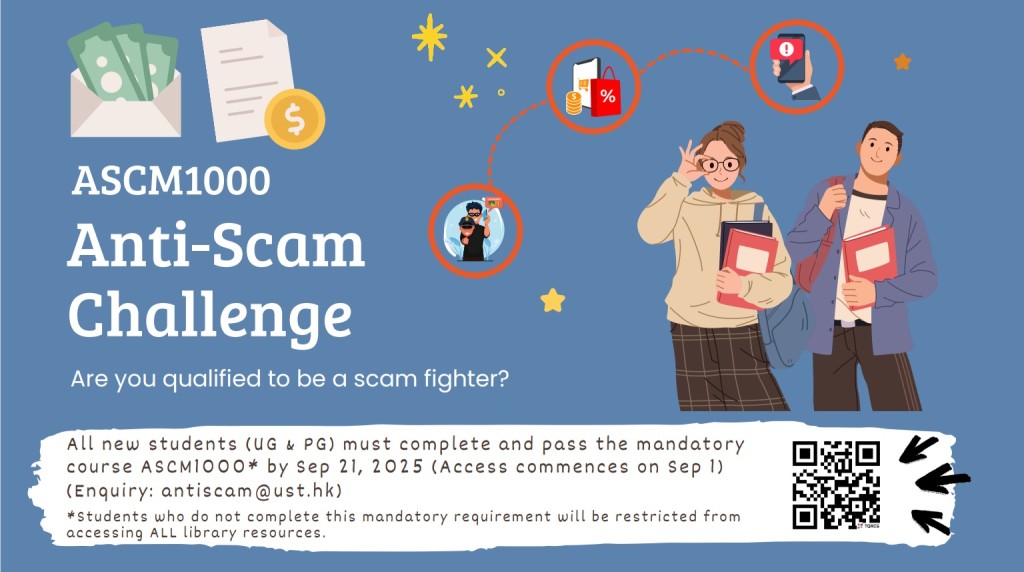
New students at the Hong Kong University of Science and Technology must complete a police “anti-scam assessment,” and those who fail will be barred from entering the library.
ADVERTISEMENT
SCROLL TO CONTINUE WITH CONTENT
In a bid to protect students from rising online fraud, the Hong Kong University of Science and Technology (HKUST) has introduced a mandatory anti-scam course for all incoming freshmen starting this academic year.
The initiative requires new students to complete and pass an Anti-Scam Challenge, designed by the Hong Kong Police, by September 21.
Failure to meet this requirement will result in restricted access to university library resources, including entry to the library, borrowing electronic devices, and booking study rooms.
Students who complete the assessment after the deadline will regain access to library services after a two-day processing period.
The Anti-Scam Challenge, known as ASCM1000, consists of 15 randomly selected multiple-choice questions, with a minimum passing score of 50 percent.
HKUST has emphasized the importance of this program, noting that it builds on efforts started last year when freshmen were required to study an anti-scam toolkit provided by the police’s Anti-Deception Coordination Centre.
The university views the temporary suspension of library accounts for non-compliant students as an incentive to prioritize this critical safety education, rather than a punitive measure.
The initiative aims to equip students with essential knowledge to navigate the increasing threat of scams, fostering a safer campus environment.
HKUST is not alone in this approach. Earlier this year, the University of Hong Kong implemented a similar requirement, mandating students to complete a police-designed anti-scam questionnaire to access library and study spaces. Following this trend, HKUST’s new policy reflects a growing emphasis among Hong Kong universities on safeguarding students against fraud. Various HKUST faculties, including the School of Business, have actively reminded students of the mandatory course through their websites, ensuring freshmen are aware of the deadline and the consequences of non-compliance. The university underscores that mastering basic anti-scam knowledge is vital for students’ security and well-being during their academic journey.