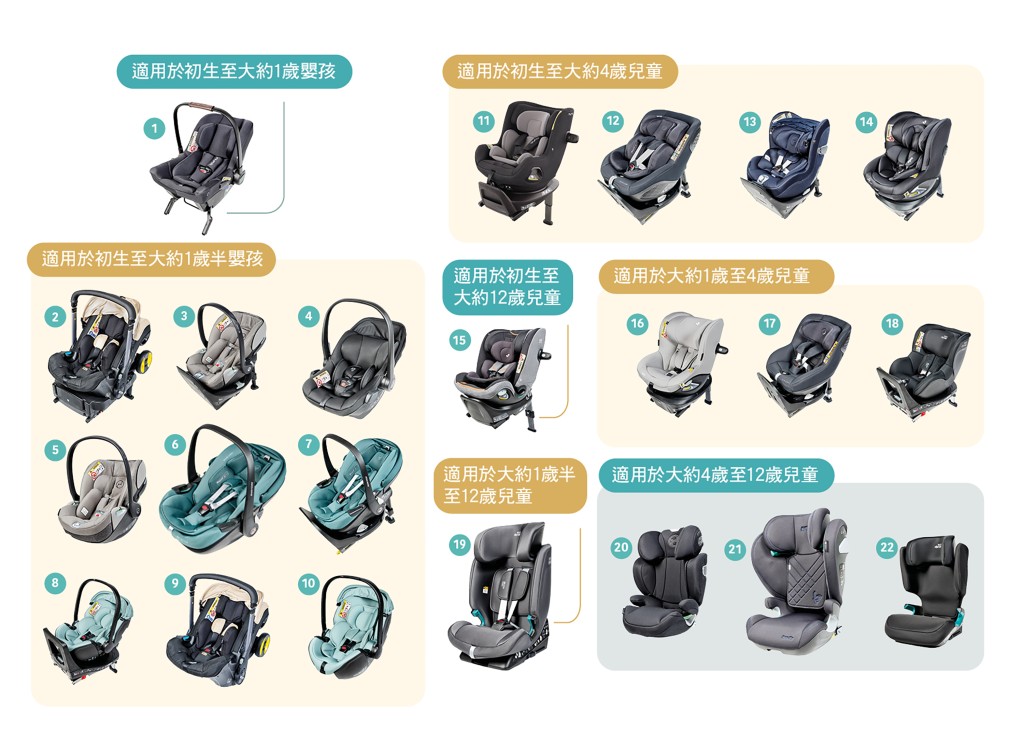
As Hong Kong prepares to enforce mandatory child safety seats on November 1, the Consumer Council has tested 22 car seat models to assist parents in choosing safe and reliable options based on safety, usability, comfort, and harmful substances.
The tested models, all available in the city, range in price from HK$2,380 to HK$7,760 (including separate bases) and are suitable for children from newborns to around 12 years old.
Among the models suitable for infants up to 18 months, the lowest-priced option achieved an impressive total rating of 4.5 stars, demonstrating that budget-friendly models can still be excellent choices.
Frontal test: 2 models showed weaker protection
As the ability of child safety seats to offer real protection during a crash is crucial, the Council conducted a frontal impact test at a speed of 64 km/h, measuring the impact force and the “injury” level experienced by various parts of a dummy's body.
Among nine models suitable for infants from newborn to about 1.5 years old, five performed exceptionally well, effectively reducing force and earning a rating of 5 points.
However, two models demonstrated weaker protection capabilities, receiving only 3 points.
One model suitable for newborns to children around 12 years old, showed safety concerns as the seatbelt slightly compressed the neck, indicating a higher risk of injury in the event of frontal impact.
Another model suitable for children from around 1.5 to 12 years old has shown higher force values in tests, reflecting weaker protective capabilities.
Side impact test: 1 model found slightly weaker
In tests simulating a vehicle being struck from the side at 50 km/h, ten models performed outstandingly, achieving a rating of 5 points.
However, a model suitable for children from around 4 to 12 years old exhibited higher force values on the dummy during testing, indicating slightly weaker protection and earning a rating of only 3.5 points.
Detection of harmful substance
In terms of testing the materials and workmanship of the seats to protect children's delicate skin, the Council discovered that eight models had trace amounts of dangerous substances such as phenols, organotin compounds, and polycyclic aromatic hydrocarbons (PAHs).
Nevertheless, experts assessed that the risks to environmental and human health were low.
Installation designs and recommendations
The Council noted that all 22 models exhibited solid design, allowing secure installation in various car seats, earning high scores of 4 or 4.5 points.
However, four models had complicated installation procedures, increasing the likelihood of errors, and ten models had unclear instructions or labels.
As improper installation can diminish the protective capability of child car seats, the Council urges manufacturers to enhance the design and user instructions of these products.
Why is it essential to use child car safety seats?
According to the World Health Organization, correctly using rear-facing child restraint devices can reduce the risk of injury by up to 80 percent in a crash.
Notably, employing forward-facing car seats can cut the risk by 50 percent, making it far safer than depending exclusively on adult seat belts, which only reduce the risk by about 32 percent.
Experts suggest that ISOFIX designs offer additional advantages, connecting directly to the fixed points in a car's seats and minimizing the risk of incorrect installation.
While booster seats are less safe without a backrest and lack side protection, they are still safer than not using any restraint device at all.
Consumer watchdog's tips for selecting and using child car seats
Before purchasing the child restraining devices, the Council recommends the parents to check products that comply with the Road Traffic (Safety Equipment) Regulations.
Highlighting the age recommendations for the devices is simply a guideline, parents should prioritize their child's height and weight when choosing a seat and bring them along to ensure a proper fit.
Since some models come with separate bases that may facilitate installation, parents should confirm whether the price includes these bases before purchase.
Parents considering some ISOFIX models should check with the store or provider to ensure that the gadgets can be securely placed in their vehicle.
Furthermore, parents should avoid purchasing second-hand seats because the structure may be affected, even if they appear to be in good condition.